
The business electricity unit rate is one of the most important figures to understand when reviewing your company’s energy costs. It tells you how much your electricity supplier charges for each unit of electricity your business uses.
Electricity consumption is normally measured in kilowatt-hours (kWh), so your business electricity unit rate is typically expressed as a price per kWh, such as pence per kWh.
However, the unit rate is only one part of your total electricity bill. Businesses may also pay a standing charge, taxes and other applicable charges. This means that choosing a tariff based solely on the lowest unit rate does not always result in the lowest overall cost.
In this guide, we’ll explain what a business electricity unit rate is, how it works, how it is calculated, what affects it, and how businesses can compare electricity rates more effectively.
What Is a Business Electricity Unit Rate?
A business electricity unit rate is the amount your business pays for each kilowatt-hour (kWh) of electricity it consumes.
For example, if your electricity tariff has a unit rate of:
25p per kWh
and your business uses:
1,000 kWh
your electricity usage charge would be:
1,000 × £0.25 = £250
This is the cost of the electricity consumed at that unit rate.
It does not necessarily represent your entire electricity bill because other charges, such as the standing charge and applicable taxes, may also apply.
What Is a kWh?
A kilowatt-hour (kWh) is a unit used to measure electricity consumption.
One kWh represents the amount of energy used by a 1-kilowatt appliance operating for one hour.
For example:
- A 1 kW appliance running for 1 hour = 1 kWh
- A 2 kW appliance running for 30 minutes = 1 kWh
- A 0.5 kW appliance running for 2 hours = 1 kWh
Your electricity meter records consumption, and your supplier uses the recorded usage to calculate the energy charge.
Understanding business electricity kWh is therefore essential when trying to understand your unit rate and overall energy costs.
How Is the Business Electricity Unit Rate Calculated?
At a basic level, the electricity consumption charge can be calculated using:
Electricity consumption × unit rate = electricity usage cost
For example:
5,000 kWh × 24p = £1,200
So, at a unit rate of 24p per kWh, consuming 5,000 kWh would result in an electricity usage charge of £1,200 before other applicable charges.
However, the unit rate itself is not simply determined by taking the wholesale electricity price and adding a fixed percentage.
The rate offered to a business can reflect a range of costs and commercial factors, including wholesale energy costs, network-related costs, policy costs, supplier operating costs and risk.
What Does “p/kWh” Mean?

You may see business electricity tariffs advertised or shown on bills using p/kWh.
This means pence per kilowatt-hour.
For example:
22p/kWh
means the business pays 22 pence for each kWh of electricity consumed under that tariff.
A unit rate of:
£0.22/kWh
is the same as:
22p/kWh
Understanding this notation makes it easier to compare different business electricity tariffs.
Example of a Business Electricity Unit Rate
Suppose a business uses:
2,500 kWh per month
and its unit rate is:
25p/kWh
The electricity usage cost would be:
2,500 × £0.25 = £625
If the standing charge and other applicable charges added another £100 during the billing period, the bill before applicable taxes would be higher than £625.
This demonstrates why the unit rate is important but shouldn’t be viewed in isolation.
Business Electricity Unit Rate vs Standing Charge
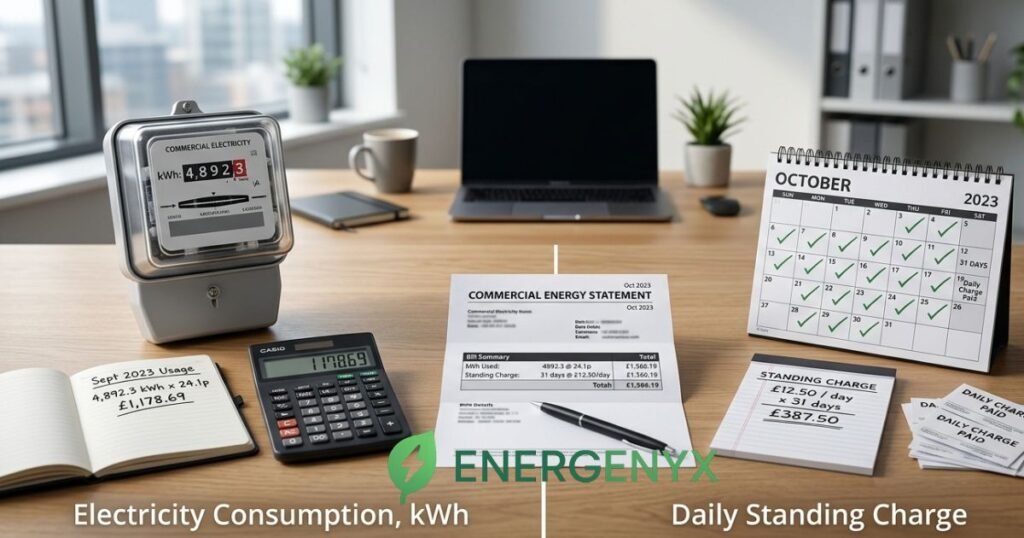
The unit rate and standing charge are two different parts of a business electricity tariff.
Unit rate
The unit rate is charged according to how much electricity your business consumes.
Example:
25p/kWh
Standing charge
The standing charge is generally a fixed daily charge associated with the electricity supply.
Example:
£1.50 per day
A business can therefore have a relatively low unit rate but a higher standing charge, or vice versa.
When comparing tariffs, you should consider both.
Why Is the Unit Rate Important for Businesses?
The unit rate can have a significant effect on a business’s electricity costs, particularly for companies with high electricity consumption.
A business using:
100,000 kWh per year
will be much more sensitive to changes in the unit rate than a small business using:
5,000 kWh per year.
For example, a difference of just 1p per kWh would represent:
100,000 × £0.01 = £1,000
over 100,000 kWh of annual consumption.
This is why high-consumption businesses should pay close attention to the rates offered when reviewing contracts.
What Affects Business Electricity Unit Rates?
Business electricity unit rates can vary significantly between tariffs and businesses.
Several factors can influence the rate available.
1. Wholesale Electricity Costs
Wholesale electricity costs are an important component of energy pricing.
Suppliers purchase energy through wholesale markets and need to account for the costs and risks associated with supplying customers.
When wholesale market conditions change, this can affect the prices suppliers offer to businesses.
2. Business Electricity Consumption
The amount of electricity your business uses can affect the type of tariff and pricing available.
A business consuming hundreds of thousands of kWh annually may have different requirements from a small office using only a few thousand kWh.
Consumption information is therefore important when obtaining business electricity quotes.
3. Contract Length
Business electricity contracts can have different contract lengths.
Depending on market conditions and supplier pricing, the length of a contract can influence the rate available.
Businesses should consider both the price and the contractual commitment before agreeing to a new deal.
4. Meter Type
The type of electricity meter and the way consumption is measured can affect the structure of a business energy contract.
Some businesses have:
- Smart meters
- Traditional meters
- Half-hourly meters
- Advanced meters
- Other metering arrangements
The requirements of larger or higher-consumption businesses can be different from those of smaller businesses.
5. Half-Hourly Settlement
Some business electricity supplies are associated with half-hourly metering and settlement arrangements.
These supplies can have more detailed consumption information available, allowing electricity usage to be measured in half-hourly periods.
For businesses with relevant metering arrangements, pricing and procurement can be more complex than a simple headline unit rate.
6. Location
The location of a business can also be relevant because electricity distribution and network arrangements vary across Great Britain.
Network-related costs can form part of the overall price businesses pay for electricity.
This means two businesses with similar consumption may not necessarily receive identical pricing.
7. Market Conditions
Electricity prices can change as market conditions change.
Factors affecting the energy market can include:
- Wholesale market movements
- Supply and demand
- Weather
- Generation availability
- International energy markets
- Regulatory changes
- Network costs
- Broader economic conditions
This is one reason business electricity prices can change between contract periods.
Does a Lower Unit Rate Always Mean a Cheaper Electricity Bill?
No.
This is an important point for business owners.
Suppose you receive two electricity quotes:
Tariff A
- Unit rate: 23p/kWh
- Standing charge: £2.00/day
Tariff B
- Unit rate: 24p/kWh
- Standing charge: £1.00/day
For a low-consumption business, the tariff with the slightly higher unit rate could potentially have a lower overall cost because of the lower standing charge.
For a high-consumption business, the lower unit rate may become more significant.
The right comparison depends on your actual consumption and tariff terms.
How Do You Calculate Business Electricity Costs?

A simplified calculation is:
Annual electricity consumption × unit rate
For example:
Annual consumption:
50,000 kWh
Unit rate:
25p/kWh
Calculation:
50,000 × £0.25 = £12,500
This represents the electricity consumption component.
You would then need to consider the standing charge and other applicable costs to understand the overall bill.
How to Calculate the Cost of 1 kWh of Business Electricity
The calculation is straightforward.
If your tariff is:
28p/kWh
then:
1 kWh = 28p
If you use:
10 kWh
then:
10 × 28p = £2.80
If you use:
100 kWh
then:
100 × 28p = £28
This makes kWh useful for estimating electricity costs for individual appliances, departments or entire premises.
How to Calculate the Unit Rate From an Electricity Bill
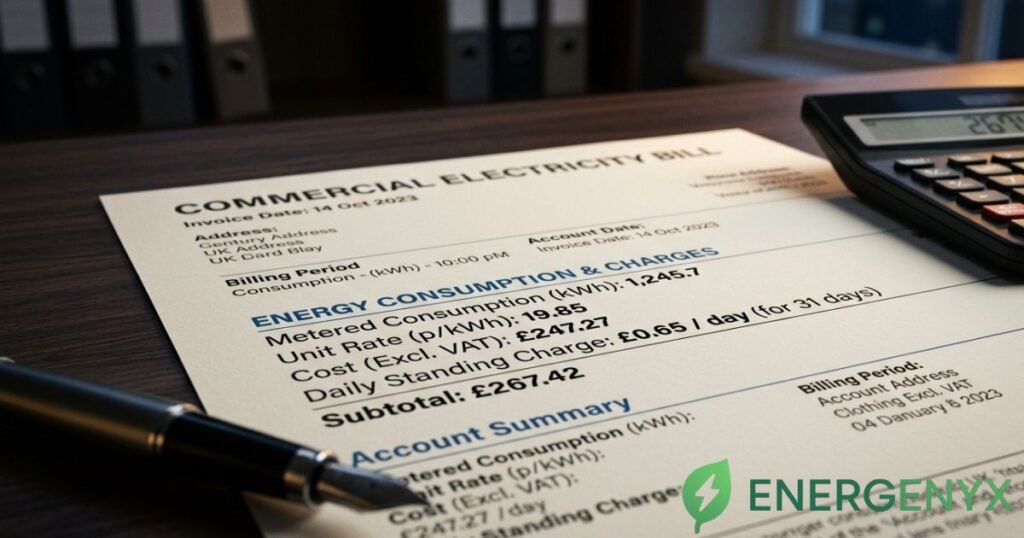
If you want to check the effective unit rate from a bill, you can use:
Electricity usage charge ÷ electricity consumption = effective unit cost
For example:
Electricity usage charge:
£500
Electricity consumption:
2,000 kWh
Calculation:
£500 ÷ 2,000 = £0.25/kWh
So the effective unit cost is:
25p/kWh
However, make sure you’re dividing the electricity usage charge by the relevant consumption and not accidentally including standing charges, taxes or other charges.
What Is the Average Business Electricity Unit Rate?
There is no single business electricity unit rate that applies to every UK business.
Unlike domestic energy pricing, business electricity contracts can vary considerably depending on the business, contract, consumption, meter arrangement, supplier and market conditions.
Rates can also change over time.
Therefore, publishing one “average business electricity unit rate” without specifying the period, business profile and tariff assumptions can be misleading.
The best way to understand the rate available to your business is to obtain a quote based on your actual circumstances.
Why Business Electricity Rates Differ From Domestic Rates
Business electricity pricing isn’t simply a commercial version of a household tariff.
Business customers can have different:
- Consumption levels
- Contract structures
- Metering arrangements
- Contract lengths
- Risk profiles
- Network requirements
- Procurement needs
Businesses also generally need to pay close attention to contract renewal dates because commercial energy contracts can operate differently from domestic arrangements.
Fixed vs Variable Business Electricity Unit Rates
The way your tariff is structured can affect how your unit rate behaves.
Fixed-rate business electricity
With a fixed-rate tariff, the agreed unit rate may remain fixed for the contractual period, subject to the terms of the contract.
This can provide greater price certainty.
However, a fixed rate does not necessarily mean your total bill will be fixed because your consumption and other charges can change.
Variable business electricity
A variable tariff can have pricing that changes according to the supplier’s terms and market conditions.
This can provide flexibility but may also expose the business to price changes.
Businesses should carefully check the terms of any variable tariff before choosing it.
Can Businesses Negotiate Electricity Unit Rates?
Business energy pricing can sometimes involve more commercial flexibility than standard household energy tariffs, particularly for larger or higher-consumption customers.
The rate offered may depend on factors such as:
- Annual consumption
- Contract length
- Meter type
- Business profile
- Market conditions
- Supplier
- Contract timing
An energy broker may also help a business obtain and compare quotes from different suppliers.
However, businesses should compare the overall contract cost and terms, rather than focusing only on whether a particular unit rate can be negotiated.
How Can a Business Get a Better Electricity Unit Rate?
There isn’t one guaranteed method for securing a lower rate, but businesses can improve their position by taking a structured approach.

1. Know Your Consumption
Review your historical electricity usage.
Understanding your annual kWh consumption gives suppliers or brokers useful information when preparing quotes.
2. Check Your Contract End Date
Don’t wait until your existing contract has already ended before thinking about your next deal.
Start reviewing your options early enough to understand the available choices.
3. Compare Multiple Suppliers
Different suppliers may offer different tariffs and commercial terms.
Comparing options can help you identify a deal that suits your business.
4. Compare Total Costs
Look beyond the headline unit rate.
Consider:
- Unit rate
- Standing charge
- Contract length
- Additional charges
- Payment terms
- Other contract conditions
5. Improve Energy Efficiency
Reducing unnecessary electricity consumption can lower your overall energy costs regardless of the unit rate you pay.
Does Energy Efficiency Reduce Your Unit Rate?
Not directly.
Energy efficiency reduces the amount of electricity your business consumes.
For example, if your business reduces annual electricity usage from:
100,000 kWh to 80,000 kWh
at a unit rate of:
25p/kWh
the electricity consumption cost falls from:
£25,000 to £20,000
The unit rate remains 25p/kWh, but the business uses fewer units.
This distinction is important:
Lower unit rate = pay less for each kWh
Lower consumption = use fewer kWh
Businesses can benefit from both.
How Do Energy Brokers Compare Business Electricity Unit Rates?
An energy broker can help businesses gather and compare electricity quotes from suppliers.
Depending on the service provided, a broker may consider information such as:
- Current consumption
- Existing contract
- Contract end date
- Meter type
- Business location
- Supplier options
- Tariff structure
The objective shouldn’t simply be to find the lowest advertised unit rate.
Instead, businesses should look for an electricity contract that provides an appropriate combination of price, terms, flexibility and suitability.
What Information Do You Need to Compare Business Electricity Rates?
To obtain meaningful business electricity quotes, it can help to have:
- Business name
- Supply address
- MPAN
- Current supplier
- Current tariff
- Annual electricity consumption
- Recent electricity bills
- Meter type
- Contract end date
- Current unit rate
- Current standing charge
Your MPAN and meter number can also be useful when identifying the correct electricity supply.
Business Electricity Unit Rate Checklist
Before reviewing your next electricity contract, check:
- Current unit rate
- Standing charge
- Annual electricity consumption
- Current supplier
- Contract end date
- Meter type
- MPAN
- Meter number
- Contract length
- Payment terms
- Any additional charges
- Available supplier options
Having these details available makes it easier to compare like-for-like offers.
Common Business Electricity Unit Rate Mistakes
Mistake 1: Choosing the lowest unit rate automatically
The lowest unit rate doesn’t necessarily mean the lowest total bill.
Mistake 2: Ignoring the standing charge
A high standing charge can have a significant effect on total costs, particularly for lower-consumption businesses.
Mistake 3: Comparing rates without checking contract terms
Two tariffs with similar unit rates can have different contractual conditions.
Mistake 4: Using outdated consumption data
Old consumption figures may not accurately represent your current business operations.
Mistake 5: Waiting until the last minute to compare
Businesses can benefit from reviewing their energy contract before the current agreement ends.
Mistake 6: Confusing unit rate with total electricity cost
The unit rate only covers the price associated with electricity consumption. Your total bill can include other charges.
Business Electricity Unit Rate FAQs
What is a business electricity unit rate?
A business electricity unit rate is the price a business pays for each kilowatt-hour of electricity consumed. It is commonly displayed in pence per kWh.
What is a good business electricity unit rate?
There is no single rate that is “good” for every business. The appropriate rate depends on factors including consumption, location, meter type, contract terms and market conditions.
How is business electricity charged?
Business electricity bills can include charges related to electricity consumption, standing charges and other applicable costs. The exact structure depends on the tariff and supply.
Is business electricity charged per kWh?
Yes. Electricity consumption is normally measured in kilowatt-hours, and the unit rate is commonly expressed as pence per kWh.
What is the difference between unit rate and standing charge?
The unit rate is charged according to electricity consumption, while the standing charge is generally a daily charge associated with the electricity supply.
Can business electricity unit rates change?
It depends on the type of contract. Fixed-rate tariffs generally provide an agreed unit rate for the contractual period, subject to the contract terms, while variable arrangements can have rates that change.
Why is my business electricity unit rate so high?
Your rate may reflect factors including wholesale energy costs, network-related costs, market conditions, your business profile, contract timing and supplier pricing.
Can I negotiate my business electricity rate?
Depending on your business and contract circumstances, there may be opportunities to obtain or negotiate different commercial offers. Comparing multiple supplier quotes can help you understand the options available.
How can I reduce my business electricity costs?
Businesses can consider comparing electricity contracts, reducing unnecessary consumption, improving energy efficiency and reviewing their tariff structure.
Is business electricity cheaper than domestic electricity?
Not necessarily. Business and domestic electricity contracts have different pricing structures and customer requirements. The price available depends on the individual circumstances of the customer and market conditions.
Final Thoughts
The business electricity unit rate is one of the most important numbers to understand when reviewing your company’s electricity costs.
It tells you how much you’re paying for each kWh of electricity consumed, but it shouldn’t be considered on its own.
A proper comparison should also take into account your standing charge, annual consumption, contract length, tariff structure and other applicable costs.
For example, a tariff with a slightly higher unit rate could potentially work out better for a low-consumption business if it has a significantly lower standing charge. Conversely, a high-consumption business may place greater importance on securing a competitive unit rate.
The best approach is to understand your actual electricity usage, review your existing contract and compare suitable business electricity options based on the overall cost and terms, rather than chasing one headline number.
If your business electricity contract is approaching renewal, this is a good time to review what you’re currently paying and see what alternatives may be available.
Ready to Compare Business Electricity Prices?
Don’t focus on the unit rate alone. Energenyx can help you review your business electricity options and compare suitable deals based on your business requirements.
Compare Business Electricity Prices →
Reviewed by: Energenyx Energy Content Team