

Switching your business electricity supplier can be an effective way to review your energy costs, contract terms and overall commercial energy arrangements.
However, switching business electricity is different from changing a domestic energy supplier. Businesses usually operate under commercial contracts, which can have specific end dates, notice periods, renewal provisions and termination conditions.
Before switching, it is therefore important to understand your existing contract, electricity usage and the options available to your business.
In this guide, we’ll explain how to switch business electricity supplier in the UK, when you can switch, what information you need, how the process works, potential exit fees and what businesses should check before agreeing to a new contract.
What Does Switching Business Electricity Supplier Mean?
Switching business electricity supplier means moving your electricity supply from your current commercial electricity supplier to another supplier.
The physical electricity supply to your premises generally continues through the same electricity network. You are changing the company responsible for supplying and billing your electricity rather than changing the physical cables delivering electricity to your property.
Your new supplier will take over the supply arrangement from the agreed switch date.
The process can involve several steps, including:
- Checking your existing electricity contract
- Finding your contract end date
- Reviewing your current rates
- Gathering electricity consumption information
- Comparing alternative suppliers
- Choosing a new contract
- Agreeing the new terms
- Completing the switching process
For many businesses, the most important step is checking the current contract before agreeing to switch.
Can a Business Switch Electricity Suppliers?
Yes, businesses can generally choose their electricity supplier.
However, your ability to switch at a particular time depends on the terms of your existing contract.
Ofgem advises businesses to check their contract carefully because most suppliers will not allow a business to switch before the end of its existing contract. Contract terms can also specify notice periods and what happens when the agreement reaches its end date. (ofgem.gov.uk)
This means that switching isn’t simply a matter of finding a cheaper supplier and immediately moving across.
You first need to understand your current contractual position.
When Can You Switch a Business Electricity Supplier?
The best time to switch commercial energy depends on your current contract.
If you’re on a fixed-term business electricity contract, you may need to wait until the appropriate switching or renewal window.
Your contract may specify:
- Contract end date
- Notice period
- Renewal window
- Termination conditions
- Early exit fees
- Automatic renewal provisions
If you don’t know when your contract ends, check your latest electricity bill or contract documents, or contact your existing supplier.
Starting this process early gives you more time to compare your options.
How to Check Your Current Business Electricity Contract
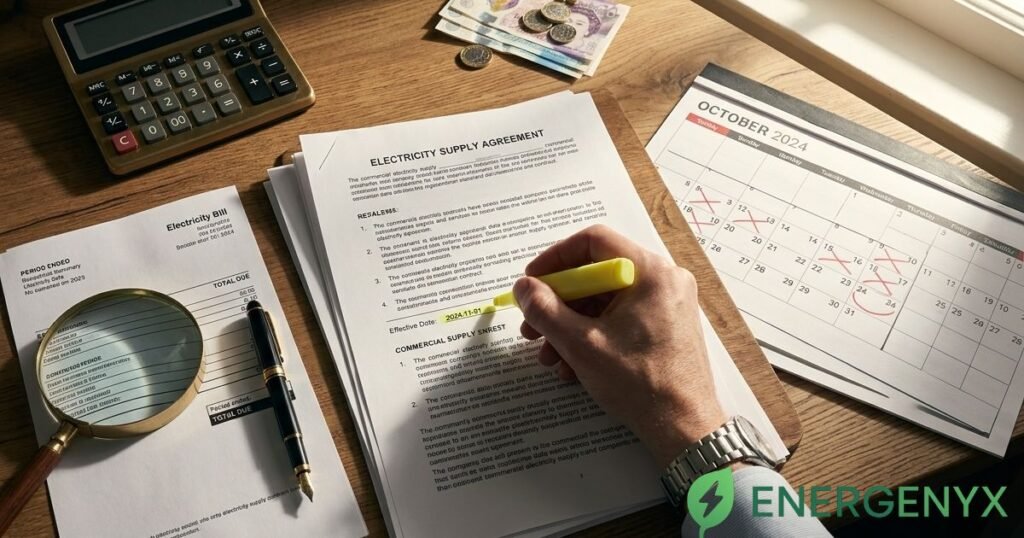
Before looking for a new supplier, find your current electricity contract.
Important information to identify includes:
Current Supplier
Find the name of the company currently supplying your electricity.
Contract Start Date
This tells you when your existing agreement began.
Contract End Date
This is one of the most important dates to identify.
Unit Rate
Check how much you currently pay for electricity consumption.
Standing Charge
Find the daily or applicable standing charge.
Annual Consumption
Look for your annual electricity consumption, usually measured in kWh.
Renewal Terms
Check whether your contract automatically renews or changes to another arrangement when it expires.
Exit Conditions
Find out whether early termination charges or other restrictions apply.
If you’re unsure about any part of your contract, ask the supplier for clarification before making a decision.
Why Your Contract End Date Matters
The contract end date can significantly affect your ability to switch.
If you attempt to leave a fixed-term contract early, you may face contractual charges or may not be permitted to switch at that point.
On the other hand, waiting until the last possible moment can leave you with less time to compare alternatives.
A better approach is to know your end date well in advance and start reviewing your options before the contract reaches expiry.
This also gives you time to compare business electricity prices rather than accepting the first available renewal offer.
What Information Do You Need to Switch Business Electricity?
Having the right information available can make the switching process much easier.
You may need:
- Business name
- Supply address
- Current electricity supplier
- Current contract details
- Contract end date
- Electricity meter details
- MPAN
- Recent electricity bills
- Annual electricity consumption
- Payment information
- Contact details
- Details of any additional business premises
What Is an MPAN?
An MPAN, or Meter Point Administration Number, identifies the electricity supply point associated with a property.
It can be found on electricity bills and other supply documentation.
Providing accurate supply information helps suppliers identify the correct electricity connection and prepare an appropriate quotation.
How to Compare Business Electricity Suppliers
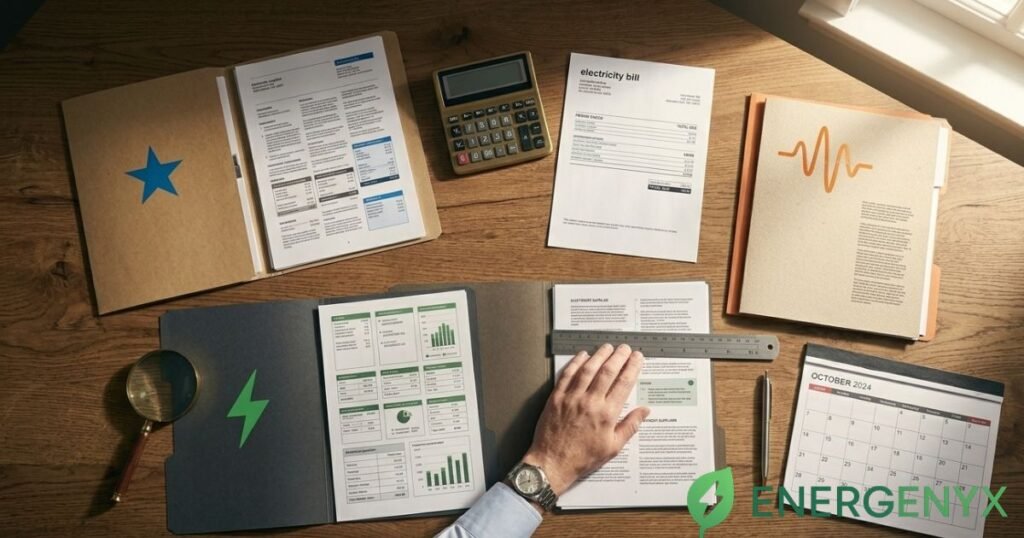
Finding another supplier is only one part of switching.
You also need to compare the contracts being offered.
Don’t automatically choose the supplier offering the lowest unit rate.
Instead, compare the complete arrangement.
Look at:
Unit Rate
How much will you pay for each kWh?
Standing Charge
How much will you pay regardless of consumption?
Contract Length
How long will the agreement last? or how long is business energy contract length?
Contract Type
Is the price fixed or variable or based on another structure?
Estimated Annual Cost
What could the total annual cost look like based on your consumption?
Payment Terms
How and when will you need to pay?
Renewal Conditions
What happens when the contract ends?
Exit Conditions
Can you leave early and, if so, what charges may apply?
Additional Charges
Are there other costs that should be included in your business energy comparison?
A supplier with a slightly higher unit rate could potentially offer a more suitable overall contract depending on the complete terms.
Fixed vs Variable Business Electricity When Switching
One of the decisions you’ll need to consider is the type of contract you want.
Fixed Business Electricity Contract
A fixed-rate contract generally provides an agreed electricity unit rate for the contract period.
The main attraction is price certainty.
This can help businesses forecast energy expenditure and manage budgets.
However, a fixed contract may also mean that the business doesn’t automatically benefit if market prices fall.
It is also important to understand that a fixed unit rate doesn’t necessarily mean every component of the bill is fixed.
Always check the contract terms.
Variable Business Electricity Contract
A variable arrangement allows certain electricity prices to change according to the applicable pricing structure.
This can provide greater exposure to market movements.
If energy prices fall, a business could potentially benefit.
If prices increase, however, costs may also rise.
The suitability of a variable arrangement depends on the business’s financial position, risk tolerance and energy strategy.
How Does the Business Electricity Switching Process Work?
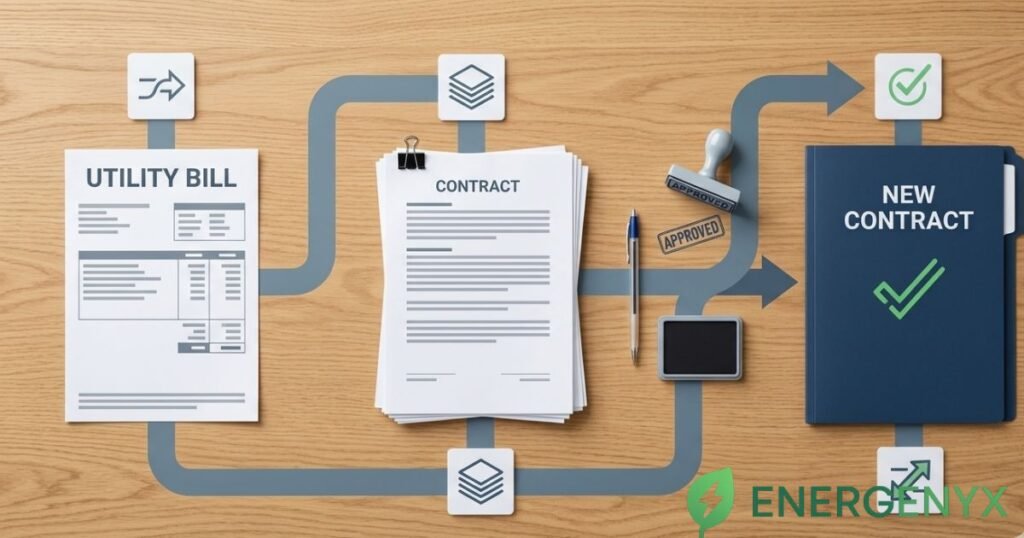
Although the exact process can vary between suppliers, switching generally follows a series of steps.
Step 1: Review Your Current Contract
Find your current supplier, contract end date, rates and contractual conditions.
Step 2: Understand Your Electricity Usage
Review recent bills and determine your approximate annual electricity consumption.
Step 3: Compare Available Options
Obtain quotations from suitable suppliers or use a commercial energy broker.
Step 4: Compare the Complete Costs
Look beyond the headline unit rate and compare standing charges, estimated annual costs and contractual terms.
Step 5: Choose a New Contract
Once you’ve assessed the available options, select the arrangement that best suits your business.
Step 6: Agree the Contract
Review the terms carefully before signing.
Step 7: Switching Is Arranged
Your new supplier or intermediary will normally coordinate the transfer process.
Step 8: Take a Final Meter Reading
Keep a record of the meter reading around the time of the switch.
Step 9: Receive Your Final Bill
Your previous supplier should issue the appropriate final bill for the period it supplied your business.
How Long Does It Take to Switch Business Electricity?
The exact timescale can vary depending on the supplier, contract, property and circumstances.
A straightforward switch may be relatively simple when the business has accurate supply information and is already approaching the end of its existing contract.
However, businesses should not leave the process until the last minute.
There can be administrative requirements involving:
- Contract notice periods
- Supplier communication
- Meter information
- Account details
- Contract documentation
- Billing arrangements
Planning ahead gives you more time to resolve problems before the existing contract ends.
Can You Switch Business Electricity Before Your Contract Ends?
In many situations, switching before the end of a fixed-term contract may not be possible without consequences.
Ofgem states that most suppliers will not allow businesses to switch before their contract ends. Businesses should therefore check their existing contract for termination provisions and applicable notice requirements. (ofgem.gov.uk)
Some contracts may contain early termination provisions.
If you’re considering an early switch, ask your current supplier:
- Can I terminate the contract early?
- Is there an exit fee?
- What notice is required?
- What amount would I need to pay?
- Are there circumstances where the fee does not apply?
Don’t assume that a cheaper alternative automatically makes an early switch financially worthwhile.
What Are Business Electricity Exit Fees?
An exit fee is a charge that may apply if you terminate a contract before the agreed end date.
The existence and amount of any charge depend on the contract.
Before switching early, calculate the potential cost.
For example, suppose:
- Your current contract has six months remaining
- Your current electricity costs are relatively low
- A new supplier offers a lower rate
- Your current contract includes a significant termination charge
The savings from switching may not outweigh the cost of leaving your current agreement.
This is why businesses should compare the total financial impact, rather than looking only at the new unit rate.
What Happens When Your Business Electricity Contract Ends?
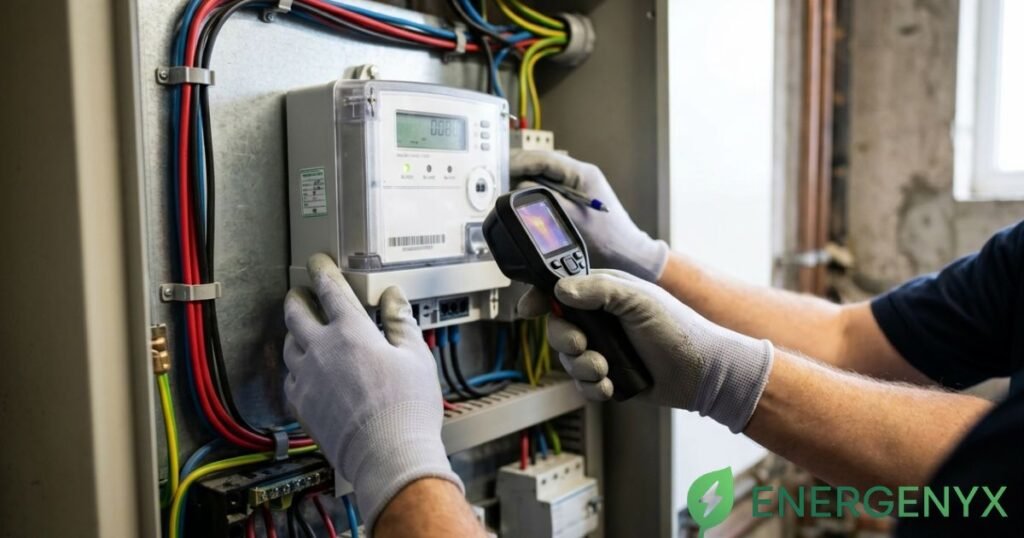
When your contract reaches its end date, the next step depends on the terms of your existing agreement.
You may:
- Renew with your existing supplier
- Switch to another supplier
- Agree a new contract
- Move onto an out-of-contract arrangement
- Be placed onto a deemed contract in certain circumstances
- Automatically renew if rollover provisions apply
Ofgem distinguishes between deemed contracts and out-of-contract arrangements, so businesses should check exactly what their contract says will happen after expiry. (ofgem.gov.uk)
This is why you shouldn’t wait until the contract has already expired before investigating your options.
How Early Should You Start Looking for a New Supplier?
There’s no single timeframe that applies to every business.
The best starting point is your current contract.
Check:
- Contract end date
- Notice period
- Renewal provisions
- Switching conditions
- Early termination provisions
Then give yourself enough time to research suppliers and compare contracts.
The more complex your business is, the more important this becomes.
A company operating several premises or consuming large amounts of electricity may need more time to assess its procurement options.
Switching Business Electricity When Moving Premises

Moving to a new business property creates additional energy considerations.
Before moving, check the electricity arrangements for both your old and new premises.
For your existing property, determine:
- Contract end date
- Termination conditions
- Final meter reading requirements
- Final billing arrangements
For the new property, find out:
- Current electricity supplier
- Meter details
- MPAN
- Current supply arrangement
- Whether the premises is already under a contract
If a business moves into premises and starts using electricity without first agreeing a contract, a deemed contract may apply. (ofgem.gov.uk)
Planning the electricity supply before moving in can therefore help avoid unnecessary complications.
Will Switching Electricity Suppliers Interrupt Your Business?
Switching suppliers normally does not require the physical electricity connection to be replaced.
Your premises continues to receive electricity through the existing network.
The change is primarily an administrative and contractual transfer between suppliers.
Businesses should nevertheless keep their records up to date and ensure the switch is correctly arranged.
Take a meter reading around the switching date and keep a copy for your records.
This can be useful if there is later a disagreement about the final bill or the amount of electricity used.
What Happens to Your Electricity Meter When You Switch?
In most cases, switching supplier does not mean replacing your existing electricity meter.
The meter remains connected to the property and continues recording electricity consumption.
The new supplier takes responsibility for billing the business under the new contract.
The situation can be different if the business is changing its metering arrangements, installing a new meter or moving premises.
If you have a half-hourly electricity meter, make sure the new supplier understands your metering arrangement and consumption requirements.
Switching Business Electricity With a Half-Hourly Meter
Businesses with half-hourly meters can have more detailed information about their electricity consumption.
Half-hourly data can show electricity usage in 30-minute intervals and can provide useful information about when electricity is being consumed.
This can be particularly relevant for businesses with significant electricity demand.
When comparing contracts, consider:
- Your consumption profile
- Operating hours
- Peak usage periods
- Metering arrangement
- Contract structure
- Procurement strategy
Don’t assume that a half-hourly meter automatically means your electricity will be cheaper.
Instead, the data can help businesses better understand their consumption and make more informed procurement decisions.
For more information, see our guide to half-hourly electricity meters.
Can an Energy Broker Help You Switch?
Yes.

A business can approach electricity suppliers directly or use an intermediary such as an energy broker.
A broker may help with:
- Gathering quotations
- Comparing suppliers
- Explaining contract options
- Negotiating energy arrangements
- Managing administrative steps
- Supporting the switching process
However, businesses should understand how the broker is compensated.
Before using a broker, ask:
- Which suppliers do you work with?
- Do you cover the whole market?
- How are you paid?
- Do I pay you directly?
- Is commission included in the supplier price?
- What services are included?
- Are there any additional charges?
Ofgem advises businesses to check an intermediary’s fees, supplier coverage, service terms and other relevant conditions before entering into an agreement. (ofgem.gov.uk)
Transparency is important because the cheapest-looking quote isn’t necessarily the best overall option.
How to Choose a New Business Electricity Supplier
When comparing suppliers, consider more than price.
1. Pricing
Compare unit rates and standing charges.
2. Contract Terms
Check the start date, end date and renewal conditions.
3. Payment Options
Understand how payments will be collected.
4. Customer Support
Consider how easy it is to contact the supplier when something goes wrong.
5. Billing
Check how bills are produced and whether they provide the information your business needs.
6. Metering
Make sure the supplier can accommodate your meter type and business requirements.
7. Contract Flexibility
Understand what happens if your business expands, reduces consumption or moves premises.
8. Additional Services
Some suppliers or intermediaries may provide energy management or other related services.
Your decision should be based on the overall suitability of the contract rather than one headline figure.
Common Business Electricity Switching Mistakes
1. Waiting Until the Last Minute
Starting too late can leave you with fewer options.
2. Looking Only at the Unit Rate
The lowest unit rate doesn’t automatically produce the lowest total bill.
3. Ignoring the Standing Charge
A lower unit rate can sometimes be offset by a higher standing charge.
4. Forgetting the Contract End Date
Not knowing your end date makes it difficult to plan properly.
5. Ignoring Renewal Conditions
Some contracts can automatically renew or move into another arrangement.
6. Not Checking Exit Fees
Leaving early could create additional costs.
7. Comparing Different Consumption Assumptions
Make sure supplier quotations are based on comparable electricity usage.
8. Not Reading the New Contract
Never rely solely on a verbal quotation.
Read the written terms before agreeing.
9. Choosing Solely on Price
A slightly cheaper rate isn’t necessarily worth it if the contract has unsuitable terms or poor flexibility.
10. Not Keeping Meter Records
Keep a meter reading around the switching date and retain your bills and contract documents.
How to Switch Business Electricity Supplier: Quick Checklist
Before switching, work through the following:
- Find your current electricity supplier
- Find your contract end date
- Check your current unit rate
- Check your standing charge
- Review your annual electricity consumption
- Check your contract’s renewal terms
- Check for early termination fees
- Find your MPAN and meter information
- Gather recent electricity bills
- Compare alternative suppliers
- Compare complete contract costs
- Review payment terms
- Read the new contract carefully
- Confirm the switching date
- Take a meter reading
- Keep your final bill and new contract documents
Frequently Asked Questions
Can I switch my business electricity supplier?
Yes, businesses can generally choose their electricity supplier, although the timing of a switch depends on the terms of the existing contract.
How do I switch business electricity suppliers?
Review your existing contract, check your end date, gather your electricity information, compare alternative suppliers, choose a suitable contract and complete the switching process with the new supplier or intermediary.
Can I switch business electricity before my contract ends?
It depends on your contract. Most suppliers will not allow businesses to switch before the end of their existing contract, although specific contractual provisions may apply. (ofgem.gov.uk)
How long does it take to switch business electricity?
The timescale varies depending on the supplier, contract, property and administrative requirements. Businesses should begin the process early rather than waiting until their existing contract expires.
Will my electricity be disconnected when I switch suppliers?
Changing electricity supplier does not normally require the physical electricity connection to be changed. Your supply continues through the existing network.
Do I need a new electricity meter when changing suppliers?
Usually not. The existing meter normally remains in place when a business changes electricity supplier.
What is an MPAN?
An MPAN is a unique identifier associated with an electricity supply point. It can usually be found on a business electricity bill.
Can an energy broker switch my business electricity supplier?
A broker can assist with comparing suppliers and arranging a new contract, depending on the services they provide. Businesses should understand the broker’s fees, supplier coverage and terms before using their services.
Is it cheaper to switch business electricity suppliers?
Switching can potentially help a business find a more suitable price or contract, but savings aren’t guaranteed. Businesses should compare the complete costs and terms before changing supplier.
What happens if my business electricity contract expires?
The outcome depends on the contract. You may agree a new contract, switch supplier, or move onto another arrangement such as an out-of-contract or deemed contract in applicable circumstances. (ofgem.gov.uk)
Final Thoughts
Switching business electricity supplier doesn’t have to be complicated, but it does require preparation.
The first step is understanding your existing contract.
Find your contract end date, unit rate, standing charge, annual consumption, renewal conditions and termination provisions before looking at alternative suppliers.
Once you understand your current position, compare the complete terms of available contracts rather than focusing on a single headline price.
Consider the unit rate, standing charge, contract structure, payment terms, supplier service, renewal conditions and any potential exit fees.
Businesses with more complex electricity requirements should also consider their consumption patterns, meter type and wider energy procurement strategy.
Most importantly, don’t leave the process until the last minute.
Starting your research early gives you more time to compare options and choose an electricity contract that fits your business.
Compare Business Electricity Options with Energenyx

Reviewing business electricity suppliers can take time, particularly when you need to compare different rates, contract structures and terms.
Energenyx helps UK businesses explore their commercial energy options and understand the factors that matter when reviewing electricity contracts.
Whether your current contract is approaching its end, you’re considering switching suppliers or you’re simply reviewing your business energy costs, comparing your options can help you make a more informed decision.
Ready to review your business electricity options?
Get in touch with Energenyx to explore suitable commercial energy options for your business.