
Introduction
When comparing business energy quotes, it’s easy to focus on the price you pay for each unit of electricity or gas. However, there’s another important cost that can significantly affect your overall energy bill—the business energy standing charge.
Many business owners are unsure what this charge covers or why they have to pay it even when they use little or no energy.
Understanding how standing charges work can help you compare business energy tariffs more accurately, estimate your monthly costs, and choose a contract that offers the best overall value rather than simply the lowest unit rate.
In this guide, we’ll explain what business energy standing charges are, why suppliers charge them, how they differ from unit rates, and what you can do to manage your business energy costs.
Key Takeaways
Before we look at the details, here are the key points to remember:
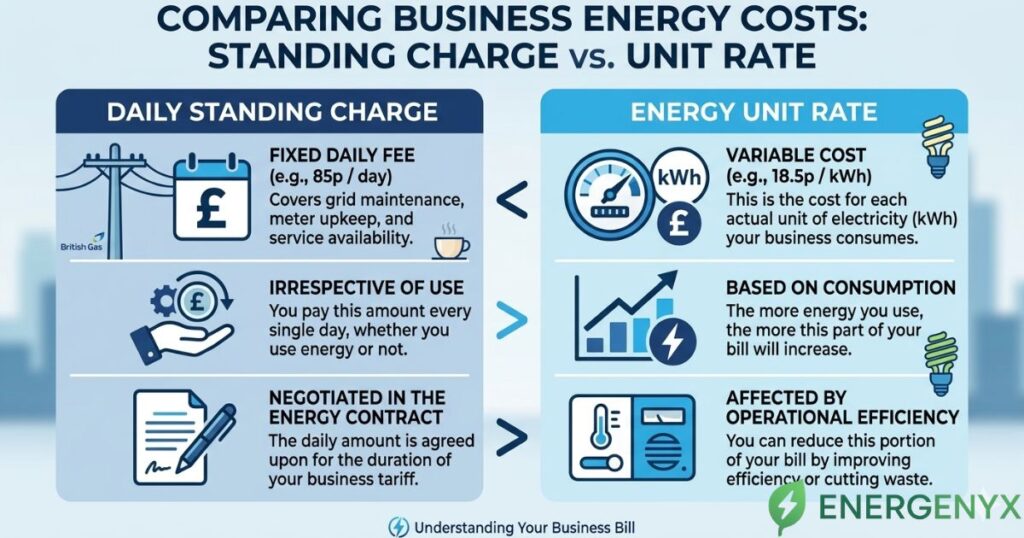
- A business energy standing charge is a fixed daily fee.
- It is charged regardless of how much electricity or gas your business uses.
- Standing charges help cover the cost of maintaining the energy network and your supply connection.
- Both electricity and gas contracts may include standing charges.
- When comparing business energy quotes, always consider both the standing charge and the unit rate.
What Are Business Energy Standing Charges?
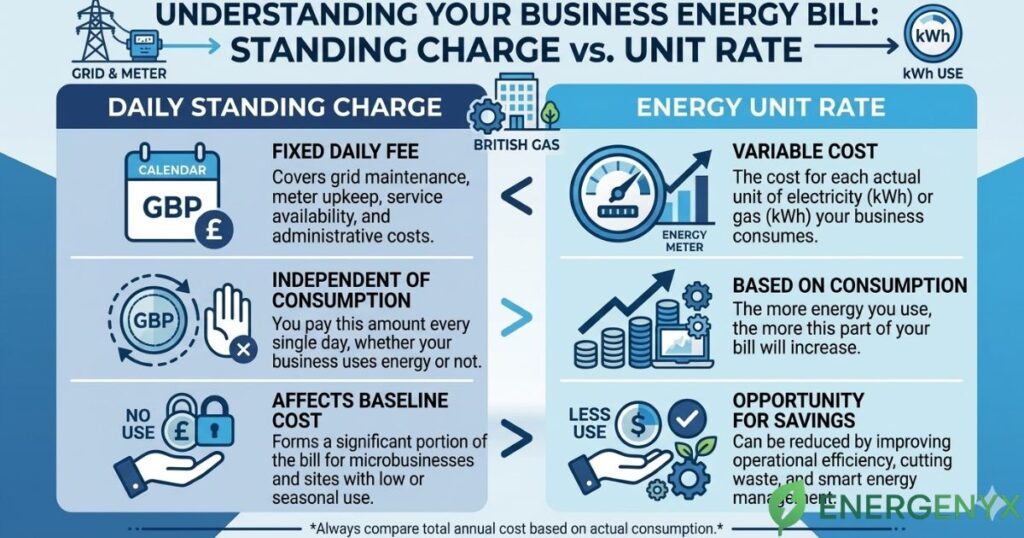
A business energy standing charge is a fixed daily amount that your energy supplier charges to keep your business connected to the electricity or gas network.
Unlike your unit rate—which depends on how much energy you consume—the standing charge is payable whether your business uses a large amount of energy, a small amount, or none at all on a particular day.
Think of it as the cost of keeping your energy supply available.
The charge helps cover the ongoing costs of maintaining the infrastructure and services required to deliver electricity and gas to your premises.
Although every supplier sets its own pricing, most business energy contracts include a standing charge alongside the unit rate.
What Does a Business Energy Standing Charge Cover?
Standing charges contribute to several essential services that support your energy supply.
These may include:
- Maintaining electricity and gas distribution networks.
- Operating and maintaining pipes, cables, and substations.
- Meter management and administration.
- Customer account management.
- Billing systems and customer support.
- National infrastructure and network costs.
While the exact breakdown varies between suppliers, standing charges are designed to help cover fixed costs that exist whether or not energy is being consumed.
Business Energy Standing Charge vs Unit Rate
One of the most common areas of confusion is the difference between a standing charge and a unit rate.
Here’s a simple comparison:
| Feature | Standing Charge | Unit Rate |
|---|---|---|
| How it’s charged | Fixed daily fee | Charged per kilowatt-hour (kWh) used |
| Changes with energy usage? | No | Yes |
| Paid even if no energy is used? | Yes | No |
| Included in most contracts? | Yes | Yes |
If you’re comparing different tariff types, it’s also worth understanding the differences between fixed and variable business energy tariffs.
When comparing tariffs, it’s important to look at both figures together.
A tariff with a low unit rate but a high standing charge may not always be cheaper than one with a slightly higher unit rate and a lower daily charge—especially if your business has relatively low energy consumption.
Why Do Business Energy Suppliers Charge Standing Charges?
Energy suppliers incur a range of fixed costs that don’t depend on how much energy a customer uses.
For example, they still need to:
- Keep your supply connected.
- Maintain network infrastructure.
- Operate billing systems.
- Manage customer accounts.
- Ensure your meter is supported and maintained where applicable.
Standing charges help recover these ongoing costs so suppliers can continue providing a reliable electricity and gas supply.
Without a standing charge, suppliers would need to recover all of these costs through higher unit rates.
Do All Business Energy Contracts Include Standing Charges?
Many business electricity and gas contracts include a standing charge, but not every tariff is structured in the same way.
Some suppliers may offer tariffs with:
- A standard daily standing charge.
- A lower standing charge combined with a higher unit rate.
- A higher standing charge paired with a lower unit rate.
The most suitable option depends on your business’s energy usage.
For example, a business that consumes a large amount of electricity may benefit from a lower unit rate, even if the standing charge is slightly higher.
On the other hand, businesses with lower energy consumption may prefer a tariff with a lower standing charge.
This is why comparing the total annual cost of a tariff is often more helpful than focusing on a single pricing element.
What Affects Business Energy Standing Charges?
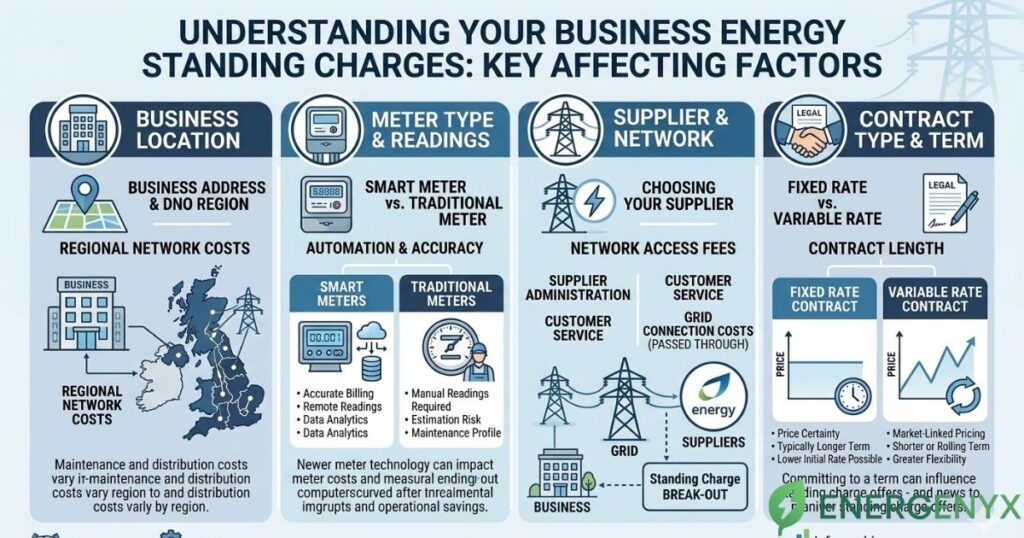
Business energy standing charges are not the same for every company. The amount you pay can vary depending on several factors, including your location, the type of business you operate, and the energy contract you choose.
Understanding these factors can help you compare quotes more effectively and avoid focusing solely on the unit rate.
Business Location
Where your business is located can influence your standing charge.
Different parts of the UK have different electricity and gas distribution costs. These regional differences are reflected in the tariffs offered by energy suppliers.
Electricity or Gas Supply
Electricity and gas are separate services, so they usually have their own standing charges.
If your business uses both electricity and gas, you’ll typically pay:
- One standing charge for your electricity supply.
- A separate standing charge for your gas supply.
Businesses that operate entirely on electricity may only see an electricity standing charge on their bill.
Meter Type
The type of meter installed at your premises can also affect your energy costs.
For example, some businesses have:
- Smart meters
- Half-hourly electricity meters
- Multi-rate meters
- Standard meters
Different meter types may be associated with different pricing structures depending on the supplier and contract.
Energy Supplier
Each supplier sets its own business energy tariffs.
This means standing charges can vary between suppliers, even for businesses with similar energy usage.
Comparing quotes from multiple suppliers can help you understand the total annual cost of each tariff rather than focusing on one pricing element.
Contract Type
The type and length of your business energy contract may also influence the standing charge.
For example, suppliers may offer:
- Fixed-price contracts
- Variable tariffs
- Flexible commercial energy agreements
Each pricing structure has its own advantages depending on your business’s energy requirements and appetite for price certainty.
The length of your agreement can also influence pricing. Learn more about business energy contract lengths before signing a new deal.
Are Standing Charges the Same for Electricity and Gas?
No.
Although both electricity and gas contracts often include standing charges, the daily amount is usually different.
This is because the costs of maintaining electricity and gas infrastructure are not identical.
For example:
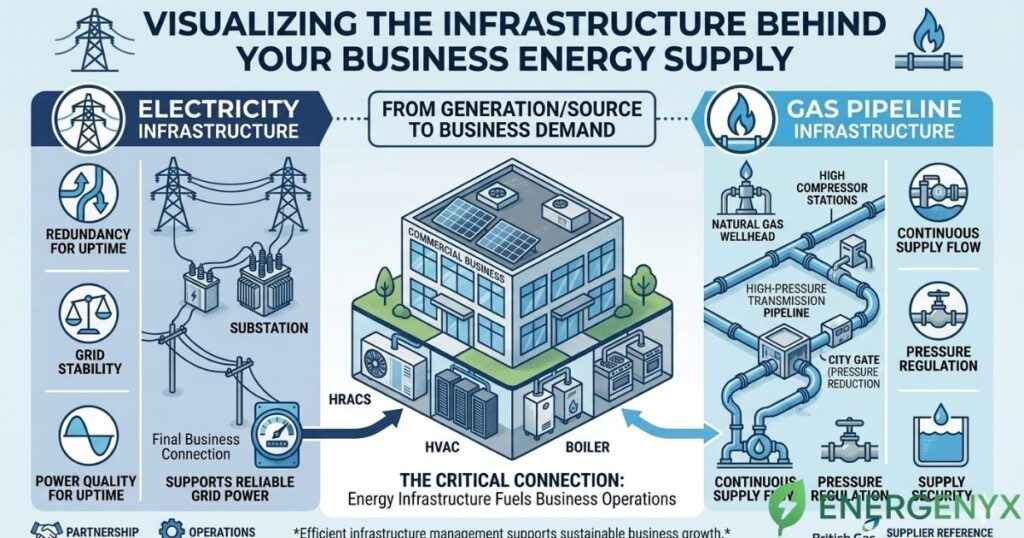
- Electricity standing charges help support power distribution networks.
- Gas standing charges contribute towards maintaining the gas distribution network.
If your business receives both services, your energy bill will usually display separate standing charges for each supply.
Can You Reduce Business Energy Standing Charges?
While you may not be able to remove standing charges completely, there are several ways to reduce your overall business energy costs.
Compare Business Energy Suppliers
You can compare business energy suppliers, different suppliers offer different pricing structures.
Some tariffs may have:
- Lower standing charges.
- Lower unit rates.
- Better overall annual costs.
Looking at the total cost rather than one individual charge gives you a clearer picture of which tariff offers the best value.
Review Your Contract Before Renewal
Many businesses automatically renew their energy contract without reviewing alternative options.
Comparing quotes before your renewal date gives you an opportunity to secure more competitive pricing.
Understand Your Energy Usage
Knowing your annual electricity and gas consumption helps suppliers provide more accurate quotes.
It also makes it easier to determine whether a tariff with a lower standing charge or a lower unit rate is more suitable for your business.
Avoid Out-of-Contract or Deemed Rates
If your contract expires and you don’t arrange a new agreement, you may be placed on higher-priced out-of-contract or deemed rates.
Although standing charges are only one part of the bill, moving onto these temporary tariffs can increase your overall energy costs.
Planning ahead and arranging a new contract before your current one ends can help avoid unnecessary expenses.
Standing Charges for Small Businesses vs Large Businesses
Standing charges affect businesses of all sizes, but the overall impact can vary depending on energy consumption.
Small Businesses
For businesses with relatively low energy usage, the standing charge can represent a larger proportion of the total bill.
Examples include:
- Small offices
- Independent retailers
- Cafés
- Hair salons
- Professional services
These businesses often benefit from comparing the total annual cost of different tariffs rather than focusing only on the unit rate.
Medium and Large Businesses
Businesses with higher electricity or gas consumption usually spend more on unit rates than standing charges.
Examples include:
- Manufacturers
- Warehouses
- Hotels
- Distribution centres
- Industrial facilities
For these organisations, even a small reduction in the unit rate can have a significant effect on annual energy costs.
However, standing charges should still be considered as part of the overall pricing structure.
Common Misconceptions About Standing Charges
There are several misunderstandings surrounding business energy standing charges.
Let’s clear up some of the most common myths.
“I Shouldn’t Pay a Standing Charge if I Don’t Use Energy”
Not necessarily.
Standing charges are designed to cover the fixed costs of keeping your supply connected.
Even if your business uses very little electricity or gas on a particular day, these network and administration costs still exist.
“The Cheapest Unit Rate Means the Cheapest Tariff”
Not always.
A tariff with the lowest unit rate may include a higher standing charge.
Always compare the total estimated annual cost rather than focusing on a single figure.
“Every Supplier Charges the Same Standing Charge”
No.
Standing charges vary between suppliers and tariff types.
This is one reason why comparing multiple business energy quotes is worthwhile.
Expert Tips for Comparing Business Energy Tariffs
When reviewing quotes, don’t just ask:
“Which supplier has the lowest unit rate?”
Instead, consider:
- The standing charge.
- The unit rate.
- Contract length.
- Exit fees.
- Renewal terms.
- Customer service.
- Billing options.
- Whether prices are fixed or variable.
Taking a broader view can help you choose a tariff that offers better long-term value rather than simply the lowest headline price.
You should also have your MPAN and MPRN number ready when requesting quotes.
Example Scenario
Imagine two suppliers offering electricity contracts for the same small retail business.
Supplier A offers a lower unit rate but a higher standing charge.
Supplier B offers a slightly higher unit rate with a lower daily standing charge.
For a business that uses relatively little electricity, Supplier B could work out cheaper over the course of a year.
This example highlights why it’s important to compare the total expected annual cost instead of looking at just one element of the tariff.
Frequently Asked Questions
What is a business energy standing charge?
A business energy standing charge is a fixed daily fee that helps cover the cost of maintaining your electricity or gas supply.
Unlike the unit rate, which depends on how much energy your business uses, the standing charge is usually payable every day, regardless of your consumption.
Do I Pay a Standing Charge Every Day?
Yes.
Most business energy suppliers apply a standing charge for each day your premises are connected to the electricity or gas network.
The charge is typically shown separately from your energy usage on your bill.
Is the Standing Charge Included in My Energy Bill?
Yes.
Your business energy bill usually includes:
- A daily standing charge.
- A unit rate for electricity or gas used.
- VAT.
- Any other applicable charges or adjustments.
Reviewing each part of your bill can help you better understand your overall energy costs.
Why Do Suppliers Charge a Standing Charge?
Standing charges help cover fixed costs associated with supplying energy to your business.
These costs may include:
- Maintaining the electricity and gas network.
- Meter administration.
- Billing systems.
- Customer support.
- Infrastructure maintenance.
These costs exist whether your business uses a large amount of energy or very little.
Can I Avoid Paying a Standing Charge?
It depends on the tariff offered by the supplier.
While some suppliers may offer alternative pricing structures, most business energy contracts include a standing charge.
Instead of focusing solely on removing the standing charge, it’s usually more beneficial to compare the total annual cost of different tariffs.
Are Standing Charges the Same for Every Supplier?
No.
Standing charges vary between suppliers and tariff types.
This is one reason why comparing multiple business energy quotes is worthwhile before signing a new contract.
Are Standing Charges Different for Electricity and Gas?
Yes.
Electricity and gas are separate supplies with different distribution networks.
As a result, they often have different standing charges.
If your business uses both electricity and gas, your bill will usually show separate standing charges for each.
Should I Choose the Lowest Standing Charge?
Not necessarily.
A tariff with the lowest standing charge may have a higher unit rate.
The most cost-effective option depends on your business’s annual energy consumption.
Comparing the total expected yearly cost is usually a better approach than focusing on one pricing element.
Final Thoughts
Business energy standing charges are an important part of every commercial energy bill, but they should always be considered alongside the unit rate and other contract terms.
Understanding how standing charges work can help you compare business energy tariffs more accurately and avoid making decisions based on only one aspect of pricing.
Whether you’re renewing your contract, switching suppliers, or requesting your first commercial energy quote, looking at the total cost of a tariff will give you a much clearer picture of its value.
Taking the time to compare suppliers and understand your energy usage can help your business make more informed decisions and potentially reduce long-term operating costs.
Ready to Compare Business Energy Quotes?
If you’re reviewing your business energy contract or comparing new tariffs, Energenyx can help you make an informed decision.
Our free business energy comparison service allows UK businesses to compare commercial electricity and gas quotes from trusted suppliers, helping you find a tariff that matches your energy usage and budget.
By comparing both standing charges and unit rates, you can choose a contract based on overall value—not just the lowest headline price.
Request your free, no-obligation business energy comparison today and see how much your business could save.