
Introduction
If your business is paying more than expected for electricity or gas, you might be wondering whether it’s time to switch business energy supplier and do a comparison between different suppliers, then you are in the right place. The good news is that switching business energy is often simpler than many business owners expect—and it can lead to significant savings on your monthly energy bills.
Unlike domestic energy, business energy contracts aren’t protected by the same pricing rules, which means suppliers can offer different rates, contract terms, and renewal conditions. If you’ve been with the same supplier for several years or your contract is approaching renewal, comparing your options could help you secure a more competitive deal.
Whether you run a small retail shop, a busy office, a restaurant, or a large warehouse, understanding the business energy switching process is essential for controlling one of your biggest operating expenses.
In this guide, we’ll explain how to change business energy, when you can switch, what information you’ll need, and how to avoid common mistakes during the process.
Why Do Businesses Switch Energy Suppliers?
Energy is one of the largest ongoing costs for many UK businesses. While you can’t eliminate this expense, you can often reduce it by ensuring you’re on the right tariff.
Many businesses stay with the same supplier simply because they’re busy running their operations. Unfortunately, this can mean paying higher rates than necessary, especially if they’ve been automatically moved onto a renewal or out-of-contract tariff.
Here are some of the most common reasons businesses decide to switch energy suppliers.

Lower Energy Costs
For most businesses, saving money is the biggest motivation.
Business energy prices vary between suppliers, and rates change throughout the year depending on wholesale market conditions. Comparing suppliers before your contract renews can help you find a tariff that’s better suited to your business needs.
Even modest savings per kilowatt-hour can add up over the course of a year, particularly for businesses with high electricity or gas usage.
Better Customer Service
Price isn’t the only factor worth considering.
Some businesses switch because they’re unhappy with their supplier’s customer support, billing accuracy, or response times.
A reliable supplier that communicates clearly and resolves issues quickly can save valuable time and reduce unnecessary stress.
You can also get more info here on Citizen advice switching guide.
More Suitable Contract Terms
Not every business has the same energy requirements.
Some companies prefer the certainty of fixed-rate contracts, while others may benefit from more flexible arrangements depending on their circumstances.
Switching allows you to choose a contract that aligns with your budget, growth plans, and energy usage.
Access to Renewable Energy
Sustainability has become increasingly important for businesses across the UK.
Many suppliers now offer renewable electricity tariffs that allow businesses to reduce their environmental impact while supporting corporate sustainability goals.
For organisations working towards environmental certifications or ESG objectives, switching to a renewable tariff may also strengthen their brand reputation.
Can You Switch Business Energy Suppliers?
In most cases, yes.
Almost every business in the UK can switch suppliers, provided certain conditions are met.
The best time to begin comparing suppliers is several months before your current contract expires. Starting early gives you enough time to review available tariffs and complete the switching process without feeling rushed.
Generally, you can switch if:
- Your current contract is approaching its end date.
- You’ve reached the end of your fixed-term agreement.
- You’re moving into new business premises.
- You’re currently on an out-of-contract or deemed tariff.
- Your supplier allows an early switch without significant exit fees.
If you’re unsure about your eligibility, checking your current contract or speaking with an energy comparison specialist can help you understand your options.
When Is the Best Time to Switch Business Energy?
Timing plays an important role in securing the best available rates.
Many suppliers allow businesses to arrange a new contract several months before their existing agreement ends. This means you don’t have to wait until the final day of your contract before exploring alternative suppliers.
As a general rule, it’s advisable to start comparing business energy prices three to six months before your renewal date.
This approach offers several advantages:
- More supplier options.
- Better opportunities to secure competitive rates.
- Enough time to provide any required notice.
- Reduced risk of being placed on expensive renewal or deemed tariffs.
Waiting until the last minute can limit your choices and may result in higher energy costs.
What Information Do You Need Before Switching?
Before beginning the business energy switching process, it’s helpful to gather a few important details.
Having this information ready makes comparing suppliers faster and helps ensure you receive accurate quotations.
You should have access to:
- Your latest business energy bill.
- Your business address and postcode.
- Your current supplier’s name.
- Your contract end date.
- Your annual electricity and gas consumption (if available).
- Your MPAN (electricity) and MPRN (gas) numbers.
- Details of your current tariff.
Don’t worry if you don’t have every piece of information immediately available. Most of it can be found on your recent energy bill, and an energy broker can often help you locate any missing details.
Preparing these documents in advance makes the entire switching process much smoother and reduces delays when comparing suppliers.
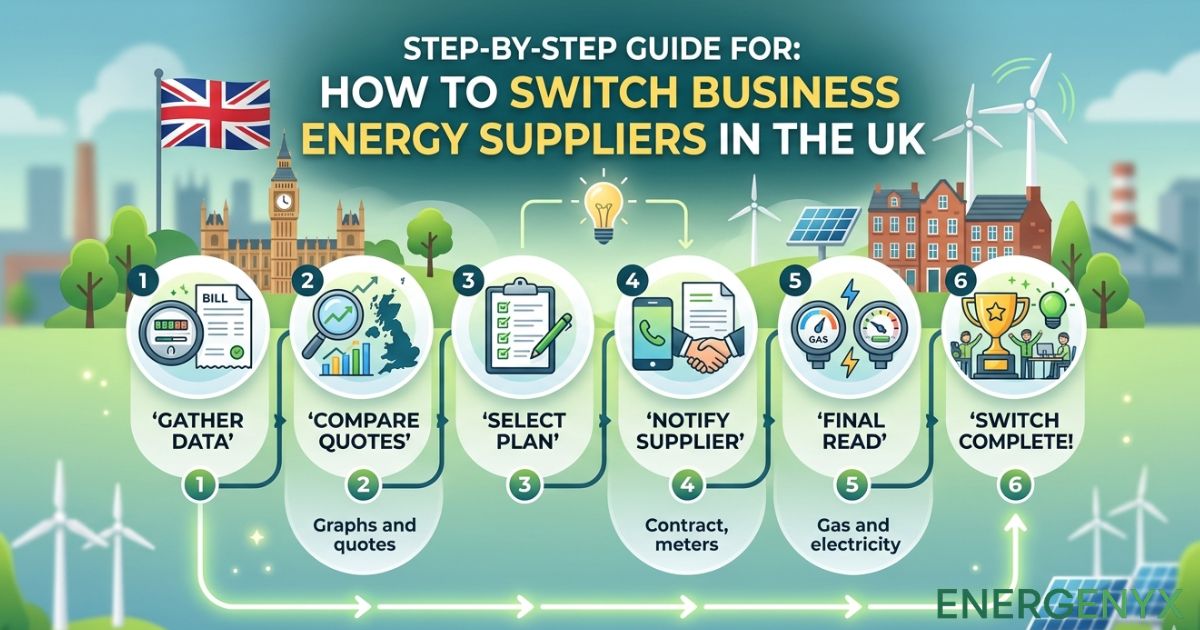
The Business Energy Switching Process: Step by Step
Now that you know when you can switch and what information you’ll need, let’s walk through the business energy switching process from start to finish.
Although every supplier has slightly different procedures, the overall process is straightforward and usually takes just a few simple steps.
Step 1: Review Your Current Business Energy Contract
Before you begin comparing suppliers, take a few minutes to review your existing contract.
Pay particular attention to:
- Your contract end date
- Any notice period
- Early termination fees
- Your current tariff
- Your annual energy usage
Many businesses unknowingly allow their contracts to renew automatically because they miss the notice period. Once this happens, they may be tied into another contract or moved onto higher renewal rates.
If you’re unsure about your contract details, your current supplier can usually provide this information.
Step 2: Gather Your Business Energy Information
Accurate quotes depend on accurate information.
Before requesting quotes, have the following details available:
- Business name
- Business address
- Latest electricity and gas bill
- MPAN number (electricity)
- MPRN number (gas)
- Estimated annual energy consumption
- Current supplier
- Contract expiry date
The more information you provide, the more accurate your energy comparison will be.
Step 3: Compare Business Energy Suppliers
This is where the biggest savings are often made.
Rather than accepting your current supplier’s renewal offer, compare prices from multiple business energy suppliers.
When comparing suppliers, don’t focus solely on the cheapest unit rate.

Consider:
- Unit price
- Standing charges
- Contract length
- Customer service reputation
- Renewable energy options
- Billing methods
- Online account management
- Exit fees
A slightly higher unit rate may still offer better overall value if the supplier provides lower standing charges or better customer support.
This is why many businesses choose to work with an independent comparison service such as Energenyx, which helps compare multiple suppliers in one place.
Step 4: Choose the Right Energy Tariff
Once you’ve compared available options, it’s time to choose a tariff that suits your business.
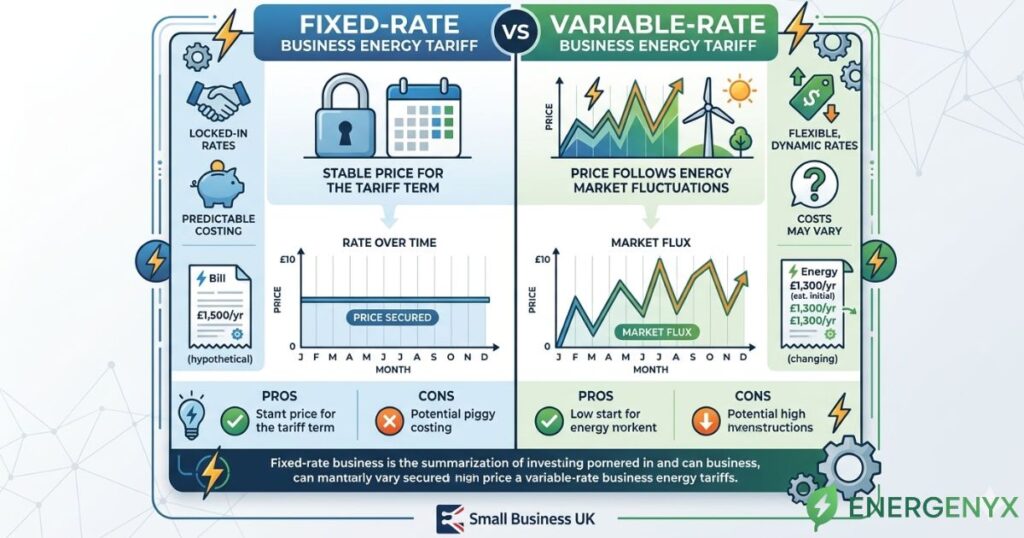
The most common business energy tariffs include:
Fixed-Rate Tariffs
A fixed-rate tariff locks your unit price for the duration of your contract.
Benefits include:
- Predictable monthly costs
- Protection from wholesale price increases
- Easier budgeting
These tariffs are popular with businesses that prefer financial certainty.
Variable-Rate Tariffs
Variable tariffs change according to market conditions.
They may offer lower prices when wholesale costs fall but can become more expensive if energy prices rise.
Businesses choosing this option should be comfortable with fluctuating monthly bills.
Green Business Energy Tariffs
Many suppliers now offer renewable electricity generated from sustainable sources.
Choosing a green tariff can help your business:
- Reduce its carbon footprint
- Support sustainability initiatives
- Meet ESG objectives
- Improve brand reputation
For many organisations, environmental responsibility is becoming just as important as price.
Step 5: Accept Your New Energy Contract
After selecting the most suitable tariff, you’ll receive a contract outlining:
- Unit rates
- Standing charges
- Contract length
- Payment terms
- Start date
- Renewal conditions
Read the agreement carefully before signing.
If anything is unclear, ask questions before committing.
A reputable broker or comparison service should explain the terms in plain English rather than relying on technical language.
Step 6: Your New Supplier Handles the Switch
One of the biggest misconceptions about switching business energy is that it’s complicated.
In reality, once you’ve accepted a new contract, most of the work is handled for you.
Your new supplier typically:
- Contacts your current supplier
- Arranges the transfer
- Confirms your switch date
- Coordinates meter readings
- Sets up your new account
In most cases, you don’t need to contact your old supplier yourself.
Will My Business Lose Power During the Switch?
No.
Changing your business energy supplier does not interrupt your electricity or gas supply.
The physical infrastructure delivering your energy remains exactly the same.
Only the company responsible for billing your energy changes.
This means your staff can continue working without disruption while the switch takes place behind the scenes.
How Long Does It Take to Switch Business Energy?
The exact timeline depends on your current contract and supplier.
Typically, switching business energy takes between two and six weeks after your new contract has been agreed.
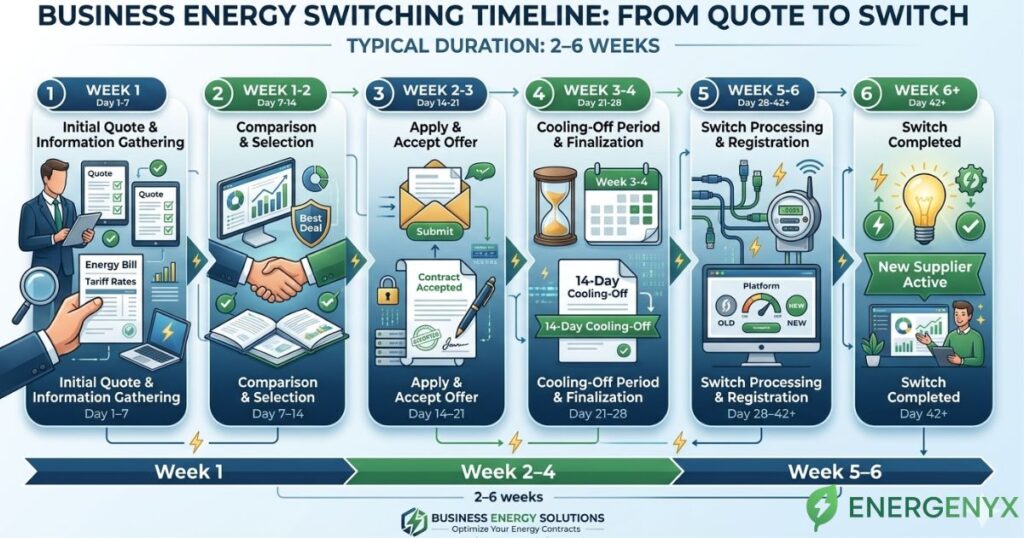
Several factors can influence the timescale, including:
- Your notice period
- Contract end date
- Meter type
- Outstanding account issues
- Supplier processing times
Planning ahead gives you more flexibility and helps avoid unnecessary delays.
Common Mistakes Businesses Make When Switching
Many businesses could save more simply by avoiding a few common mistakes.
Waiting Until the Last Minute
Leaving everything until your contract expires limits your options and may lead to expensive renewal rates.
Start comparing suppliers at least three months before renewal.
Focusing Only on Price
The cheapest tariff isn’t always the best value.
Always compare:
- Customer support
- Contract flexibility
- Standing charges
- Billing accuracy
- Renewable energy options
Ignoring the Notice Period
Missing your supplier’s notice window can result in automatic contract renewal.
Set reminders well before your contract expires.
Not Understanding the Contract
Before signing any agreement, make sure you understand:
- Contract duration
- Exit fees
- Renewal terms
- Payment conditions
A few extra minutes reviewing your contract could prevent costly surprises later.
How Energenyx Makes Business Energy Switching Simple
At Energenyx, we believe switching business energy shouldn’t be confusing or time-consuming.
Instead of contacting multiple suppliers individually, we help businesses compare competitive tariffs from trusted UK energy suppliers in one place.
Our team supports you throughout the process—from reviewing your current contract to finding suitable tariffs and helping coordinate the switch.
Whether you’re a small business looking to reduce monthly costs or a larger organisation reviewing multiple sites, our goal is to make the switching process as straightforward as possible, so you can focus on running your business.
Can You Switch Business Energy Suppliers Before Your Contract Ends?
One of the most common questions business owners ask is whether they need to wait until their current contract expires before changing suppliers.
The answer is not always.
In many cases, you can arrange your next business energy contract well before your existing one ends. However, whether you can switch immediately depends on the terms of your current agreement.
If you’re still within a fixed-term contract, leaving early may result in an early termination fee. These charges vary between suppliers and are designed to cover the remaining value of your agreement.
Before making any decisions, it’s worth reviewing:
- Your contract end date
- Your notice period
- Any exit fees
- Whether your supplier allows an early renewal with a different provider
If you’re unsure, an independent energy comparison service like Energenyx can help you understand your options before you commit to a new contract.
What Are Early Termination Fees?
Some business energy contracts include penalties for ending the agreement before the agreed expiry date.
These are known as early termination fees.
Not every contract includes these charges, and the amount can vary depending on:
- Your supplier
- Remaining contract length
- Annual energy consumption
- Contract terms
In some situations, the savings from moving to a lower-priced tariff may outweigh the cost of an early termination fee.
This is why it’s important to compare the total cost rather than focusing on one factor alone.
How Much Can Businesses Save by Switching Energy Suppliers?
Every business is different, so there’s no fixed amount that every company will save.
However, businesses that compare suppliers before renewing their contracts often find better rates than those who simply accept an automatic renewal offer.
Potential savings depend on factors such as:
- Annual electricity usage
- Gas consumption
- Contract length
- Wholesale market prices
- Business location
- Meter type
For businesses with high energy usage, even a small reduction in the unit rate can make a noticeable difference to annual operating costs.
More importantly, reviewing your energy contract regularly helps ensure you’re paying a competitive market rate rather than remaining on an outdated tariff.
How to Choose the Right Business Energy Supplier
Price is important, but it shouldn’t be the only factor influencing your decision.
The right supplier should provide a balance between competitive pricing, reliable service, and contract flexibility.
When comparing suppliers, consider the following:
Transparent Pricing
Look beyond the headline unit rate.
Check for:
- Standing charges
- Contract fees
- Exit charges
- Payment options
Understanding the full cost of the contract will help you make a more informed decision.
Customer Service
Reliable customer support can save valuable time if you ever need assistance with billing, meter readings, or account management.
Before choosing a supplier, consider reading independent customer reviews and checking how easily their support team can be contacted.
Renewable Energy Options
If sustainability is part of your business strategy, look for suppliers offering renewable electricity backed by recognised certification.
Green energy tariffs can support your environmental goals while demonstrating your commitment to responsible business practices.
Flexible Contract Options
Every business has different priorities.
Some prefer long-term price certainty through fixed contracts, while others value shorter agreements that allow greater flexibility.
Choose a tariff that matches your financial plans and expected energy usage.
Why Businesses Choose Energenyx
Finding the right business energy contract can be time-consuming, especially when comparing multiple suppliers individually.
Energenyx simplifies the process by helping UK businesses compare competitive energy tariffs from trusted suppliers—all in one place.
When you work with Energenyx, you benefit from:
- Access to multiple UK business energy suppliers
- Competitive electricity and gas quotes
- Simple, straightforward comparisons
- Support throughout the switching process
- A free, no-obligation comparison service
Our aim isn’t just to help you switch suppliers—it’s to help you make a well-informed decision that supports your business in the long term.
Whether you’re renewing an existing contract, moving into new premises, or reviewing your current energy costs, we’re here to help you explore your options with confidence.
Frequently Asked Questions
Can I switch my business energy supplier if I’m in a contract?
Yes, but you should first check whether your current agreement includes early termination charges. In many cases, you can arrange your next contract before your existing one ends.
How long does it take to switch business energy suppliers?
Most business energy switches are completed within two to six weeks, although the timeline depends on your current contract, notice period, and supplier processes.
Will my electricity or gas supply be interrupted?
No.
Switching suppliers only changes the company that bills you for your energy. Your electricity and gas supply continues without interruption throughout the switching process.
Do I need a new meter when I switch suppliers?
Usually not.
In most cases, your existing electricity and gas meters remain exactly the same unless you’ve specifically requested a meter upgrade.
Want to know, What happens to my smart meter when I change supplier? Read it by clicking the highlighted link.
Is switching business energy free?
Yes.
There is generally no charge for switching suppliers itself. However, if you leave a fixed-term contract early, your existing supplier may apply an early termination fee.
Can small businesses switch energy suppliers?
Absolutely.
Whether you’re a sole trader, independent retailer, café owner, office manager, or operate multiple commercial premises, comparing business energy suppliers can help ensure you’re on a competitive tariff.
Final Thoughts
Energy costs play a significant role in the day-to-day running of any business.
While many companies focus on reducing expenses in areas such as staffing, marketing, or inventory, reviewing your business energy contract is another practical way to manage operating costs.
The good news is that switching business energy suppliers is often far simpler than many people expect. By planning ahead, understanding your current contract, and comparing multiple suppliers, you can make a well-informed decision that supports both your budget and your long-term business goals.
If your contract is approaching renewal or you’re unsure whether you’re paying competitive rates, now is an excellent time to review your options.
Ready to Switch Business Energy Suppliers?
At Energenyx, we help businesses across the UK compare business electricity and gas tariffs from trusted suppliers.
Our comparison service is free, with no obligation to switch.
Request your free business energy quote today and discover whether your business could benefit from a more competitive energy contract.

Ready to reduce your business energy costs?
Compare electricity and gas tariffs from trusted UK suppliers with Energenyx. Our free comparison service helps businesses find competitive energy contracts without the hassle of contacting multiple suppliers individually.
Request your free, no-obligation business energy quote today.