
Introduction
Understanding your business energy bill is one of the simplest ways to take control of your energy costs. Whether you’re reviewing your monthly expenses, preparing to switch suppliers, or checking that you’re being billed correctly, knowing what each section of your bill means can help you make informed decisions.
Many UK business owners find commercial electricity and gas bills confusing. Terms such as standing charge, unit rate, MPAN, MPRN, estimated readings, and VAT can make it difficult to understand exactly what you’re paying for.
The good news is that once you know how to read a business energy bill, comparing quotes, identifying billing errors, and choosing the right tariff becomes much easier.
if your supplier fails to resolve a billing error, escalate your dispute via the Citizens Advice Consumer Service. The dedicated Citizens Advice Energy Problem Page or the Citizens Advice Guide on Business Energy Debt to provide immediate, actionable help.
In this guide, we’ll explain every major section of a UK business energy bill in plain English, helping you understand your charges and make better decisions when comparing business energy suppliers.
Key Takeaways
Before we dive into the details, here are the main things you should know:
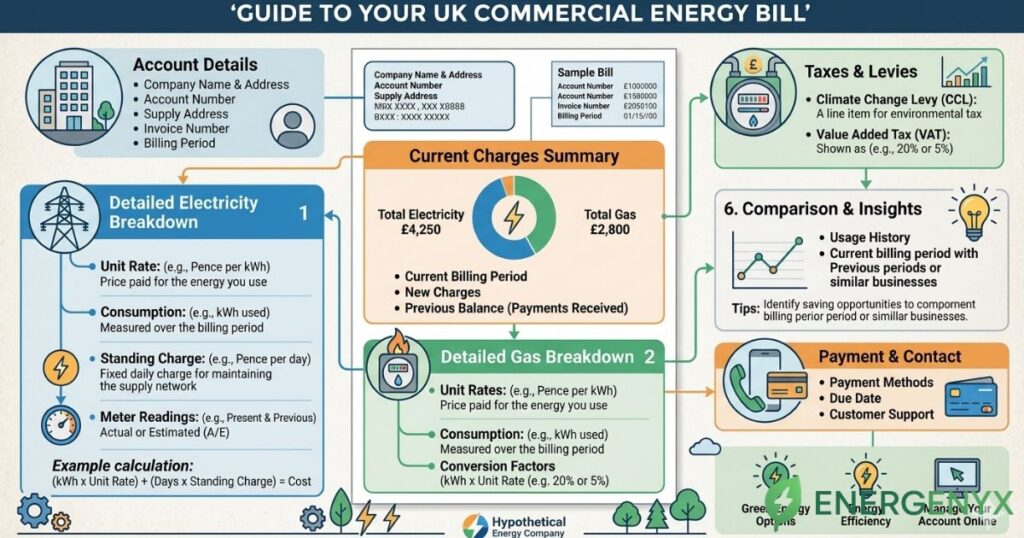
- A business energy bill contains information about your supplier, account, energy usage, pricing, and taxes.
- Your total bill is usually made up of a standing charge, unit rate, and any applicable taxes or additional charges.
- Checking your meter readings regularly can help you avoid estimated bills.
- Understanding your MPAN and MPRN numbers can make switching suppliers easier.
- Reviewing your bill carefully can help you spot errors and reduce unnecessary costs.
Why Is It Important to Understand Your Business Energy Bill?
Your energy bill isn’t just a payment request—it’s a valuable source of information about how your business consumes electricity and gas.
By understanding the information it contains, you can:
- Verify that you’re being charged correctly.
- Monitor changes in your energy usage.
- Compare business energy quotes more accurately.
- Identify opportunities to reduce energy costs.
- Prepare for contract renewals or supplier switches with confidence.
Many businesses focus only on the total amount due, but taking a few minutes to review the breakdown of charges can reveal useful insights that may help reduce future costs.
| Charge | Example |
|---|---|
| Electricity used | 1,200 kWh |
| Unit rate | £0.24/kWh |
| Usage cost | £288.00 |
| Standing charge | £18.00 |
| VAT | £61.20 |
| Total | £367.20 |
What Information Is Included on a Business Energy Bill?
Although the layout varies between suppliers, most UK business energy bills include similar information.
Let’s look at each section.
Business Details
At the top of the bill, you’ll usually find details that identify your account.
This may include:
- Business name
- Business address
- Account number
- Customer reference number
- Contact information
Always check that these details are correct, particularly if you’ve recently moved premises or changed your business name.
Incorrect account information can sometimes lead to billing issues or delays when contacting your supplier.
Supplier Information
Your bill will also include details about your energy supplier, including:
- Supplier name
- Customer service contact details
- Emergency contact numbers
- Payment methods
- Website and online account information
Keeping these details handy can save time if you need to report an issue, query a bill, or discuss your contract.
Billing Period
The billing period shows the dates covered by the invoice.
For example:
Billing Period
1 June 2026 – 30 June 2026
This tells you exactly when your energy usage was measured and charged.
Always check that the billing period matches your expectations and doesn’t overlap with previous invoices.
Account Number
Your account number identifies your business account with your current supplier.
It’s important to remember that your account number is not the same as your MPAN or MPRN.
- Your account number identifies your customer account.
- Your MPAN identifies your electricity supply point.
- Your MPRN identifies your gas supply point.
You’ll often be asked for your account number when contacting customer support, while MPAN and MPRN numbers are commonly required when comparing quotes or arranging a supplier switch.
Understanding Your Energy Usage
One of the most important sections of your business energy bill shows how much electricity or gas your business has used during the billing period.
Your supplier calculates your energy charges based on this information.
Understanding how usage is measured can help you identify unusual consumption patterns and improve energy efficiency.
What Is a Kilowatt-hour (kWh)?
Business energy usage is measured in kilowatt-hours (kWh).
A kilowatt-hour is a standard unit that represents the amount of energy used over time.
For example, if a 1 kW appliance runs continuously for one hour, it uses 1 kWh of electricity.
The more electricity or gas your business consumes, the more kilowatt-hours you’ll see on your bill.
Your unit rate is applied to the number of kilowatt-hours you’ve used to calculate your usage charges.
Meter Readings
Your bill will usually include opening and closing meter readings for the billing period.
These readings show how much energy your business has consumed between two dates.
Recording and submitting regular meter readings helps ensure your bills are accurate and based on actual usage rather than estimates.
If your business has a smart meter, readings may be sent to your supplier automatically.
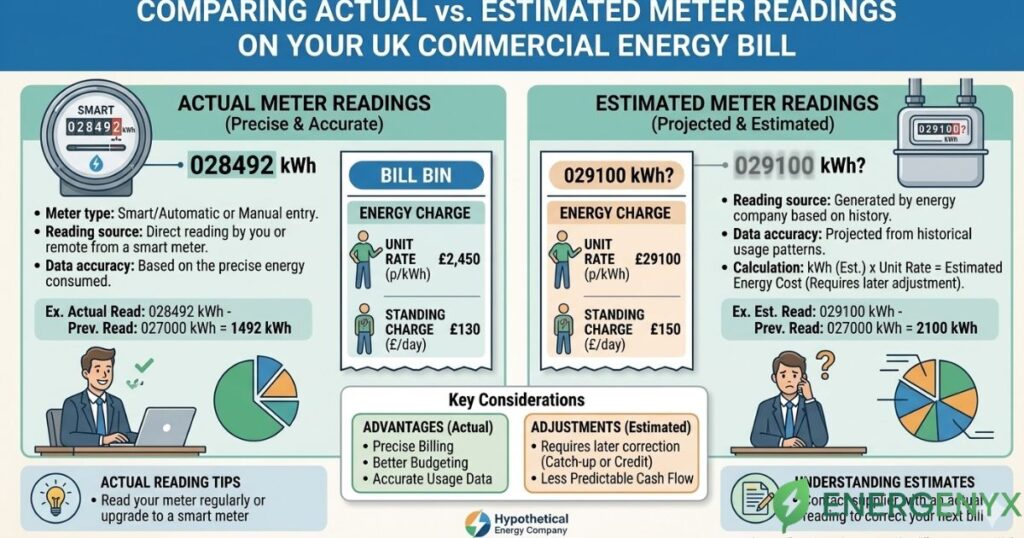
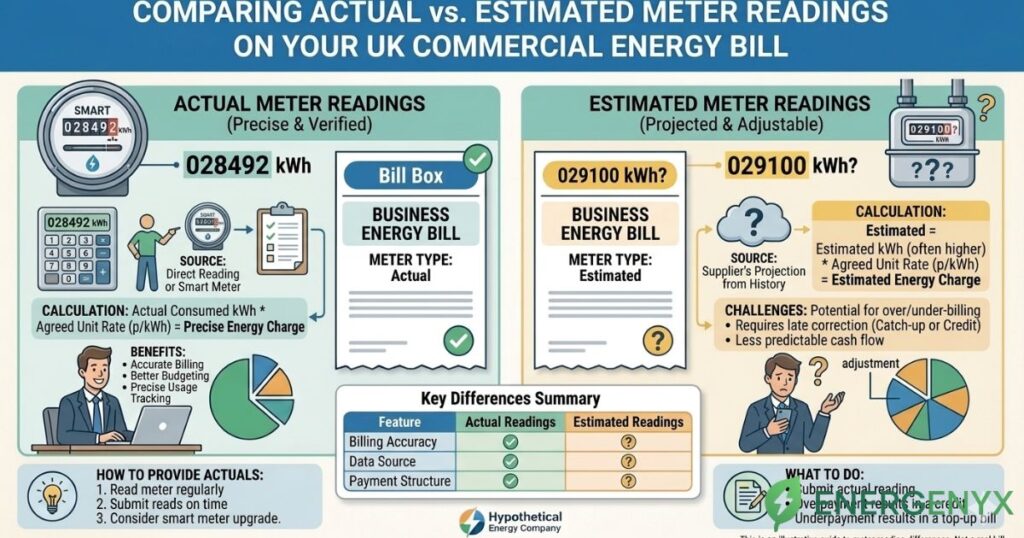
Estimated vs Actual Meter Readings
One of the first things you should check on every business energy bill is whether your charges are based on:
- Actual meter readings
- Estimated meter readings
Actual Readings
Actual readings are taken directly from your meter or automatically transmitted by a smart meter.
These provide the most accurate picture of your energy consumption.
Estimated Readings
If your supplier doesn’t receive an up-to-date meter reading, they may estimate your usage based on previous consumption patterns.
Estimated bills aren’t always accurate.
If the estimate is higher than your actual usage, you may pay more than necessary until the account is adjusted.
Submitting regular meter readings can help prevent unexpected corrections and improve billing accuracy.
Understanding Unit Rates
One of the biggest costs on your business energy bill is the unit rate.
The unit rate is the amount you pay for each kilowatt-hour (kWh) of electricity or gas your business uses during the billing period.
Unlike a standing charge, which is a fixed daily cost, the unit rate increases or decreases depending on your energy consumption.
For example, if your electricity unit rate is 25p per kWh and your business uses 1,000 kWh during the month, the usage cost would be:
1,000 kWh × £0.25 = £250
The same principle applies to your business gas bill, although gas unit rates are usually different from electricity rates.
When comparing business energy quotes, don’t focus only on the unit rate. A tariff with a lower unit rate may have a higher standing charge, so it’s important to compare the total annual cost.
Fixed vs Variable Unit Rates
Business energy suppliers typically offer two main pricing structures. Learn more about business energy tariffs before choosing your next contract.
Fixed Unit Rates
With a fixed tariff, your unit rate remains the same for the length of your contract.
This provides greater certainty because your energy price won’t change if wholesale market prices increase.
Fixed tariffs are often chosen by businesses that want predictable monthly budgeting.
Variable Unit Rates
With a variable tariff, your unit rate can rise or fall during the contract depending on market conditions.
Although prices may decrease when wholesale costs fall, they can also increase unexpectedly.
Businesses considering this type of tariff should understand the potential risks as well as the possible savings.
What Is a Standing Charge?
Another important section of your bill is the standing charge.
A standing charge is a fixed daily fee that helps cover the cost of maintaining your electricity or gas supply, regardless of how much energy you use.
Standing charges contribute towards:
- Maintaining electricity and gas networks.
- Meter administration.
- Billing systems.
- Customer support.
- Infrastructure maintenance.
Even if your business uses very little energy during a particular day, you’ll usually still pay the standing charge.
For this reason, it’s important to compare both the standing charge and the unit rate when evaluating business energy tariffs.
Where Can You Find Your MPAN and MPRN?
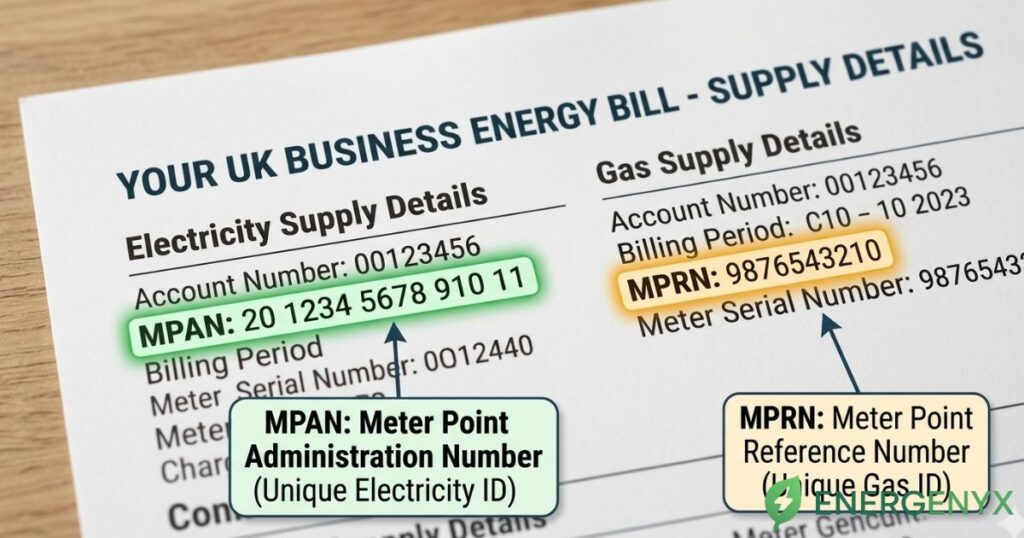
If your business energy bill includes electricity, you’ll usually find your MPAN (Meter Point Administration Number) somewhere on the electricity section of the bill.
If your business also uses gas, you’ll normally find your MPRN (Meter Point Reference Number) on the gas section.
These numbers are unique identifiers for your supply points and are commonly required when:
- Comparing business energy quotes.
- Switching suppliers.
- Moving into new business premises.
- Renewing your contract.
It’s important not to confuse your MPAN or MPRN with your account number or your meter serial number, as each serves a different purpose.
Understanding VAT on a Business Energy Bill
Most business energy bills include Value Added Tax (VAT).
The applicable VAT rate depends on your business and how the energy is used.
Many commercial customers pay the standard rate of VAT, while some organisations may qualify for a reduced rate if they meet specific eligibility criteria.
Your bill will usually show:
- VAT rate
- VAT amount
- Total including VAT
If you’re unsure which VAT rate applies to your organisation, it’s worth discussing this with your supplier or accountant.
What Is the Climate Change Levy (CCL)?
Some UK businesses may also see the Climate Change Levy (CCL) on their energy bills.
The CCL is a government environmental tax that encourages businesses to improve energy efficiency and reduce carbon emissions.
Whether your business pays the levy depends on factors such as the type of organisation you operate and any exemptions or reliefs that may apply.
If the levy is included, it will normally appear as a separate line on your bill.
Other Charges You May See on Your Bill
Depending on your supplier and contract, your bill may also include additional information or charges.
These could include:
- Contract discounts.
- Credit or debit adjustments.
- Late payment charges.
- Renewable energy contributions.
- Meter-related charges.
- Previous balance carried forward.
Reviewing these sections carefully can help ensure you understand exactly how your total bill has been calculated.
How Is Your Total Business Energy Bill Calculated?
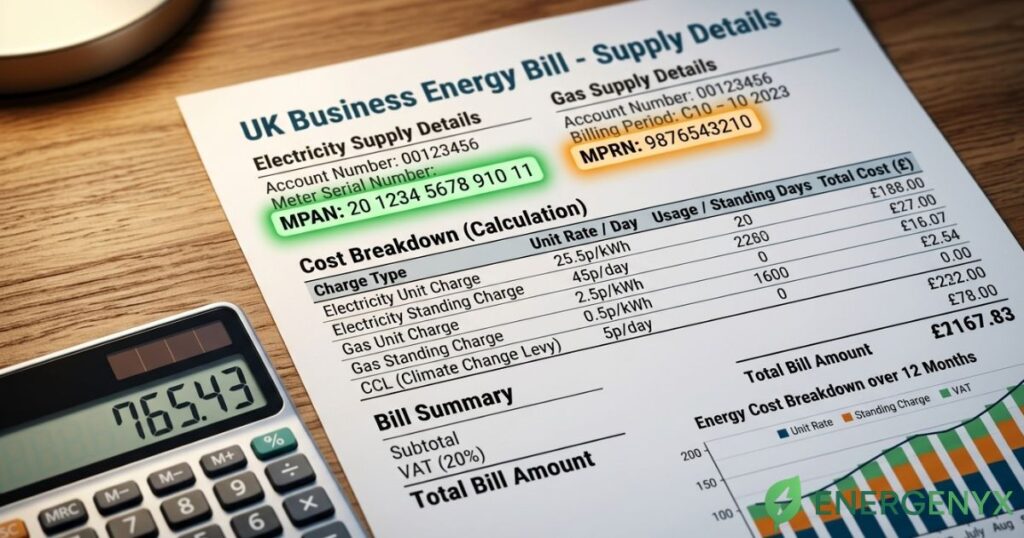
Although the layout differs between suppliers, the overall calculation follows a similar structure.
Key Terms
| Term | Meaning |
|---|---|
| kWh | Unit of energy consumption |
| MPAN | Electricity supply identifier |
| MPRN | Gas supply identifier |
| Standing charge | Fixed daily cost |
| Unit rate | Cost per kWh |
| VAT | Value Added Tax |
Your total bill is generally made up of:
- Electricity or gas usage (kWh × unit rate).
- Daily standing charges.
- Climate Change Levy (where applicable).
- VAT.
- Any additional adjustments or credits.
Example Calculation
Imagine your business uses 1,200 kWh of electricity in one month.
- Unit rate: 24p per kWh
- Standing charge: 60p per day
- Billing period: 30 days
Usage cost
1,200 × £0.24 = £288.00
Standing charges
30 × £0.60 = £18.00
Subtotal
£288.00 + £18.00 = £306.00
VAT and any other applicable charges would then be added to calculate the final amount payable.
This example shows why it’s important to consider both the unit rate and the standing charge when comparing business energy contracts.
Tips for Checking Your Business Energy Bill

Before paying your bill each month, take a few moments to review the following:
- Check that your business details are correct.
- Confirm the billing period.
- Verify whether meter readings are actual or estimated.
- Review your unit rate and standing charge.
- Check your MPAN and MPRN details if you’re preparing to switch suppliers.
- Look for any unexpected fees or adjustments.
- Compare your current charges with previous bills to identify unusual changes.
Regularly reviewing your energy bills can help you identify issues early and make better-informed decisions about your business energy contract.
Business Energy Bill Checklist
| Check | Why It Matters |
|---|---|
| Meter readings | Ensure they are actual, not estimated |
| Standing charge | Compare with other suppliers |
| Unit rate | Affects most of your bill |
| Contract end date | Avoid expensive renewal rates |
| MPAN/MPRN | Needed when switching suppliers |
Common Mistakes Businesses Make When Reading Their Energy Bills
Even experienced business owners sometimes overlook important details on their energy bills. Taking a few minutes to review your bill carefully can help you avoid unnecessary costs and billing disputes.
Here are some of the most common mistakes.
Ignoring Estimated Meter Readings
Many businesses don’t realise their bill is based on an estimated meter reading rather than an actual reading.
If the estimate is too high, you could temporarily pay more than you owe. If it’s too low, you may receive a larger catch-up bill later.
Submitting regular meter readings or using a smart meter can help ensure your bills are based on actual energy usage.
Focusing Only on the Total Amount
It’s natural to look at the total amount due first, but this doesn’t tell the whole story.
Instead, review:
- Your unit rate.
- Daily standing charge.
- Energy consumption (kWh).
- VAT.
- Any additional charges or credits.
Understanding each part of the bill makes it easier to compare tariffs accurately.
Missing Your Contract Renewal Date
Many businesses remain with the same supplier simply because they miss their renewal deadline.
Reviewing your bill regularly can help you identify:
- Contract end date.
- Renewal notice period.
- Current tariff details.
Planning ahead gives you more time to compare suppliers and negotiate a better deal.
Understanding your business energy contract duration can help you prepare well before renewal.
Not Checking Your MPAN or MPRN
If you’re planning to switch suppliers, you’ll usually need your MPAN (for electricity) or MPRN (for gas).
Knowing where these numbers are located before requesting quotes can make the switching process faster and more accurate.
Tips to Reduce Your Business Energy Costs
Reading your bill is only the first step. Acting on the information it contains can help reduce your long-term energy expenses.
Compare Suppliers Before Renewing
Don’t wait until your contract has automatically renewed.
Requesting quotes from multiple suppliers before your renewal date can help you find more competitive prices and contract terms.
Submit Regular Meter Readings
Accurate meter readings reduce the likelihood of estimated bills and help ensure you’re paying for the energy your business actually uses.
Review Your Energy Usage
Look for unusual increases in consumption.
If your usage rises unexpectedly, investigate possible causes such as:
- New equipment.
- Longer operating hours.
- Faulty appliances.
- Heating or cooling systems running inefficiently.
Improve Energy Efficiency
Simple improvements can reduce your electricity and gas usage over time.
Examples include:
- Switching to LED lighting.
- Maintaining heating and cooling systems.
- Turning off unused equipment.
- Installing smart controls.
- Encouraging energy-saving practices among staff.
Reducing consumption lowers the number of kilowatt-hours (kWh) your business uses, which can reduce your overall bill.
Frequently Asked Questions
How do I read a business electricity bill?
Start by checking your billing period, meter readings, unit rate, standing charge, VAT, and total amount due. Understanding each section helps you verify your charges and compare tariffs more effectively.
What is the difference between a standing charge and a unit rate?
A standing charge is a fixed daily cost for maintaining your energy supply, while the unit rate is the price you pay for each kilowatt-hour (kWh) of electricity or gas your business consumes.
Where can I find my MPAN or MPRN?
Your MPAN is usually displayed on the electricity section of your bill, while your MPRN is shown on the gas section.
These numbers are commonly required when switching suppliers or requesting business energy quotes.
Why is my business energy bill higher than expected?
There are several possible reasons, including:
- Higher energy usage.
- Estimated meter readings.
- Changes to unit rates.
- Increased standing charges.
- Seasonal demand.
- Additional taxes or adjustments.
Reviewing each section of your bill can help identify the cause.
Should I Compare Business Energy Quotes Before My Contract Ends?
Yes.
Comparing quotes before your renewal date gives you more options and may help you secure a more competitive tariff.
Waiting until after your contract expires could result in your business being placed on more expensive out-of-contract or deemed rates.
Final Thoughts
Your business energy bill contains much more than just the amount you need to pay.
It provides valuable information about your energy usage, pricing, contract, and supply details.
By understanding how to read each section of your bill, you can identify potential billing errors, monitor your energy consumption, and make more informed decisions when evaluating suppliers.
Taking a proactive approach to reviewing your business energy bills can help you manage costs more effectively and avoid surprises at renewal time.
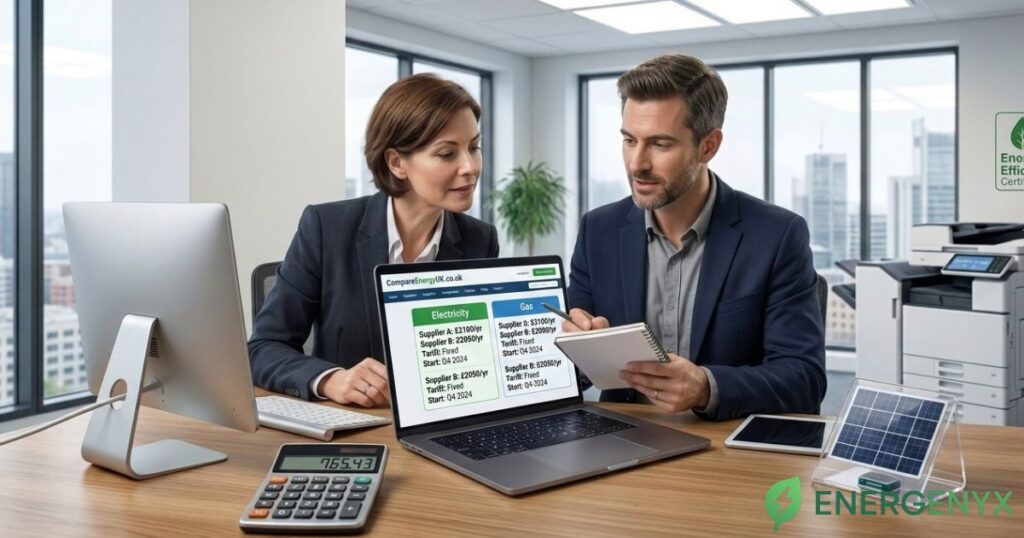
Compare Business Energy Quotes with Confidence
Once you understand your current business energy bill, you’re in a much better position to compare alternative tariffs.
At Energenyx, we help UK businesses compare commercial electricity and gas quotes from trusted suppliers, making it easier to find a contract that matches your energy usage and budget.
Whether you’re approaching your renewal date, moving premises, or simply looking to reduce costs, comparing quotes could help your business save money.
Request your free, no-obligation business energy comparison today and take the next step towards smarter energy management.