
Introduction
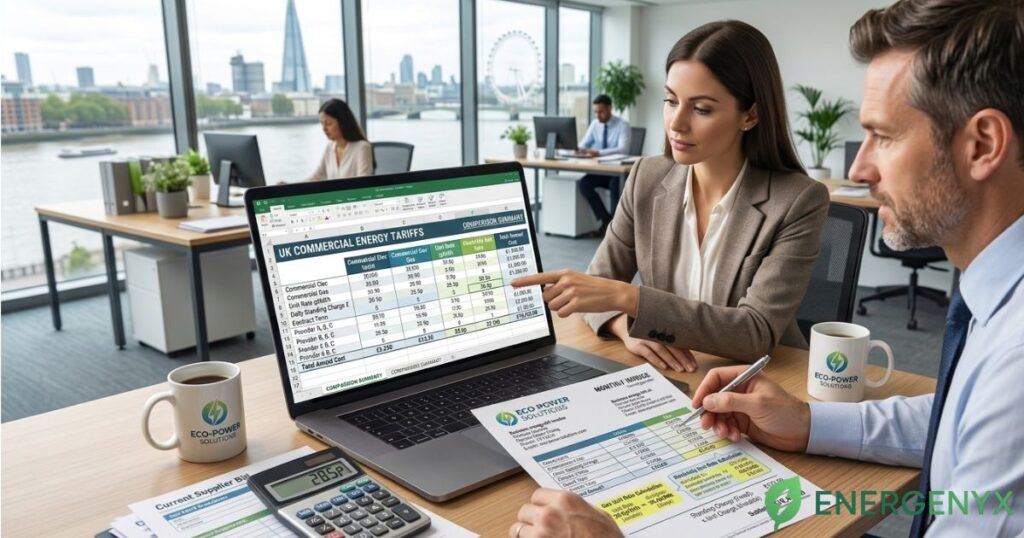
If you’ve ever looked at a business energy bill or compared commercial electricity and gas quotes, you’ve probably come across the term unit rate. While it may seem like just another pricing term, your business energy unit rate is one of the biggest factors affecting how much you pay for electricity and gas.
Every kilowatt-hour (kWh) your business uses is charged at a specific unit rate. Even a small difference in that rate can have a significant impact on your annual energy costs, especially for businesses with high energy consumption.
Understanding how business energy unit rates work can help you compare tariffs more effectively, avoid expensive contracts, and make informed decisions when switching suppliers or renewing your agreement.
In this guide, we’ll explain what business energy unit rates are, how they’re calculated, what affects them, and how you can potentially reduce your overall energy costs.
If you want to know, how the UK business energy market operates and what commercial customers should consider when choosing an energy supplier. Ofgem provides guidance on it.
Key Takeaways
Before we explore the details, here are the main points to remember:
- A business energy unit rate is the price you pay for each kilowatt-hour (kWh) of electricity or gas your business consumes.
- Unit rates vary between suppliers, tariff types, contract lengths, and business locations.
- Both your unit rate and standing charge determine your total energy bill.
- Comparing the total annual cost—not just the lowest unit rate—can help you choose the best tariff.
- Reviewing your contract before renewal may help you secure more competitive business energy prices.
What Is a Business Energy Unit Rate?
A business energy unit rate is the amount your supplier charges for every kilowatt-hour (kWh) of electricity or gas your business uses.
Unlike a standing charge, which is a fixed daily fee, the unit rate depends entirely on your energy consumption.
For example:
- If your electricity unit rate is 25p per kWh
- And your business uses 2,000 kWh during the billing period
Your electricity usage charge would be:
2,000 × £0.25 = £500
This usage cost is then combined with your standing charges, VAT, and any other applicable charges to calculate your final bill.
For businesses with high energy usage, even a small reduction in the unit rate can lead to meaningful savings over the course of a year.
What Is a Kilowatt-hour (kWh)?
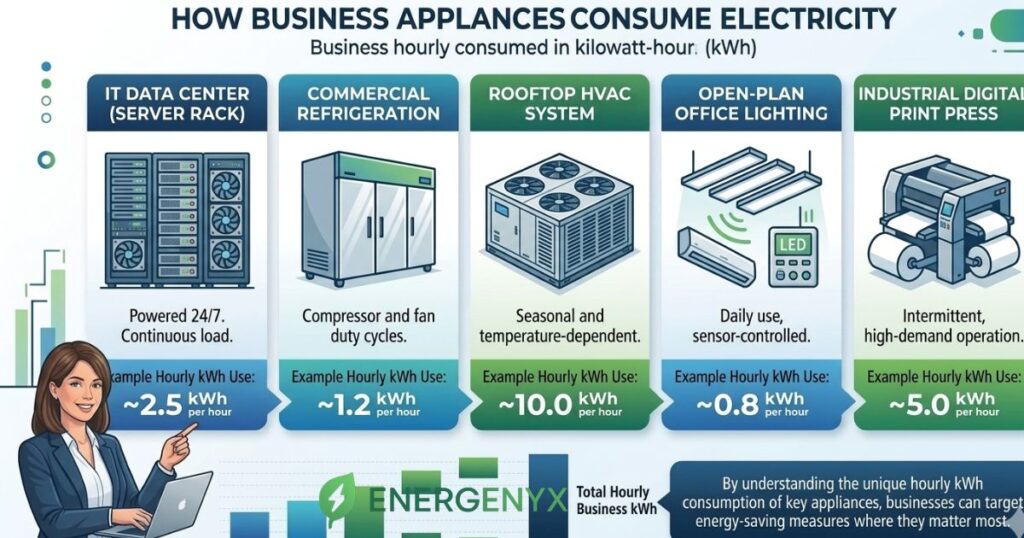
To understand unit rates, it’s important to understand what a kilowatt-hour (kWh) means.
A kilowatt-hour is the standard unit used to measure electricity and gas consumption.
In simple terms:
- A 1 kW appliance running for one hour uses 1 kWh of energy.
For example:
| Appliance | Running Time | Energy Used |
|---|---|---|
| 1 kW electric heater | 1 hour | 1 kWh |
| 2 kW commercial oven | 3 hours | 6 kWh |
| 0.5 kW office equipment | 8 hours | 4 kWh |
Your supplier records the number of kilowatt-hours your business uses during the billing period and multiplies that figure by your agreed unit rate.
Understanding your kWh consumption makes it easier to identify opportunities to improve energy efficiency and reduce costs.
You can see your kWh usage on your business energy bill each month.
How Are Business Energy Unit Rates Calculated?
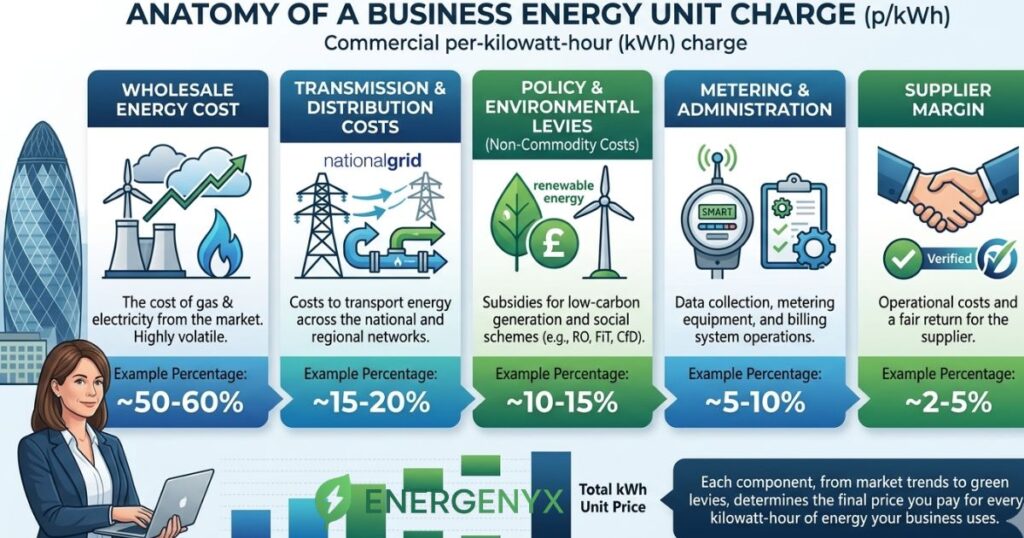
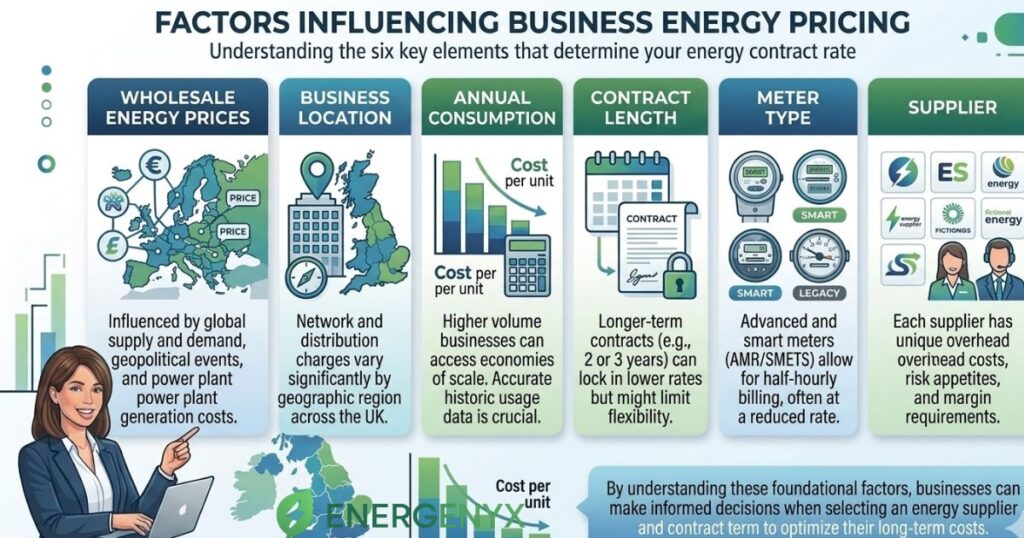
Business energy suppliers consider a range of factors when determining the unit rate they offer.
Although every supplier has its own pricing model, several common factors influence the final rate.
Wholesale Energy Prices
Wholesale electricity and gas prices are one of the biggest influences on business energy unit rates.
Suppliers purchase energy from wholesale markets before selling it to businesses.
When wholesale prices rise, suppliers may increase their unit rates. When wholesale costs fall, businesses renewing or switching contracts may benefit from more competitive pricing.
Business Location
Your business location can also affect your unit rate.
This is because regional network and distribution costs vary across the UK.
Businesses operating in different regions may receive different quotes, even if their annual energy consumption is similar.
Annual Energy Consumption
Suppliers often consider how much energy your business uses each year.
Businesses with higher annual consumption may qualify for more competitive pricing because they purchase larger volumes of energy.
However, the most suitable tariff depends on your individual usage profile rather than consumption alone.
Contract Length
The length of your business energy contract can influence the unit rate you’re offered.
Some suppliers provide lower unit rates in exchange for longer fixed-term agreements, while shorter contracts may offer greater flexibility.
Choosing the right contract length depends on your business objectives, market conditions, and appetite for price certainty.
Meter Type
The type of meter installed at your premises may also affect your tariff.
Examples include:
- Standard business meters
- Smart meters
- Half-hourly electricity meters
Some tariffs are designed specifically for businesses with half-hourly meters, where energy usage is recorded more frequently.
Energy Supplier
Every supplier uses its own pricing strategy.
As a result, the same business may receive different unit rates from different suppliers.
This is one of the main reasons why comparing multiple business energy quotes before signing a contract is worthwhile.
Business Electricity vs Business Gas Unit Rates
Although both electricity and gas are measured in kilowatt-hours (kWh), their unit rates are usually different.
In most cases, business electricity has a higher unit rate than business gas. This is due to differences in generation, transmission, distribution, and market conditions.
Your business may have:
- An electricity unit rate
- A gas unit rate
- Separate standing charges for each supply
If your business uses both electricity and gas, compare the overall annual cost of each supply rather than focusing on just one price.
Network infrastructure also affects energy costs, with regional distribution managed by companies across Great Britain.
Why Do Electricity and Gas Unit Rates Differ?
Several factors influence the difference between electricity and gas prices.
These include:
- Wholesale market prices
- Network and distribution costs
- Government policies and levies
- Supplier pricing strategies
- Regional infrastructure costs
- Seasonal demand
Because these factors change over time, unit rates can also change when you renew or switch your business energy contract.
Business Energy Unit Rate vs Standing Charge
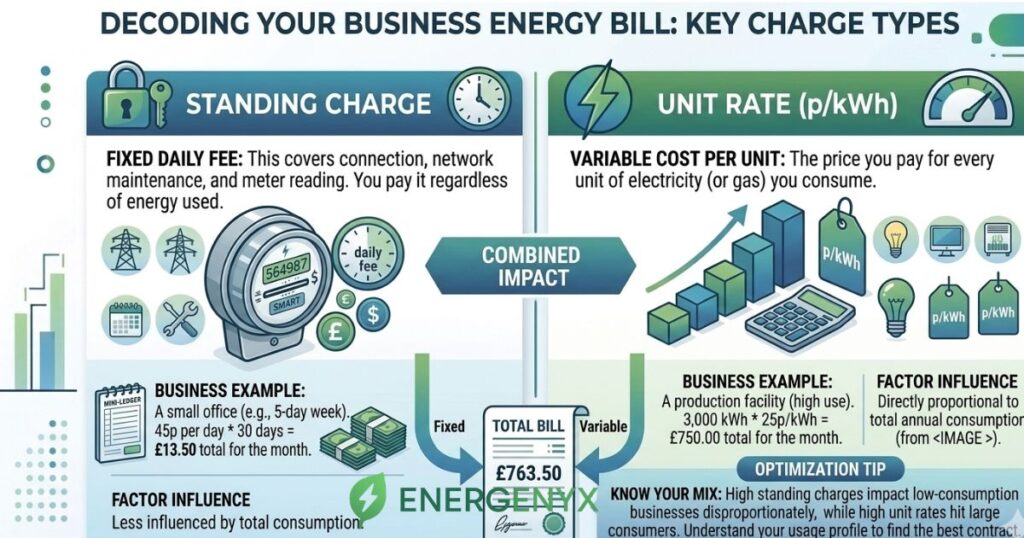
Many businesses assume that the lowest unit rate automatically means the cheapest tariff.
However, that’s not always true.
Your total energy bill is generally made up of two main charges:
| Charge | What It Covers |
|---|---|
| Unit Rate | The price you pay for every kWh of electricity or gas used. |
| Standing Charge | A fixed daily fee for maintaining your energy supply. |
For example:
Tariff A
- Lower unit rate
- Higher standing charge
Tariff B
- Higher unit rate
- Lower standing charge
Depending on your annual energy usage, either tariff could work out cheaper.
Businesses with lower consumption may benefit from a lower standing charge, while businesses with higher consumption often focus more on securing a competitive unit rate.
The best approach is to compare the total expected annual cost, rather than looking at one charge in isolation.
Fixed vs Variable Unit Rates
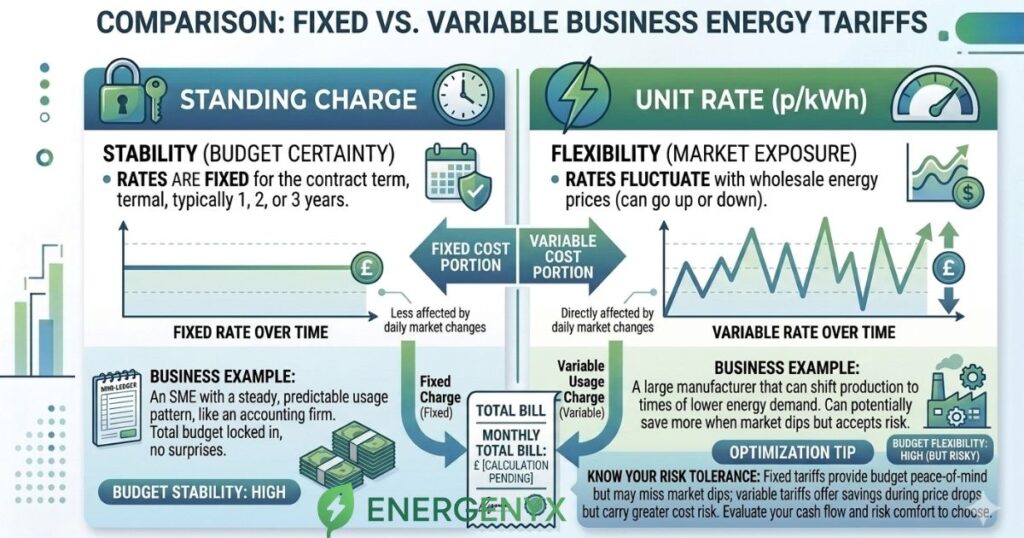
When comparing business energy quotes, you’ll usually choose between a fixed tariff and a variable tariff.
Fixed Unit Rates
A fixed tariff keeps your unit rate the same throughout your contract.
Advantages
- Predictable monthly budgeting
- Protection against market price increases
- Greater cost certainty
Considerations
- You won’t benefit if wholesale prices fall significantly during your contract.
Variable Unit Rates
A variable tariff allows your unit rate to rise or fall in line with market conditions.
Advantages
- Opportunity to benefit from lower market prices.
Considerations
- Costs can increase unexpectedly if wholesale prices rise.
Businesses should carefully consider their appetite for risk before choosing a variable tariff.
Why Do Business Energy Unit Rates Change?
Many business owners are surprised when their renewal quote differs from their previous contract.
Several factors can influence pricing.
Wholesale Market Conditions
Changes in global energy markets can affect supplier pricing.
Contract Renewal Timing
Businesses that compare quotes well before their renewal date often have more options available than those leaving it until the last minute.
Changes in Energy Usage
If your annual consumption has changed significantly, suppliers may adjust the rates they offer.
Market Competition
Different suppliers may offer promotional pricing or sector-specific tariffs, making it worthwhile to compare multiple quotes before committing to a contract.
How to Reduce Your Business Energy Unit Rate
While you can’t control wholesale energy markets, there are practical steps that may help you secure more competitive pricing.
The Energy Saving Trust offers practical advice on reducing workplace energy consumption and improving efficiency.
Compare Multiple Suppliers
Request quotes from several business energy suppliers before your contract expires.
Comparing offers gives you a better understanding of the market and may reveal more competitive tariffs.
Renew Before Your Contract Ends
Leaving your renewal until after your contract expires could result in higher out-of-contract or deemed rates.
Planning ahead gives you more time to review available options.
Read our guide on deemed rates, if you want to know more about it.
Understand Your Energy Usage
Knowing your annual energy consumption helps suppliers provide more accurate quotations.
It also allows you to compare tariffs based on your actual usage rather than estimates.
Improve Energy Efficiency
Reducing unnecessary electricity and gas consumption lowers the number of kilowatt-hours your business uses.
Simple measures include:
- Upgrading to LED lighting.
- Maintaining heating and cooling systems.
- Switching off equipment when not in use.
- Installing smart controls.
- Monitoring energy consumption regularly.
Improving efficiency won’t reduce your unit rate, but it can significantly reduce your total energy costs.
Example Business Energy Bill Calculation
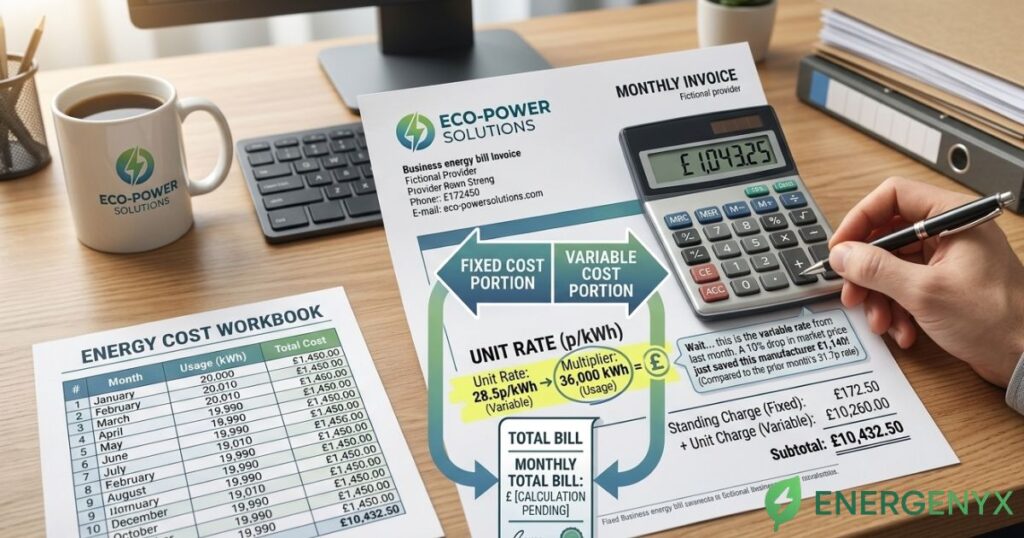
Let’s look at a simple example.
Imagine your business uses:
- Electricity consumption: 2,500 kWh
- Unit rate: 23p per kWh
- Standing charge: 55p per day
- Billing period: 30 days
Step 1: Usage Cost
2,500 × £0.23 = £575.00
Step 2: Standing Charges
30 × £0.55 = £16.50
Step 3: Subtotal
£575.00 + £16.50 = £591.50
VAT and any other applicable charges would then be added to calculate the final amount payable.
This example shows why comparing both the unit rate and standing charge is essential when evaluating business energy tariffs.
Common Mistakes Businesses Make When Comparing Unit Rates
Choosing a business energy tariff based solely on the lowest advertised unit rate can sometimes lead to higher overall costs.
Here are some of the most common mistakes businesses make.
Looking Only at the Unit Rate
A low unit rate doesn’t always mean you’ll pay less overall.
Your total energy bill also includes:
- Daily standing charges
- VAT
- Climate Change Levy (where applicable)
- Other contract-specific charges
Always compare the estimated annual cost of a tariff rather than focusing on a single price.
Ignoring Standing Charges
Some tariffs advertise attractive unit rates but have relatively high standing charges.
For businesses with lower energy consumption, a higher standing charge can significantly increase annual costs.
Review both charges together before making a decision.
Waiting Until the Last Minute to Renew
Many businesses don’t start comparing suppliers until their contract is about to end.
Leaving your renewal too late can reduce your options and may result in your business moving onto more expensive out-of-contract or deemed rates.
Starting the comparison process a few months before your renewal date usually gives you more flexibility.
Not Understanding Your Energy Usage
Without knowing how much electricity or gas your business uses each year, it’s difficult to determine which tariff offers the best value.
Reviewing previous bills can help you understand your annual consumption and compare quotes more accurately.
Tips for Choosing the Right Business Energy Tariff
When comparing business energy offers, consider the complete package rather than a single price.
A good comparison should include:
- Unit rate
- Standing charge
- Contract length
- Fixed or variable pricing
- Customer service
- Billing options
- Renewable energy availability
- Exit fees (if applicable)
Looking at the bigger picture can help you choose a tariff that suits your business rather than simply selecting the lowest headline rate.
Frequently Asked Questions
What is a business energy unit rate?
A business energy unit rate is the amount you pay for each kilowatt-hour (kWh) of electricity or gas your business consumes. It is one of the main charges that makes up your energy bill.
Is a lower unit rate always better?
Not necessarily.
A lower unit rate may be paired with a higher standing charge or different contract terms.
The most cost-effective tariff depends on your overall annual energy usage.
Why do business energy unit rates change?
Unit rates can change due to:
- Wholesale energy market prices
- Contract renewals
- Changes in business energy usage
- Regional distribution costs
- Supplier pricing strategies
Can I negotiate my business energy unit rate?
Some suppliers or energy brokers may be able to offer different pricing depending on your business’s energy profile, annual consumption, and contract requirements.
Comparing multiple quotes is one of the best ways to identify competitive offers.
How can I reduce my business energy costs?
You may be able to reduce your costs by:
- Comparing suppliers before renewal.
- Improving energy efficiency.
- Monitoring energy usage.
- Submitting accurate meter readings.
- Choosing a tariff that matches your business’s consumption patterns.
Are Unit Rates the Same Across All Suppliers?
No.
Every supplier sets its own pricing based on wholesale costs, network charges, market conditions, and commercial strategy.
This is why comparing quotes from several suppliers can help you identify better-value tariffs.
Final Thoughts
Understanding business energy unit rates is essential when reviewing your energy bills or comparing suppliers.
While the unit rate plays a significant role in determining your overall costs, it should always be considered alongside standing charges, contract length, tariff type, and your annual energy consumption.
Taking the time to understand these factors will help you make more informed decisions and choose a tariff that offers the best overall value for your business.
Related Business Energy Guides
- How to Read a Business Energy Bill
- Business Energy Standing Charges Explained
- Fixed vs Variable Business Energy Tariffs
- Business Energy Contract Lengths Explained
- Business Energy Deemed Rates
- How to Switch Business Energy Suppliers
- What Is an MPAN and MPRN Number?
Compare Business Energy Quotes with Energenyx
Finding the right business energy tariff doesn’t have to be complicated.
At Energenyx, we help UK businesses compare commercial electricity and gas quotes from trusted suppliers, making it easier to find competitive prices that suit your business needs.
Whether you’re approaching a contract renewal, switching suppliers, or reviewing your current energy costs, comparing multiple quotes can help you make a more informed decision.
Request your free, no-obligation business energy comparison today and discover whether your business could benefit from a better energy deal.
You can also reach out to UK Government business support, incase for any inconvenience in your business.