

Introduction
Business energy procurement is more than simply choosing an electricity or gas supplier. It is the process of planning, sourcing, purchasing, and managing commercial energy contracts in a way that supports a business’s operational and financial objectives.
For many UK businesses, energy represents one of the largest ongoing operating expenses. Making informed procurement decisions can help organisations secure suitable contract terms, improve budget planning, manage market volatility, and support long-term sustainability goals.
Whether you’re a small business purchasing energy for a single site or a large organisation managing multiple locations, having a structured procurement strategy can make comparing suppliers and selecting contracts more straightforward.
Business energy procurement involves understanding your energy consumption, reviewing market conditions, evaluating contract options, comparing suppliers, and deciding whether to purchase directly or work with an energy broker or procurement specialist.
In this guide, we’ll explain how commercial energy procurement works, the different procurement strategies available, and the key factors businesses should consider before choosing an energy contract.
Key Takeaways
Before developing a business energy procurement strategy, keep these points in mind:
- Energy procurement is about more than finding the lowest price.
- Understanding your energy usage is the foundation of effective procurement.
- Compare multiple suppliers and contract structures before making a decision.
- Review contract terms, standing charges, and unit rates together.
- Consider renewable energy options where appropriate.
- Regularly review your procurement strategy as your business evolves.
What Is Business Energy Procurement?
Business energy procurement is the process of purchasing electricity and gas for commercial organisations.
Rather than simply accepting a renewal offer, businesses assess their energy requirements, compare suppliers, evaluate contract structures, and choose an approach that aligns with their operational goals.
The procurement process may involve:
- Analysing historical energy consumption
- Forecasting future demand
- Comparing suppliers
- Reviewing market conditions
- Evaluating commercial contracts
- Managing contract renewals
- Monitoring ongoing energy performance
For larger organisations, procurement often forms part of a wider financial and operational strategy.
Why Is Energy Procurement Important?
Energy procurement affects more than your monthly utility bill.
A well-planned procurement strategy can help businesses:
- Improve budget forecasting
- Manage commercial energy risks
- Support operational planning
- Increase contract transparency
- Improve sustainability planning
- Simplify supplier management
- Make informed purchasing decisions
As energy markets change over time, reviewing procurement decisions regularly helps businesses remain prepared for future opportunities.
Effective energy procurement involves reviewing business gas pricing, contract terms, expected consumption, and the overall value offered by different suppliers.
Who Needs Business Energy Procurement?
Every organisation purchasing commercial electricity or gas can benefit from a structured procurement approach.
Examples include:
- Small businesses
- Retail stores
- Restaurants and cafés
- Hotels and hospitality businesses
- Offices
- Warehouses
- Manufacturing facilities
- Healthcare providers
- Educational institutions
- Multi-site organisations
The level of procurement complexity usually depends on the size of the business, the number of premises, and the amount of energy consumed.
You can also read our article on : Business Energy for Small Businesses: Complete UK Guide
How the Business Energy Procurement Process Works
Although every organisation has different requirements, most commercial procurement follows a similar process.
Step 1 – Analyse Your Energy Usage

The first stage is understanding how your business consumes electricity and gas.
Review information such as:
- Annual electricity usage
- Annual gas usage
- Seasonal demand
- Peak consumption periods
- Operating hours
- Meter types
- Business growth plans
Having accurate usage data allows businesses to compare contracts more effectively.
Step 2 – Review Your Existing Contract

Before approaching suppliers, review your current agreement carefully.
Check:
- Contract expiry date
- Notice period
- Unit rates
- Standing charges
- Payment terms
- Meter information
- Renewal conditions
Understanding your current position provides a useful benchmark when comparing new offers.
Step 3 – Assess Business Requirements
Every organisation has different priorities.
Before requesting quotations, identify what matters most to your business.
Common considerations include:
- Budget certainty
- Contract flexibility
- Renewable energy
- Multi-site management
- Customer support
- Online account access
- Billing preferences
Clearly defining your objectives makes supplier comparisons more meaningful.
Step 4 – Compare Energy Suppliers

The next stage is obtaining quotations from several commercial energy suppliers.
Rather than comparing only headline prices, review:
- Unit rates
- Standing charges
- Contract length
- Tariff structure
- Renewable energy options
- Billing methods
- Customer support
- Additional services
Taking a balanced approach helps businesses identify contracts that provide the best overall value.
Step 5 – Select and Implement Your Contract
After comparing suppliers and evaluating contract options, businesses choose the agreement that best matches their requirements.
Once accepted, the supplier manages the onboarding process, including account setup and any switching arrangements where applicable.
Keeping accurate records of contract dates and renewal deadlines helps businesses prepare for future procurement reviews. If you want to get more info you can also visit OFGEM official website and take energy advice for businesses.
Types of Business Energy Procurement Strategies
There is no single procurement strategy that suits every organisation.
The best approach depends on factors such as business size, energy consumption, financial planning, and appetite for market risk.
Below are the most common procurement strategies used by UK businesses.
Fixed-Price Procurement

With a fixed-price contract, the agreed unit rate remains the same for the duration of the contract.
Advantages
- Greater budget certainty
- Easier financial planning
- Protection from short-term market fluctuations
- Predictable energy costs
Considerations
- Businesses may not benefit if wholesale market prices fall significantly during the contract term.
- Fixed-price contracts can offer stability but may provide less flexibility than other procurement approaches.
Fixed-price procurement is often suitable for businesses that value predictable costs and long-term budgeting.
Flexible Energy Procurement
Flexible procurement allows businesses to purchase energy at different points rather than locking in the entire contract price at once.
Instead of buying all future energy requirements in a single transaction, organisations may secure portions of their energy over time based on market conditions.
Potential Benefits
- Increased purchasing flexibility
- Opportunity to respond to market movements
- Greater control over procurement decisions
Considerations
- Requires closer market monitoring.
- May be better suited to organisations with larger energy consumption and dedicated procurement expertise.
Flexible procurement is commonly used by larger businesses that have the resources to manage ongoing purchasing decisions.
Basket Purchasing
Basket purchasing is a procurement strategy often used by larger organisations with multiple sites or significant energy consumption.
Instead of purchasing energy individually for each location, businesses combine their energy requirements into a single procurement arrangement or “basket.” This approach can simplify procurement, improve administrative efficiency, and provide greater purchasing consistency across the organisation.
Potential Advantages
- Simplified contract management
- Consistent procurement strategy across multiple sites
- Centralised reporting and billing
- Easier budget management
- Reduced administrative workload
Considerations
Basket purchasing is generally more suitable for medium-sized and large organisations with multiple business locations rather than small single-site businesses.
If you want more info you can also read our article on : Business Electricity Suppliers UK: How to Choose the Right Supplier
Renewable Energy Procurement

Sustainability is becoming an increasingly important consideration for UK businesses.
Many organisations now include renewable energy within their procurement strategy to support environmental objectives, meet customer expectations, and contribute to corporate sustainability initiatives.
Renewable procurement may include electricity generated from:
- Wind energy
- Solar power
- Hydroelectric generation
- Biomass
- Other certified renewable sources
Some organisations also explore renewable gas options or carbon reduction initiatives as part of their wider energy strategy.
When comparing suppliers, businesses should understand:
- Renewable tariff options
- Renewable energy certification
- Sustainability reporting
- Carbon reduction programmes
- Environmental commitments
Choosing renewable energy isn’t solely about environmental responsibility—it can also support ESG (Environmental, Social and Governance) goals and demonstrate commitment to sustainable business practices.
Factors to Consider Before Buying Business Energy
Every business has unique operational requirements. Before entering a commercial energy contract, consider the following factors.
Annual Energy Consumption
Understanding your annual electricity and gas usage provides the foundation for effective procurement.
Accurate consumption data helps suppliers prepare more relevant quotations and allows businesses to compare contracts more effectively.
Business Growth Plans
Energy requirements often change as businesses expand.
Consider whether your organisation expects:
- Additional staff
- Longer operating hours
- New equipment
- Additional premises
- Increased production
Selecting a procurement strategy that accommodates future growth can reduce the need for frequent contract changes.
Budget Planning
Many organisations prioritise predictable operating costs.
Consider how different contract structures may affect your budgeting process and financial planning.
Market Conditions
Commercial energy prices can change over time due to wholesale market conditions and other factors.
While future prices cannot be predicted with certainty, understanding general market trends can help businesses decide when to begin comparing suppliers and reviewing contracts.
Contract Flexibility
Some businesses value certainty through fixed contracts, while others prefer greater purchasing flexibility.
Think about:
- Contract duration
- Renewal options
- Notice periods
- Exit terms
- Billing arrangements
Choosing the right balance between stability and flexibility depends on your organisation’s objectives.
Customer Service
Customer support remains an important part of energy procurement.
When evaluating suppliers, review:
- Response times
- Business account management
- Billing accuracy
- Online account access
- Smart meter support
- Complaint handling procedures
Strong customer service can save valuable time throughout the contract period.
Should You Use an Energy Broker or Procure Directly?

One of the most common procurement decisions is whether to purchase energy directly from suppliers or work with an energy broker.
Both approaches have advantages depending on your business needs.
Procuring Energy Directly
Some organisations choose to contact suppliers themselves and compare quotations independently.
Advantages
- Direct communication with suppliers
- Greater control over the procurement process
- Opportunity to build supplier relationships
Considerations
Businesses may need to:
- Contact multiple suppliers
- Compare complex quotations
- Review contract terms carefully
- Monitor renewal dates independently
For organisations with limited time or procurement expertise, this process can be time-consuming.
Using an Energy Broker
Energy brokers or comparison specialists help businesses review commercial energy options from multiple suppliers.
Depending on the service provided, brokers may assist with:
- Comparing quotations
- Explaining contract terms
- Monitoring renewal dates
- Supporting supplier selection
- Simplifying administrative tasks
For many businesses, especially SMEs, working with a reputable broker can make the procurement process more efficient.
If you want more info you can also read our article on : How to Compare Business Energy Quotes: A Step-by-Step UK Guide
How to Compare Business Energy Procurement Options
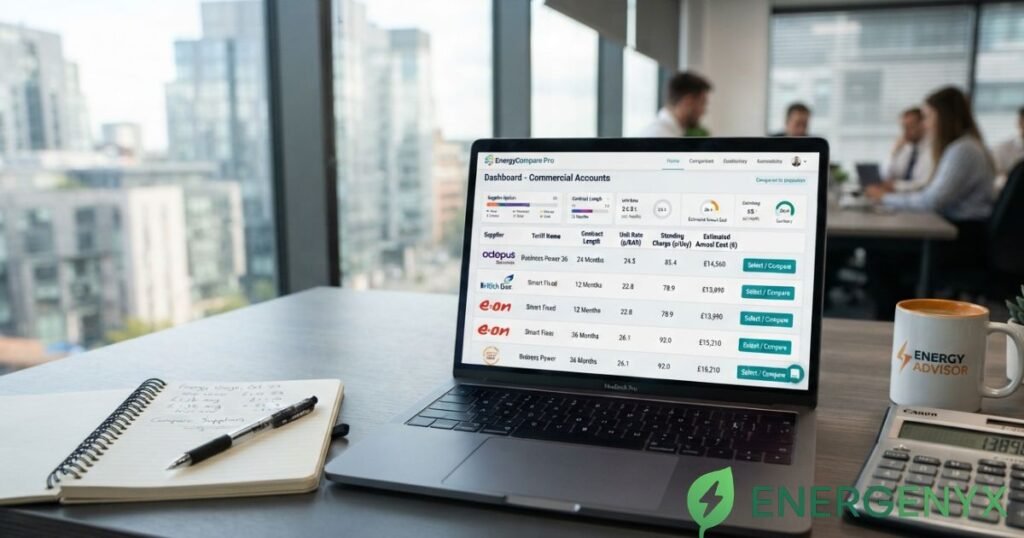
Comparing procurement options involves much more than reviewing headline prices.
Consider the following areas during your evaluation.
Unit Rates
Compare electricity and gas unit rates across suppliers while considering your expected annual consumption.
Standing Charges
Review daily standing charges alongside unit rates to understand the estimated total annual cost.
Contract Length
Choose a contract duration that aligns with your business plans and desired level of budget certainty.
Renewable Energy Options
If sustainability is important to your organisation, compare renewable energy products and environmental commitments offered by suppliers.
Customer Support
Reliable customer service and dedicated business account management can add significant value beyond pricing alone.
Billing and Account Management
Look for features such as:
- Online account portals
- Electronic billing
- Consumption reporting
- Multi-site billing
- Smart meter integration
These services can simplify ongoing energy management.
Common Business Energy Procurement Mistakes
Avoiding common mistakes can improve procurement outcomes.
Focusing Only on Price
Selecting the lowest quotation without reviewing contract terms or customer service may not provide the best long-term value.
Leaving Procurement Too Late
Starting the procurement process shortly before contract expiry can reduce available options and increase time pressure.
Begin reviewing contracts well before renewal.
Ignoring Future Growth
Procurement decisions should reflect not only current energy usage but also expected future business development.
Not Reviewing Energy Usage
Using outdated consumption data may lead to quotations that don’t accurately reflect your current requirements.
Review recent bills and annual consumption before requesting quotes.
Comparing Too Few Suppliers
Obtaining quotations from only one supplier limits your understanding of the commercial energy market.
Comparing several suppliers provides a broader perspective and supports more informed decision-making.
Best Practices for Business Energy Procurement

Successful procurement is an ongoing process rather than a one-time activity.
Many organisations follow these best practices:
- Review contracts well before renewal.
- Monitor energy consumption regularly.
- Keep accurate records of contract dates.
- Compare multiple suppliers.
- Review both pricing and service quality.
- Consider sustainability objectives.
- Evaluate procurement strategies periodically.
- Update procurement plans as business needs evolve.
Following a structured procurement process helps businesses make decisions that support operational efficiency and long-term planning.
Frequently Asked Questions
What is business energy procurement?
Business energy procurement is the process of planning, sourcing, comparing, purchasing, and managing commercial electricity and gas contracts. It involves evaluating suppliers, analysing energy usage, selecting suitable contract structures, and reviewing procurement strategies to support a business’s operational and financial objectives.
Why is energy procurement important?
A structured procurement strategy helps businesses make informed purchasing decisions by considering pricing, contract terms, customer service, sustainability goals, and long-term operational needs. It also supports better budget planning and contract management.
Should small businesses have an energy procurement strategy?
Yes. Although procurement is often associated with large organisations, small businesses can also benefit from understanding their energy usage, comparing multiple suppliers, reviewing contract terms, and planning renewals before contracts expire.
What is the difference between fixed and flexible energy procurement?
Fixed-price procurement locks in agreed unit rates for the duration of the contract, providing greater budget certainty.
Flexible procurement allows energy to be purchased at different times based on market conditions, offering greater purchasing flexibility but requiring closer market monitoring.
The most suitable approach depends on a business’s size, energy consumption, and appetite for market risk.
Should I use an energy broker?
Many businesses choose to work with an energy broker or comparison specialist because they can simplify supplier comparisons, explain contract options, and assist with the procurement process.
Others prefer to negotiate directly with suppliers. The right approach depends on your organisation’s resources, expertise, and procurement requirements.
How often should businesses review their procurement strategy?
Businesses should review their energy procurement strategy regularly, particularly before contract renewal, after significant changes in energy usage, or when expanding into new premises.
Regular reviews help ensure procurement decisions continue to support business objectives.
Final Thoughts
Business energy procurement is an essential part of managing commercial energy effectively.
Rather than focusing solely on price, businesses should consider energy consumption, contract structures, supplier performance, customer service, sustainability goals, and future operational requirements when making procurement decisions.
By taking a structured approach, comparing multiple suppliers, and reviewing procurement strategies regularly, organisations can make informed decisions that support long-term financial planning and operational efficiency.
Whether you’re managing a single site or a large multi-site portfolio, a well-planned procurement strategy can help simplify energy purchasing and improve contract management.
Compare Business Energy Options with Energenyx
Navigating the commercial energy market can be complex, but finding the right contract doesn’t have to be.
At Energenyx, we help UK businesses compare commercial electricity and gas options from trusted suppliers, making it easier to review tariffs, contract structures, renewable energy solutions, and pricing—all in one place.
Whether you’re:
- Procuring energy for the first time
- Renewing an existing contract
- Managing multiple business locations
- Reviewing your procurement strategy
- Comparing commercial energy suppliers
our comparison service is designed to help you make informed decisions with confidence.
Request your free, no-obligation business energy comparison today and explore commercial energy solutions tailored to your organisation’s needs.