
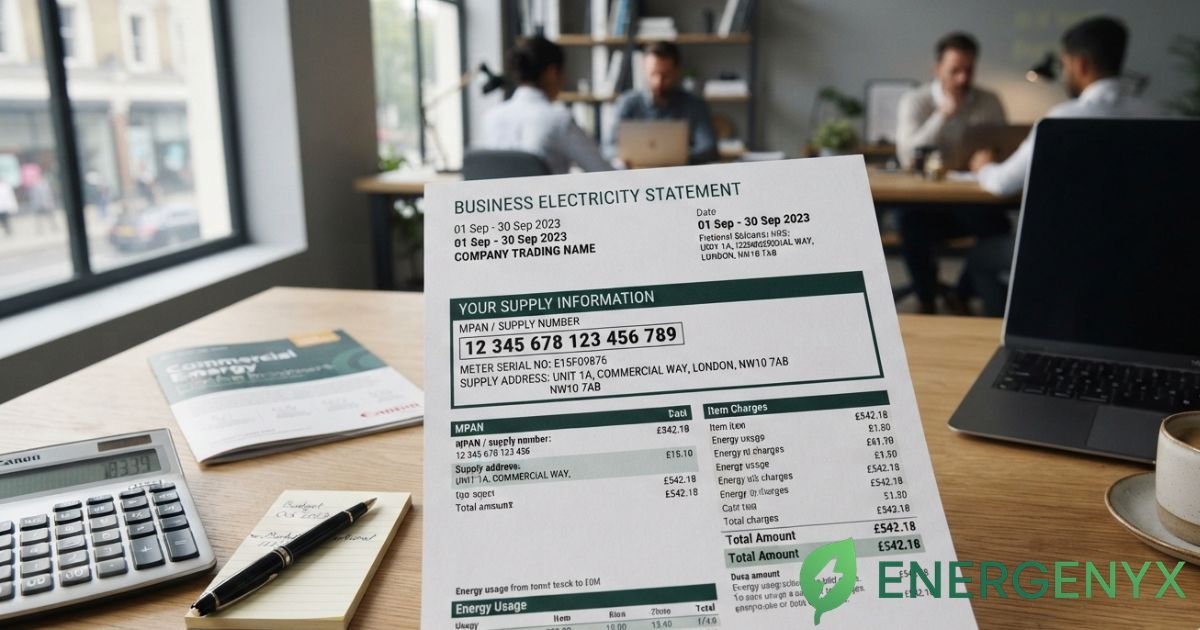
If you run a business in the UK and have ever switched electricity suppliers, requested a business energy quote or tried to resolve a metering issue, you may have been asked for your MPAN.
An MPAN is an important identifier for your electricity supply. It helps energy companies identify the specific electricity supply point associated with your business premises.
You may also see it referred to as a Meter Point Administration Number, Supply Number or S Number.
Understanding what your business electricity MPAN is, where to find it and how it differs from your meter number can make switching suppliers and managing your business energy account much easier.
In this guide, we’ll explain:
- What a business electricity MPAN is
- What an MPAN is used for
- Where to find your MPAN
- What an MPAN looks like
- The difference between an MPAN and meter number
- Whether every business has an MPAN
- How MPANs relate to switching electricity suppliers
- What to do if you can’t find your MPAN
- Common MPAN mistakes
- Frequently asked questions about business electricity MPANs
What Is a Business Electricity MPAN?
MPAN stands for Meter Point Administration Number.
It is the identifier associated with an electricity supply point.
Ofgem describes an MPAN as the number that identifies an electricity supply. It may also be referred to as a Supply Number.
For a business, the MPAN helps identify the electricity supply connected to its premises.
This is important because the physical electricity meter itself is not necessarily the identifier that suppliers use to identify the supply point.
Think of it this way:
Meter = physical equipment
MPAN = identifier for the electricity supply point
This distinction becomes particularly important when you’re changing business electricity suppliers.
What Does MPAN Stand For?
MPAN stands for:
Meter Point Administration Number
It is sometimes referred to as:
- MPAN
- Supply Number
- S Number
- Electricity supply number
You may see different terminology depending on your electricity supplier or electricity commercial broker.
Don’t confuse an MPAN with:
- Your electricity meter serial number
- Your customer account number
- Your business account number
- Your postcode
- Your MPRN
These identify different things.
What Does a Business Electricity MPAN Look Like?
A traditional MPAN is commonly displayed on an electricity bill as an S followed by a structured set of numbers.
A full MPAN is commonly described as a 21-digit identifier, although the way suppliers display it on bills can vary.
You may see something resembling:
S 03 801 240 12 3456 7890 123
The exact numbers will be different for every electricity supply.
Some electricity bills display the information in a boxed format, while others may label it as:
Supply Number
or
Meter Point Administration Number
Because supplier bill layouts differ, don’t worry if your MPAN doesn’t look exactly like an example you have seen online.
The important thing is to identify the correct supply reference.
Where Can I Find My Business Electricity MPAN?
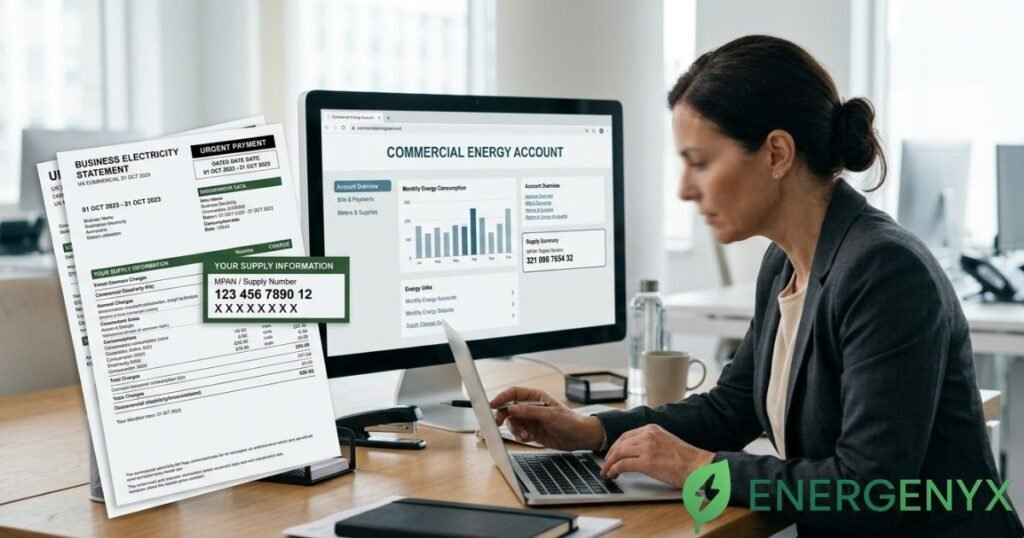
The easiest place to look is usually your business electricity bill.
Depending on your supplier, the MPAN may appear:
- Near your meter details
- In the account information section
- Under “Supply Number”
- Under “MPAN”
- Under “Meter Point Administration Number”
- On your annual statement
- In your online business energy account
Ofgem notes that MPAN information can be found on an energy bill, and businesses can also contact their local network operator if they need help identifying it.
Check Your Latest Electricity Bill
Start with your most recent business electricity bill.
Look for headings such as:
MPAN
Supply Number
Meter Point Administration Number
S Number
The MPAN may not be displayed prominently, so you may need to look through the meter or supply information section.
Check Your Online Energy Account
If your supplier provides an online account, log in and look through your:
- Account details
- Meter information
- Supply information
- Property information
- Electricity contract details
The exact location depends on the supplier.
Ask Your Electricity Supplier
If you still can’t locate the MPAN, contact your supplier.
Have your business name, premises address and customer account information available.
The supplier can help identify the electricity supply associated with your account.
Contact the Relevant Network Operator
If necessary, you may also be able to obtain supply information through the relevant electricity network operator.
This can be particularly useful if you’re dealing with an unusual metering arrangement or don’t have access to historical bills.
Is the MPAN Printed on the Electricity Meter?
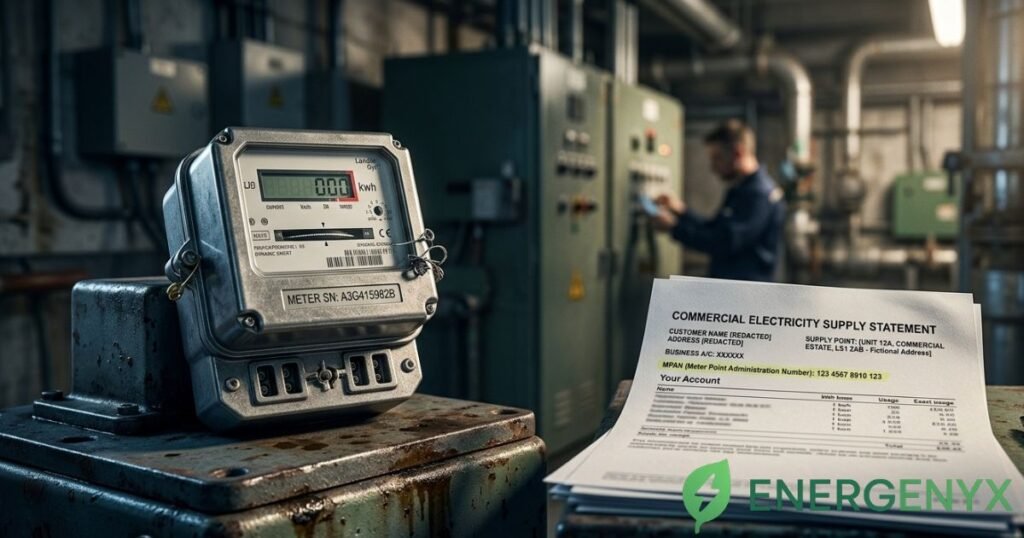
No, generally you should not expect to find the MPAN printed on the physical electricity meter.
The meter itself will normally have its own meter serial number or other equipment identification.
That is different from the MPAN.
This distinction is important.
For example, you might have:
MPAN: identifies the electricity supply point
Meter serial number: identifies the physical meter equipment
A supplier may ask for one or both depending on what you’re trying to do.
If you’re standing in front of your meter trying to find the MPAN, check your electricity bill instead.
What Is the Difference Between an MPAN and a Meter Number?
This is one of the most common sources of confusion for business owners.
MPAN
The MPAN identifies the electricity supply point.
Meter Serial Number
The meter serial number identifies the physical meter equipment.
For example, imagine a business has a meter installed at its premises.
The meter could have a serial number such as:
ABC1234567
Its electricity supply could have an MPAN such as:
S 03 123 456 12 3456 7890 123
These are not interchangeable.
Simple Comparison
| Identifier | What it identifies |
|---|---|
| MPAN | Electricity supply point |
| Meter serial number | Physical electricity meter |
| Customer account number | Supplier customer account |
| MPRN | Gas supply point |
| Postcode | Property location |
Knowing the difference can prevent mistakes when arranging a new business electricity contract.
What Is the Difference Between MPAN and MPRN?
Another common question is whether an MPAN and MPRN are the same thing.
They aren’t.
MPAN
MPAN = electricity
MPRN
MPRN = gas
Ofgem explains that an MPAN identifies an electricity supply, while an MPRN performs the equivalent role for a gas supply.
So if you’re switching your business electricity supplier, you may be asked for your MPAN.
If you’re switching your business gas supplier, you may instead need your MPRN.
Businesses that have both electricity and gas should keep both references available.
Why Is an MPAN Important for a Business?
Your MPAN is particularly useful because it helps identify the correct electricity supply.
This matters when dealing with:
Switching Electricity Suppliers
When changing business electricity supplier, accurate supply information helps ensure the correct premises and supply are associated with the new contract.
Getting Business Electricity Quotes
An energy supplier or broker may ask for information about your electricity supply when preparing a quotation.
Depending on the business and metering arrangement, other information may also be required.
Moving Business Premises
If you’re moving into a new commercial property, understanding the electricity supply information can help when arranging energy.
Resolving Billing Problems
If there’s a discrepancy involving the wrong meter, premises or supply, having the correct supply information can help when communicating with your supplier.
Managing Multiple Sites
Businesses with multiple locations may have several electricity supply points.
Keeping accurate records can help prevent confusion between different premises.
Do Businesses Have More Than One MPAN?
Yes.
A business can have multiple MPANs if it has multiple electricity supply points.
For example, a company operating:
- A head office
- A warehouse
- A retail shop
- A workshop
may have separate electricity supplies associated with different premises.
A single commercial site can also have more complex metering arrangements.
This is why businesses should not assume that one MPAN applies to every location they operate.
What If My Business Has Multiple Electricity Meters?
If your business premises has multiple electricity meters, don’t automatically assume that each physical meter corresponds to a separate MPAN in a simple one-to-one relationship.
Commercial metering arrangements can be more complicated.
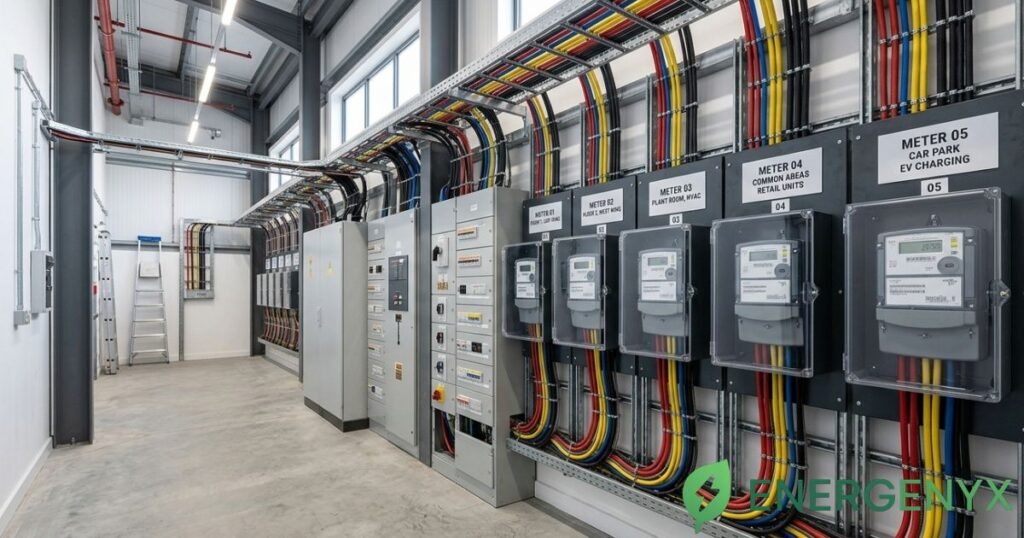
For example, a site could have:
- Multiple meters
- Multiple supplies
- Multi-rate metering
- Half-hourly metering
- Advanced meters
- Sub-metering
If you’re unsure which MPAN relates to which supply, ask your supplier or energy broker to confirm the arrangement.
This is especially important before signing a new electricity contract.
Is an MPAN the Same as an Electricity Meter Number?
No.
This distinction is worth repeating because the terms are sometimes used incorrectly.
Your meter number generally refers to the serial number associated with the physical meter.
Your MPAN identifies the electricity supply point.
When a supplier asks for an MPAN, don’t simply provide the serial number printed on the front of your electricity meter.
Check your electricity bill or supplier account instead.
How Does an MPAN Help When Switching Business Electricity Supplier?
When switching electricity suppliers, the correct supply information helps the industry identify the supply being transferred.
Ofgem explains that business energy contracts are normally arranged for the energy a business uses, and suppliers use supply and metering information as part of the energy market processes.

Your MPAN can therefore be useful when:
- Requesting business electricity quotes
- Comparing suppliers
- Starting a new contract
- Changing supplier
- Checking the correct supply
- Resolving account discrepancies
However, your MPAN isn’t the only information that may be needed.
A supplier or broker may also ask for:
- Business name
- Supply address
- Current supplier
- Current tariff
- Contract end date
- Annual electricity consumption
- Meter type
- Meter readings
- Business contact details
For a competitive quote, accurate consumption information can be just as important as identifying the correct supply.
Does an MPAN Tell You How Much Electricity You Use?
No.
An MPAN identifies your electricity supply point.
It doesn’t tell you how much electricity your business has consumed.
Your electricity consumption is measured by your electricity meter and expressed in units such as kilowatt-hours (kWh).
For example:
MPAN: identifies the supply
Meter reading: shows cumulative consumption
kWh usage: represents electricity consumed over a period
This is why your MPAN and meter reading serve completely different purposes.
If you’re interested in understanding your electricity consumption, see our guide on how to read a business electricity meter.
Does the MPAN Show Your Electricity Tariff?
No.
An MPAN doesn’t tell you whether you’re on:
- A fixed tariff
- A variable tariff
- A flexible contract
- A time-of-use tariff
- Another business electricity arrangement
Your electricity contract and supplier account contain information about your tariff and pricing.
Your MPAN is primarily an identifier for the electricity supply.
What Are the Numbers Within an MPAN?
The traditional MPAN format contains different pieces of information associated with the electricity supply.
The full structure can contain information relating to the supply’s characteristics and identifying reference.
However, you generally shouldn’t try to interpret every digit yourself when switching suppliers.
The safest approach is to provide the MPAN exactly as shown on your bill or use the supply information requested by your supplier or broker.
This is particularly important because industry arrangements and metering systems can evolve.
What Are Profile Classes and How Do They Relate to MPANs?
Some business electricity supplies have information associated with their profile class.
Historically, profile classes have helped categorise electricity consumption patterns for certain non-half-hourly supplies.
Ofgem guidance notes that the first two digits of the Supply Number can indicate profile-class information in relevant circumstances.
For example, Ofgem explains that certain supplies with numbers beginning 05, 06, 07 or 08 have been associated with half-hourly readings in specific business metering arrangements.
However, businesses shouldn’t assume that they can determine their complete metering arrangement simply by looking at the first two digits.
Modern metering and electricity-market arrangements are evolving, including changes associated with Market-wide Half-Hourly Settlement.
If you need to know whether your business has half-hourly metering, ask your supplier or energy broker to confirm.
What Is a Half-Hourly Electricity Supply?
Some businesses have electricity supplies where consumption data is recorded at half-hourly intervals.
This can provide much more detailed information about when electricity is being consumed.
Ofgem notes that, for certain business supplies, electricity usage is recorded every half hour as part of the settlement process.
Half-hourly data can be particularly relevant to businesses with significant or variable electricity consumption.
Examples might include:
- Manufacturing facilities
- Large offices
- Retail premises
- Warehouses
- Hotels
- Leisure facilities
- Industrial sites
The exact metering arrangement depends on the supply and the applicable market arrangements.
Can I Find My MPAN Without an Electricity Bill?
It may be possible, but your electricity bill is usually the simplest starting point.
If you don’t have a bill, you can:
- Contact your current supplier.
- Check your supplier’s online account.
- Ask your energy broker if they have the supply information.
- Contact the relevant electricity network operator where appropriate.
Have your business premises address and other account details ready.
If you’ve recently moved into a property, you may also need to establish which supplier currently supplies the premises before arranging a new contract.
What If I Can’t Find My Business Electricity MPAN?

Don’t panic.
This is relatively common, particularly when:
- You’ve recently moved premises
- You’re a new tenant
- You don’t have historical bills
- The previous occupier arranged the energy
- The building has multiple meters
- The site has a complicated metering setup
Start by contacting the current electricity supplier.
Explain that you need the MPAN for the business electricity supply associated with your premises.
If the supplier cannot resolve the issue, you may need to contact the relevant network operator or ask an energy broker for assistance.
What If the MPAN on My Bill Looks Wrong?
If you believe the MPAN on your bill doesn’t correspond to your business premises, don’t ignore it.
Contact your supplier and ask them to investigate.
This is particularly important if:
- The meter number doesn’t match
- The address appears incorrect
- You’re receiving bills for unexpected consumption
- You’ve recently moved premises
- Another business occupies part of the building
- Your site has multiple electricity supplies
Take photographs of your meter and keep copies of relevant bills and correspondence.
This can provide useful information when investigating a potential account or metering issue.
What If Two Businesses Share a Building?
Shared commercial buildings can create additional complexity.
For example, an office building could contain:
- Multiple businesses
- Shared electricity supplies
- Separate meters
- Sub-meters
- Landlord-controlled supplies
A business should not assume that the electricity meter closest to its office is necessarily its dedicated supply.
If you’re renting commercial premises, check your lease, landlord information and electricity account carefully.
If you’re responsible for your own electricity contract, make sure you know which supply you’re actually paying for.
What Is an MPAN Used for When Moving Business Premises?
Moving premises can involve several energy-related tasks.
Before leaving your old property, consider recording:
- Final meter reading
- Meter photograph
- MPAN
- Current supplier
- Contract details
- Final billing information
At the new premises, establish:
- Current electricity supplier
- Meter details
- MPAN
- Meter reading
- Supply arrangement
- Contract status
Taking accurate meter readings around the move can help reduce disputes about consumption between occupiers.
Ofgem also recommends taking a meter reading in certain business energy situations, including when a supplier fails and a new supplier is appointed.
MPAN Checklist for Business Owners
If you’re dealing with your business electricity supply, keep the following information together:
- MPAN
- Electricity meter serial number
- Business premises address
- Current electricity supplier
- Customer account number
- Current meter reading
- Annual electricity consumption
- Contract start date
- Contract end date
- Latest electricity bill
- Meter photographs
Keeping these details together can make future supplier comparisons and energy administration much easier.
Common Business Electricity MPAN Mistakes
Mistake 1: Confusing the MPAN With the Meter Number
The MPAN identifies the electricity supply; the meter serial number identifies the physical meter.
They are different.
Mistake 2: Giving Your Customer Account Number Instead
Your customer account number is assigned by your supplier.
It isn’t the same as your MPAN.
Mistake 3: Assuming Every Meter Has Its Own Simple MPAN
Commercial sites can have complicated metering arrangements.
If you have multiple meters, confirm which supply information applies to each one.
Mistake 4: Guessing the MPAN
Don’t try to construct an MPAN from memory.
Use the information shown on your electricity bill or obtain confirmation from your supplier.
Mistake 5: Ignoring the MPAN When Switching
Although suppliers and brokers can often obtain supply information through industry systems, having your MPAN available can make the process easier and reduce confusion.
Mistake 6: Confusing MPAN With MPRN
Remember:
MPAN = electricity
MPRN = gas
Business Electricity MPAN FAQs
What is a business electricity MPAN?
A business electricity MPAN, or Meter Point Administration Number, is an identifier associated with an electricity supply point. It is also commonly called a Supply Number or S Number.
Where can I find my business electricity MPAN?
Your MPAN is usually shown on your business electricity bill. Depending on your supplier, it may appear under headings such as MPAN, Supply Number, Meter Point Administration Number or S Number.
Is an MPAN the same as a meter number?
No. The MPAN identifies the electricity supply point, while the meter serial number identifies the physical electricity meter.
Is an MPAN the same as an MPRN?
No. An MPAN relates to electricity, while an MPRN relates to gas.
How many digits is an MPAN?
A traditional full MPAN is commonly a 21-digit identifier, usually displayed with an initial S and arranged into sections. The way suppliers display supply information can vary.
Can I find my MPAN on my electricity meter?
Generally, no. The physical meter normally has its own serial number. Your MPAN is usually found on your electricity bill or through your supplier.
Do I need an MPAN to switch business electricity supplier?
An MPAN can be useful when switching because it identifies the electricity supply point. However, suppliers and brokers may be able to obtain supply information through industry systems, and they may request additional information such as your address, meter details and consumption.
Does my MPAN tell me how much electricity I use?
No. The MPAN identifies your electricity supply. Your meter records electricity consumption, normally measured in kWh.
Does every business have an MPAN?
Electricity supplies are associated with MPANs, but businesses can have different and sometimes complex metering arrangements. A business with multiple sites may have multiple electricity supply points and therefore multiple MPANs.
What should I do if I can’t find my MPAN?
Check your latest electricity bill or online supplier account first. If you still can’t find it, contact your electricity supplier and provide your business premises details.
Can an energy broker find my MPAN?
An energy broker may be able to obtain or verify supply information using industry systems and information you provide. However, the exact process depends on the broker and circumstances.
Can I use my MPAN to compare business electricity prices?
Your MPAN can help identify the electricity supply being quoted, but it isn’t enough on its own to determine the best tariff. Suppliers or brokers may also need information about your consumption, current contract and other characteristics of the supply.
Final Thoughts
Your business electricity MPAN may look like just a long string of numbers on an electricity bill, but it plays an important role in identifying your electricity supply.
Understanding the difference between your MPAN, meter number, customer account number and MPRN can save time when dealing with suppliers, brokers and energy contracts.
If you’re switching business electricity suppliers, moving premises or investigating a billing issue, keep your MPAN together with your meter details, recent meter readings and electricity bills.
Most importantly, don’t confuse the MPAN with the physical meter number. The meter measures your electricity consumption, while the MPAN identifies the electricity supply point.
Once you know which electricity supply you’re dealing with, the next step is understanding how much electricity your business uses and how much you’re paying for it.
If your business electricity contract is approaching renewal, this is also a good opportunity to review your current tariff and compare available business electricity options.