
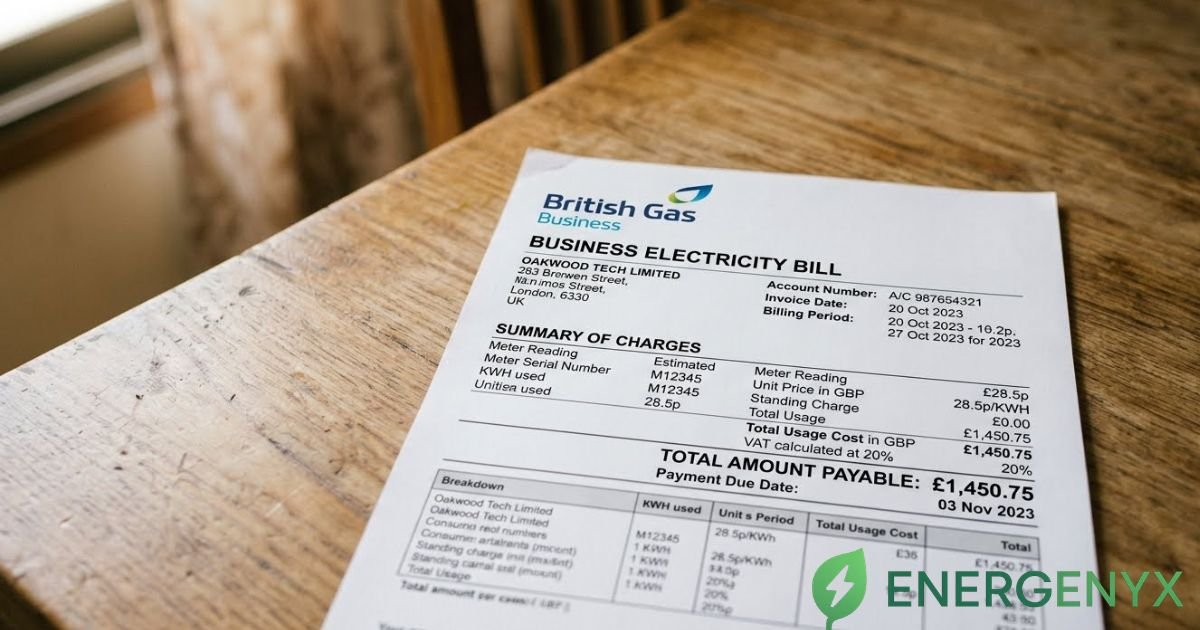
Understanding a business electricity bill can be surprisingly difficult. Unlike a simple household bill, a commercial electricity invoice can contain multiple charges, meter information, taxes, contract details and other costs.
For a business owner, understanding these figures matters because an electricity bill isn’t simply the amount of electricity you’ve used multiplied by a price.
Your bill can include electricity consumption charges, standing charges, taxes, network-related costs, government schemes and levies, supplier costs and other applicable charges. Ofgem confirms that the exact information shown depends on factors such as your business size, contract type, meter type and supplier.
This guide explains how to read a business electricity bill, what the main sections mean, why your bill can change and what you should check before paying it.
Important: Business electricity contracts and bills vary between suppliers. The examples in this guide are illustrative and should not be treated as current quotations or a substitute for checking your own contract.
What Is a Business Electricity Bill?
A business electricity bill is an invoice from your energy supplier showing the charges associated with supplying electricity to your business premises for a particular billing period.
Depending on your supplier and contract, it may show information such as:
- Account details
- Supply address
- Meter information
- Billing period
- Previous and current meter readings
- Electricity consumption in kWh
- Unit rate
- Standing charge
- Additional charges
- VAT and other taxes
- Amount owed
- Payment due date
- Contract information
Not every business electricity bill looks the same. Ofgem states that the information included can vary according to the size of the business, energy contract, meter type and supplier.
Why Should Businesses Understand Their Electricity Bills?

Understanding your bill can help you identify:
- Unexpected increases in consumption
- Incorrect meter readings
- Changes in your unit rate
- Higher standing charges
- Additional charges
- Contract changes
- Billing errors
- Unusual consumption patterns
It can also help you determine whether you’re paying for more electricity than your business actually needs.
For example, if your electricity consumption suddenly increases by 30% but your business hasn’t changed its operating hours or equipment, that’s worth investigating.
Your electricity bill can therefore be more than just an invoice — it can be a useful source of information about how your business uses energy.
What Information Is Usually on a Business Electricity Bill?
Although the layout varies by supplier, most commercial electricity bills provide several key pieces of information.
Let’s look at the most important ones.
1. Billing Period
The billing period tells you the dates covered by the invoice.
For example:
1 July – 31 July
This means the bill relates to electricity supplied during that period.
Always check the billing dates because they affect how much electricity should have been included.
If you’re comparing bills, make sure you’re comparing similar periods.
A 60-day bill will naturally contain more consumption than a 30-day bill, assuming similar usage patterns.
2. Electricity Consumption

Electricity consumption is normally measured in kilowatt-hours (kWh).
A kWh is the unit used to measure the amount of electrical energy consumed.
For example, if your business uses:
10,000 kWh
during a billing period, your supplier will use that consumption figure as part of the calculation of your electricity charges.
Ofgem confirms that business electricity usage is measured in kilowatt-hours and that the unit rate is the price charged per kWh.
3. Electricity Unit Rate
The unit rate is the price your business pays for each kWh of electricity under the applicable tariff.
For understanding electricity unit rate we can take an example, if your unit rate were:
25p per kWh
and your business used:
10,000 kWh
the simplified electricity consumption charge would be:
10,000 × £0.25 = £2,500
This is only an illustrative calculation.
Your actual bill may include other charges, taxes and adjustments.
The unit rate is one of the most important numbers to check when comparing business electricity contracts.
4. Standing Charge
The standing charge is a fixed charge applied for each day of the billing period, regardless of how much electricity you consume.
For example, if a hypothetical standing charge were:
£1 per day
and the billing period contained 30 days:
30 × £1 = £30
The standing charge would therefore contribute £30 to the bill before other applicable charges.
Ofgem identifies the standing charge as one of the costs that can appear on business energy bills.
The standing charge is particularly important when comparing tariffs because a business with low electricity consumption can be relatively more affected by daily fixed charges.
5. Meter Readings
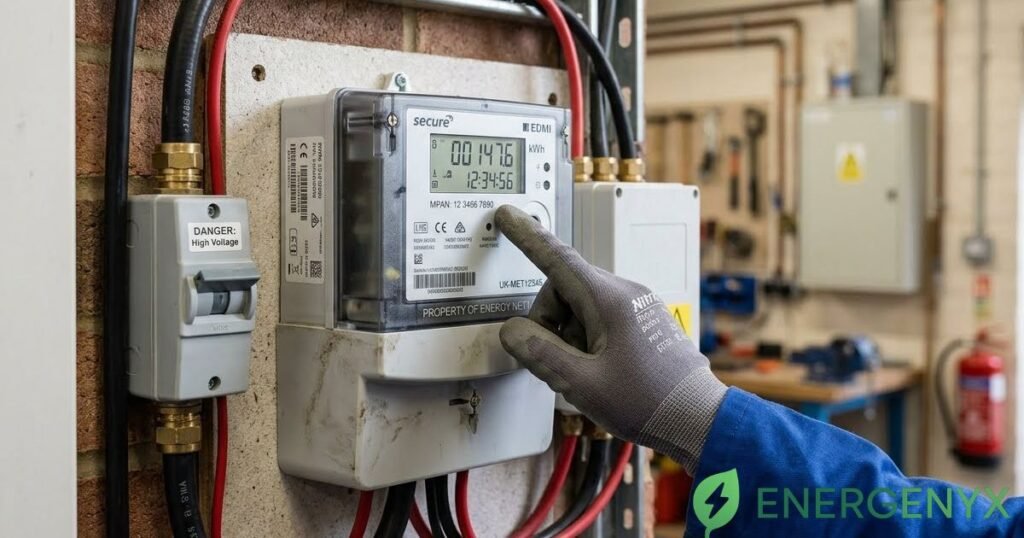
Your electricity bill may show the meter reading used to calculate your consumption.
Depending on your meter and business arrangement, the supplier may use:
- Actual meter readings
- Smart meter data
- Half-hourly data
- Estimated readings
The exact billing process depends on the type of meter and contract.
Ofgem explains that some businesses have half-hourly metering, while other businesses may have different meter arrangements.
If you see an unexpected change in your bill, checking the meter information can be a useful first step.
Actual vs Estimated Electricity Readings
One of the most important things to understand is whether your bill is based on an actual reading or an estimate.
Actual Reading
An actual reading comes from the electricity meter or relevant metering data.
Estimated Reading
An estimated reading is calculated by the supplier when an actual reading isn’t available.
An estimated bill may not accurately reflect your real consumption.
If you receive an estimated bill, check your meter and provide an actual reading to your supplier where appropriate.
This can help prevent your account balance from becoming significantly different from your actual usage.
6. Previous and Current Meter Readings
Some bills show both:
Previous reading
and
Current reading
The difference between the relevant readings can help determine electricity consumption.
For example:
Previous reading: 125,000 kWh
Current reading: 137,000 kWh
Consumption:
137,000 − 125,000 = 12,000 kWh
However, commercial metering can be more complicated than a simple meter-reading subtraction, particularly where different registers, multipliers or half-hourly arrangements apply.
If the figures don’t make sense, contact your supplier rather than assuming the calculation is wrong.
7. VAT
VAT can appear on a business electricity bill depending on the circumstances and applicable rules.
The standard VAT rate in the UK is currently 20%, while certain energy supplies can qualify for a reduced rate under specific conditions.
Businesses should therefore check the VAT treatment shown on their invoice rather than automatically assuming that every electricity bill has the same VAT rate.
If your business believes it qualifies for a special VAT treatment, check the relevant HMRC rules and documentation requirements.
8. Climate Change Levy
Some business electricity bills can include the Climate Change Levy (CCL).
CCL is an environmental tax applied to energy supplied to businesses and certain other non-domestic users, subject to applicable exemptions and reliefs.
Whether and how it appears on your bill depends on your circumstances and the relevant tax rules.
Ofgem lists CCL among the taxes that can contribute to business energy expenditure.
9. Government Schemes and Levies
Your business electricity costs can also include costs associated with government schemes and industry mechanisms.
Ofgem lists examples including:
- Renewable Obligations
- Contracts for Difference
- Feed-in Tariffs
- Renewable Energy Guarantees of Origin
- Other applicable schemes and levies
The exact charges included depend on the circumstances of the business and the contract.
You don’t necessarily need to understand every industry mechanism in detail, but you should know that your electricity bill can contain costs beyond the basic unit rate.
10. Network Charges
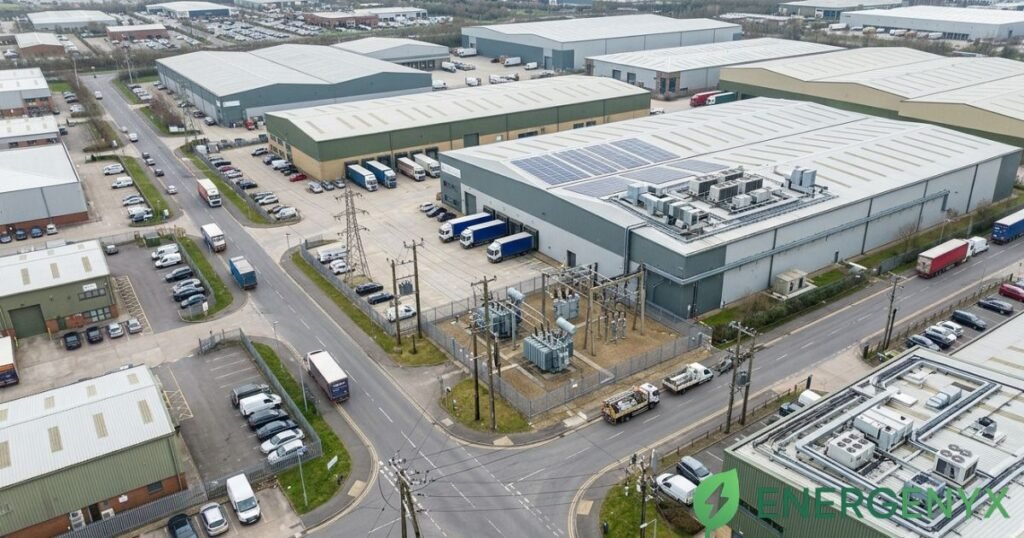
Electricity needs to travel through the UK’s electricity network before reaching your business premises.
Business energy costs can therefore include network-related charges.
Ofgem identifies several network costs that can contribute to business electricity pricing, including:
- Transmission Network Use of System charges
- Distribution Use of System charges
- Balancing Services Use of System charges
- Transmission and distribution losses
- Reactive power charges
- Other applicable network-related costs
The way these costs are presented can vary between suppliers and contracts.
11. Meter-Related Charges
Depending on the type of commercial meter and contract, your bill may include charges associated with operating and maintaining the metering equipment.
Ofgem identifies Meter Operator Charges (MOP) among possible business energy costs. These relate to providing and maintaining certain electricity metering equipment and associated communications.
This is one reason why two businesses with similar electricity consumption can still have different overall electricity costs.
12. Broker or Commission-Related Costs
If your business uses an energy broker or intermediary, the supplier contract may include costs associated with brokerage or sales commission.
Ofgem lists third-party services such as sales commissions and brokerage among potential business energy costs.
If you’re using a broker, ask clearly:
- How are you paid?
- Is commission included in the tariff?
- Is there a separate fee?
- Which suppliers do you work with?
- Is the fee refundable?
- Does the quoted price include all brokerage costs?
Transparency is particularly important when comparing different electricity deals.
13. Contract Information
Your business electricity bill may also contain information about your current contract.
This could include:
- Supplier name
- Tariff name
- Contract start date
- Contract end date
- Account number
- Supply number
- Meter details
Your contract end date is particularly important.
If your fixed-term agreement is approaching expiry, you should review your options before the contract ends.
Ofgem states that business energy contracts can last for several years and that many suppliers restrict switching before the existing contract ends.
What Is a Supply Number on a Business Electricity Bill?
Your business electricity bill may contain a supply number or Meter Point Administration Number (MPAN).
The MPAN identifies the electricity supply point associated with the premises.
It is useful when dealing with suppliers and switching electricity contracts.
Because commercial electricity supplies can have more complex metering arrangements, you should use the information shown on your own bill rather than trying to identify your supply solely from the physical meter.
How Is a Business Electricity Bill Calculated?
A simplified electricity bill calculation might look like:
Electricity consumption × unit rate
plus:
standing charges
plus:
other applicable charges
plus:
taxes
For example, consider a hypothetical business using:
10,000 kWh
at:
25p per kWh
Its simplified consumption charge would be:
10,000 × £0.25 = £2,500
If its standing charge were £1 per day for 30 days:
30 × £1 = £30
Subtotal:
£2,530
Additional charges and applicable taxes would then need to be considered.
This is a simplified illustration, not a representation of an actual supplier invoice.
Why Has My Business Electricity Bill Increased?
There are several possible reasons.
1. Your Business Used More Electricity
If your electricity consumption increased, your bill may rise even if the unit rate stayed the same.
For example:
Previous consumption: 10,000 kWh
New consumption: 12,000 kWh
At a hypothetical 25p/kWh:
Previous usage cost:
£2,500
New usage cost:
£3,000
The difference is:
£500
2. Your Electricity Unit Rate Increased
If the price per kWh increases, your bill can rise even when consumption remains unchanged.
For example:
10,000 kWh × £0.25 = £2,500
10,000 kWh × £0.28 = £2,800
The additional £300 comes from the higher unit rate.
3. Your Standing Charge Changed
A change in your daily standing charge can also affect the total bill.
This is particularly noticeable over longer billing periods.
4. An Estimated Bill Was Corrected
A supplier may later replace an estimated reading with an actual reading.
That can create a noticeable adjustment on a subsequent invoice.
5. Your Contract Changed
Your business electricity tariff may have changed because:
- Your fixed contract ended
- You renewed
- You switched tariff
- Your supplier changed certain charges
- Your contract included variable components
Always check the contract terms if your pricing suddenly changes.
6. Your Business Changed Its Operating Pattern
Electricity consumption can increase because your business:
- Extended opening hours
- Added equipment
- Increased production
- Expanded premises
- Added refrigeration
- Introduced air conditioning
- Increased staff numbers
- Changed working patterns
Even seemingly small operational changes can increase annual electricity consumption.
Why Is My Electricity Bill Higher Than Last Month?
Don’t automatically assume that a higher bill means your supplier has made a mistake.
First compare:
Billing Period
Was this bill for more days?
Consumption
Did your kWh usage increase?
Unit Rate
Did the price per kWh change?
Standing Charge
Did the daily charge change?
Meter Reading
Was this bill based on an actual or estimated reading?
Other Charges
Were additional costs included?
Comparing these figures can help identify the reason for the increase.
How to Check Whether Your Business Electricity Bill Is Correct

Use this simple process.
Step 1: Check the Billing Dates
Confirm the bill covers the expected period.
Step 2: Check the Meter Reading
Compare the reading shown on the bill with your actual meter data where appropriate.
Step 3: Check Consumption
Look at the number of kWh charged.
Step 4: Check the Unit Rate
Confirm the rate matches your agreed contract.
Step 5: Check the Standing Charge
Confirm the daily charge and number of days billed.
Step 6: Check Additional Charges
Look for taxes, levies, network-related costs and other charges.
Step 7: Check VAT
Confirm that the VAT treatment appears consistent with your circumstances.
Step 8: Contact Your Supplier
If something still doesn’t make sense, ask your supplier for a detailed explanation.
Keep copies of your bills and meter readings so you can demonstrate what you believe is incorrect.
What Should You Do If Your Business Electricity Bill Is Wrong?
If you believe your electricity bill contains an error, contact your supplier as soon as possible.
Explain:
- What you believe is incorrect
- Which billing period is affected
- Your meter reading
- The reading shown on the bill
- The amount you believe should have been charged
- Any supporting evidence
Keep records of your communications.
If the issue isn’t resolved, follow your supplier’s formal complaints process. Ofgem provides guidance for businesses dealing with energy suppliers and complaints.
How Can You Reduce Your Business Electricity Bill?
Understanding your bill is the first step.
Once you know what’s driving your costs, you can look for ways to reduce them.
Potential strategies include:
- Reducing unnecessary electricity consumption
- Improving lighting efficiency
- Using efficient equipment
- Managing heating and cooling
- Reviewing your standing charge
- Comparing electricity tariffs
- Reviewing your contract before renewal
- Monitoring electricity consumption
- Considering renewable generation where appropriate
For a detailed guide, see our article on how to reduce business electricity costs.
This distinction is important:
Understanding your bill → identifying the cost drivers → taking action.
Business Electricity Bill vs Domestic Electricity Bill
Business electricity bills can differ significantly from household electricity bills.
Businesses may have:
- Different contract structures
- Different metering arrangements
- Different consumption levels
- Different network charges
- Commercial contract terms
- Broker-related costs
- More complex billing arrangements
Most importantly, the domestic energy price cap does not protect businesses with business energy contracts. Ofgem explicitly states that businesses are not covered by the domestic energy price cap.
This is one reason businesses should actively review their electricity contracts rather than assuming that domestic energy pricing rules apply to them.
Do Businesses Pay VAT on Electricity?
Businesses can be charged VAT on electricity, but the applicable treatment depends on the circumstances.
HMRC states that electricity supplied for non-qualifying use is normally standard-rated, while qualifying uses and certain small quantities can be eligible for the reduced rate.
For this reason, don’t assume that every business pays exactly the same VAT rate.
If you’re unsure whether your business qualifies for reduced-rate treatment, check the current HMRC rules or speak with your accountant. You can also read, HMRC’s guidance on VAT for fuel and power.
How Often Should a Business Check Its Electricity Bill?
You should ideally review every electricity bill rather than only checking when something looks wrong.
A quick monthly review can help you spot:
- Unexpected consumption
- Rate changes
- Billing errors
- Estimated readings
- Unusual charges
- Contract changes
For larger or energy-intensive businesses, monitoring consumption more frequently can provide better insight.
The earlier you identify an unusual pattern, the easier it can be to investigate.
Business Electricity Bill Checklist
Before paying your next electricity bill, check:
- Billing period
- Supply address
- Meter details
- Previous reading
- Current reading
- Actual or estimated reading
- Electricity consumption in kWh
- Unit rate
- Standing charge
- Additional charges
- Network-related charges where applicable
- Taxes and levies
- VAT
- Contract details
- Amount due
- Payment deadline
This takes only a few minutes but can help you catch unusual charges before they become recurring problems.
Business Electricity Bill FAQs
What is a business electricity bill?
A business electricity bill is an invoice showing the costs associated with supplying electricity to your business premises during a particular billing period.
What is a kWh on a business electricity bill?
A kilowatt-hour (kWh) is the unit used to measure electricity consumption. Your electricity unit rate is normally expressed as a price per kWh.
What is the unit rate on a business electricity bill?
The unit rate is the amount charged for each kWh of electricity consumed under your tariff.
What is the standing charge on a business electricity bill?
The standing charge is a daily charge that applies separately from the electricity you consume. The amount and structure depend on your contract.
Why has my business electricity bill increased?
Your bill can increase because of higher electricity consumption, a higher unit rate, changes to standing charges, adjustments to estimated readings, additional charges or changes to your contract.
What is an estimated electricity bill?
An estimated bill is calculated using an estimate of your electricity consumption when the supplier doesn’t have an actual reading or relevant metering data.
How can I check if my business electricity bill is correct?
Check the billing period, meter readings, electricity consumption, unit rate, standing charge, additional charges and applicable taxes. If something doesn’t match your records, contact your supplier.
Does the energy price cap apply to business electricity?
No. Ofgem states that businesses with business energy contracts are not protected by the domestic energy price cap.
Can I dispute a business electricity bill?
Yes. If you believe your bill is incorrect, contact your supplier and provide the relevant meter readings, billing information and supporting evidence.
How can I lower my business electricity bill?
You can potentially lower your bill by reducing electricity consumption, improving energy efficiency, reviewing your tariff, comparing suppliers and monitoring your energy use.
Final Thoughts
Your business electricity bill contains much more information than simply the amount you owe.
By understanding kWh consumption, unit rates, standing charges, meter readings, taxes, network costs and other charges, you can get a much clearer picture of what you’re actually paying for.
Regularly checking your bills can also help you identify unusual consumption, billing errors and changes to your contract before they become expensive problems.
The most important numbers to understand are:
How much electricity did you use?
What did you pay per kWh?
What was your standing charge?
What other charges were added?
Does everything match your contract and meter information?
Once you understand those figures, you can make better decisions about reducing consumption, reviewing your tariff and comparing business electricity deals.
For businesses looking to reduce costs, understanding the bill should be the starting point — not the end.
Ofgem’s business energy guidance is a useful reference when checking the different costs and information that can appear on a commercial energy bill.
Think Your Business Electricity Bill Is Too High?
Understanding your electricity bill is the first step—but you may also be able to reduce what you’re paying.