

Introduction
Choosing the right business energy contract can have a significant impact on your operating costs. Whether you’re renewing an existing agreement, moving into new premises, or switching suppliers, taking the time to compare business energy quotes can help you understand the options available and select a contract that suits your business.
The UK business energy market offers a wide range of suppliers, tariff types, and contract lengths. While this gives businesses more choice, it can also make comparing quotes more challenging. Looking only at the headline price may not provide the full picture, as factors such as standing charges, contract terms, customer support, and tariff structure can all influence the overall value of a contract.
By following a structured comparison process, businesses can make more informed decisions and avoid common mistakes such as automatic renewals or choosing a contract based solely on the lowest unit rate.
In this guide, we’ll explain how to compare business energy quotes step by step, what information you’ll need before requesting quotes, what to look for when reviewing offers, and how to choose the contract that best fits your business’s needs.
Key Takeaways
Before diving into the comparison process, here are the key points to remember:
- Compare multiple business energy suppliers rather than accepting the first quote.
- Gather your recent energy bill and contract information before requesting quotations.
- Compare unit rates, standing charges, contract lengths, and customer service—not just price.
- Start comparing quotes well before your contract expires.
- Review the total estimated annual cost rather than focusing only on the unit rate.
- Understand your business’s energy usage before choosing a tariff.
Why Comparing Business Energy Quotes Matters
Many businesses remain on the same energy contract for years without reviewing the wider market. However, energy prices, supplier offerings, and business requirements can all change over time.
Comparing quotes allows you to understand what’s currently available and decide whether your existing contract still meets your needs.
Potential Cost Savings
Business energy prices vary between suppliers and contracts.
By comparing several quotations, you may identify tariff options that better match your business’s energy consumption and operational requirements.
Rather than accepting an automatic renewal offer, reviewing the market provides greater visibility of the available options.
Better Contract Options
Price is only one part of an energy contract.
Comparing suppliers also allows you to review:
- Fixed and variable tariffs
- Contract lengths
- Renewable energy options
- Billing features
- Customer support
- Online account management
Choosing the right combination of features may deliver better long-term value than focusing solely on the lowest advertised price.
Avoiding Automatic Renewals
Some business energy contracts include renewal provisions if no action is taken before the contract ends.
Starting the comparison process early gives you more time to:
- Review suppliers
- Compare tariffs
- Understand contract terms
- Make a well-informed decision
Planning ahead reduces the pressure of making decisions close to your contract expiry date.
What Information Do You Need Before Comparing Quotes?
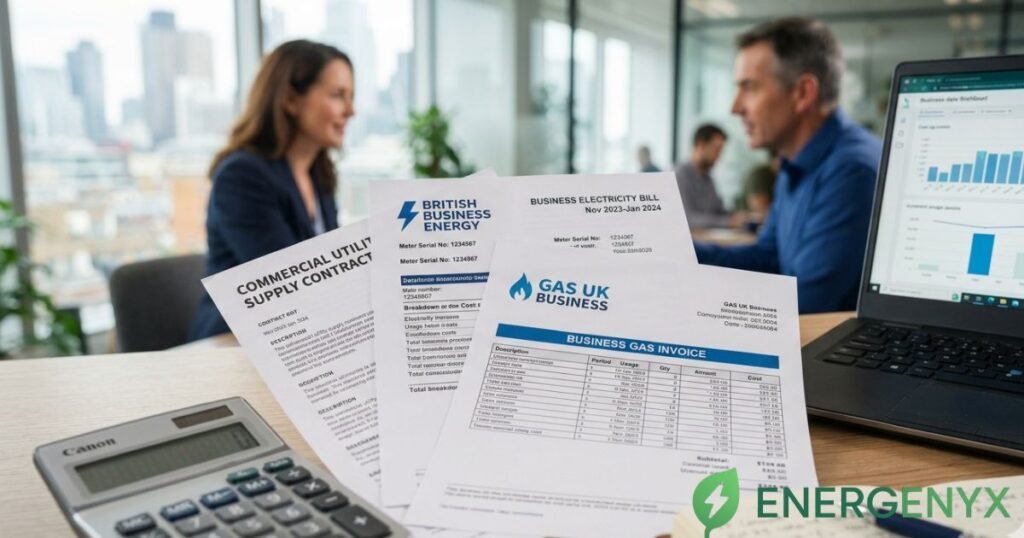
Preparing the right information before requesting quotations helps suppliers provide more accurate estimates.
The following details are commonly requested.
Business Name and Address
Suppliers need the address of the business premises receiving the energy supply.
If your organisation operates from multiple locations, prepare the details for each site.
Recent Business Energy Bill
Your latest energy bill contains valuable information, including:
- Current supplier
- Unit rates
- Standing charges
- Meter details
- Annual consumption
- Account number
Having this information available makes comparisons much easier.
MPAN and MPRN Numbers
Most suppliers will ask for your:
- MPAN (Meter Point Administration Number) for electricity.
- MPRN (Meter Point Reference Number) for gas.
These unique identifiers help suppliers locate your energy supply accurately.
If you can’t find these numbers, they’re usually shown on your electricity or gas bill.
Annual Energy Usage
Knowing your annual electricity and gas consumption helps suppliers prepare quotations based on your expected usage.
If you don’t know your annual consumption, your recent bills can usually provide this information.
Current Supplier
Knowing your existing supplier helps when comparing contracts and reviewing your current pricing.
It also helps identify when your business energy renewal window is approaching.
Contract End Date
One of the most important details is your current contract’s end date.
Starting the comparison process several months before your contract expires gives you more flexibility and time to evaluate different offers.
Step-by-Step Guide to Comparing Business Energy Quotes
Following a structured process makes it easier to compare suppliers fairly and choose a contract that meets your business requirements.
Step 1: Gather Your Energy Information
Before requesting quotes, collect:
- Recent electricity and gas bills
- Annual energy usage
- MPAN and MPRN numbers
- Current contract details
- Meter information
- Business address
Having accurate information improves the quality of the quotations you receive.
Step 2: Understand Your Current Contract
Review your existing agreement carefully.
Pay particular attention to:
- Unit rates
- Standing charges
- Contract end date
- Renewal terms
- Exit conditions
- Tariff type
Understanding your current contract provides a useful benchmark when comparing new offers.
Step 3: Compare Multiple Suppliers

Rather than requesting a single quotation, compare offers from several suppliers.
Looking at multiple options gives you a broader understanding of:
- Available tariffs
- Pricing structures
- Contract lengths
- Renewable energy options
- Customer service features
A wider comparison helps you make a more informed decision.
Step 4: Review Unit Rates and Standing Charges
Don’t focus only on the unit rate.
Compare:
- Electricity unit rates
- Gas unit rates
- Standing charges
- Estimated annual costs
Looking at the complete cost of the contract provides a more accurate comparison than reviewing individual charges in isolation.
Step 5: Compare Contract Lengths

Business energy contracts are available in a range of terms, commonly from one to several years.
The right contract length depends on your business’s priorities, such as budgeting, flexibility, and future growth plans.
When comparing contract lengths, consider:
- How long you plan to stay at your current premises
- Whether your energy usage is likely to change
- Your preference for budget certainty
- Current market conditions
A longer contract may provide greater price stability, while a shorter agreement may offer more flexibility. There is no one-size-fits-all solution, so choose a contract that aligns with your business objectives.
Step 6: Consider Customer Service

Price is important, but customer service also plays a significant role in your overall experience with an energy supplier.
Before making a decision, look at factors such as:
- Ease of contacting customer support
- Online account management
- Billing accuracy
- Complaint handling
- Meter reading processes
- Business support services
Reading independent customer reviews can provide additional insight into how suppliers support their commercial customers.
Step 7: Choose the Right Tariff

Business energy suppliers typically offer different tariff types.
The most suitable option depends on your business’s financial planning and appetite for market fluctuations.
Fixed Tariffs
A fixed tariff keeps your agreed unit rate the same throughout the contract.
Many businesses choose fixed tariffs because they offer greater certainty when budgeting.
Variable Tariffs
A variable tariff allows prices to rise or fall in line with market conditions.
Some businesses are comfortable with this flexibility, while others prefer the predictability of fixed pricing.
Review both options carefully before deciding which tariff best suits your organisation.
Step 8: Arrange the Switch

Once you’ve selected a suitable contract, the next step is arranging the switch.
In most cases, the process involves:
- Confirming your chosen supplier.
- Reviewing the contract carefully.
- Completing any required paperwork.
- Allowing the new supplier to coordinate the transfer.
- Providing final meter readings if requested.
For most businesses, switching suppliers does not interrupt the supply of electricity or gas, as the energy continues to flow through the same national infrastructure.
Common Mistakes to Avoid When Comparing Business Energy Quotes
Many businesses miss opportunities to find suitable contracts because they overlook important details during the comparison process.
Avoiding these common mistakes can help you make a better-informed decision.
Comparing Only the Unit Rate
A low unit rate may appear attractive, but it doesn’t always mean the contract offers the best overall value.
Always compare:
- Standing charges
- Contract length
- Estimated annual cost
- Customer support
- Tariff type
Looking at the complete package provides a fairer comparison.
Ignoring Standing Charges
Standing charges can have a significant impact on your annual energy costs, particularly for businesses with lower energy consumption.
Be sure to review both the standing charge and the unit rate together.
Waiting Until the Last Minute
Leaving your comparison until just before your contract expires limits the time available to review different suppliers and tariff options.
Starting early gives you greater flexibility and reduces the pressure of making a rushed decision.
Not Reading the Contract
Before signing any agreement, review the contract carefully.
Pay attention to:
- Contract duration
- Renewal terms
- Notice periods
- Exit conditions
- Billing arrangements
Understanding these details can help avoid surprises later.
Choosing Solely on Price
The cheapest quote isn’t always the most suitable.
Also consider:
- Supplier reputation
- Customer service
- Billing accuracy
- Online account tools
- Renewable energy options
- Overall contract suitability
A balanced assessment often provides better long-term value than focusing only on price.
Benefits of Using a Business Energy Comparison Service

Many businesses choose to use an energy comparison service because it simplifies the process of reviewing multiple suppliers.
Rather than contacting each supplier individually, you can compare several options in one place.
Saves Time
Researching multiple suppliers independently can take considerable time.
A comparison service streamlines the process by bringing together several quotations, making it easier to review your options efficiently.
Compare Multiple Suppliers
Instead of relying on a single quotation, businesses can compare offers from several participating suppliers.
This provides a broader understanding of available tariffs, pricing structures, and contract features.
The National Energy System Operator (NESO) provides information about Great Britain’s energy system and market.
Easier Contract Comparisons
Reviewing contracts side by side makes it easier to compare important details, including:
- Unit rates
- Standing charges
- Contract lengths
- Tariff types
- Renewable energy options
This structured approach supports more informed decision-making.
Expert Guidance
Many comparison services also help explain:
- Energy terminology
- Contract conditions
- Renewal windows
- Switching processes
This additional guidance can be particularly valuable for businesses arranging a commercial energy contract for the first time.
Renewal Reminders
Some comparison services provide reminders before your contract expires.
This gives businesses more time to compare suppliers and reduces the likelihood of rolling onto less favourable renewal arrangements.
Ongoing Support
Depending on the provider, businesses may continue receiving support after the contract has been agreed.
This can include assistance with:
- Future renewals
- Supplier queries
- Account management
- General contract guidance
Ongoing support helps businesses manage their energy contracts more effectively throughout the agreement.
Frequently Asked Questions

How long does it take to compare business energy quotes?
In many cases, gathering quotes can be relatively quick once you have your business information ready. The overall process depends on factors such as the number of suppliers you’re comparing and the complexity of your energy requirements.
What documents do I need to compare business energy quotes?
To receive accurate quotations, it’s helpful to have:
- A recent business energy bill
- Your business name and address
- MPAN (electricity) and MPRN (gas) numbers
- Annual energy consumption
- Current supplier details
- Contract end date
Having this information available allows suppliers to prepare more accurate quotes.
Can I compare electricity and gas together?
Yes. Many businesses choose to compare both commercial electricity and business gas contracts at the same time.
Reviewing both services together can simplify the comparison process and help you evaluate your overall energy costs more effectively.
Is switching business energy suppliers difficult?
For most businesses, switching suppliers is a straightforward process.
Once you’ve agreed to a new contract, the new supplier typically manages much of the switching process. In most cases, your electricity and gas supply continues without interruption because the physical infrastructure remains the same.
When should I start comparing business energy quotes?
It’s generally recommended to begin comparing business energy quotes several months before your current contract expires.
Starting early gives you more time to review suppliers, compare tariffs, and make a well-informed decision.
Should I use a business energy broker or compare suppliers myself?
Both options can work well.
Some businesses prefer researching suppliers independently, while others value the convenience and market knowledge provided by a business energy broker or comparison service. The right approach depends on your available time, resources, and confidence in comparing commercial energy contracts.
Want to know more about business energy, you can read our guide on out of contract business energy rates.
The Department for Energy Security and Net Zero publishes updates on UK energy policy that may affect businesses.
Final Thoughts
Comparing business energy quotes is one of the most effective ways to understand the options available in the commercial energy market. Rather than focusing only on the headline price, take time to review unit rates, standing charges, contract lengths, customer service, and the overall suitability of each offer.
Preparing your business information in advance, comparing multiple suppliers, and starting the process before your current contract expires can help you make a more informed decision.
Whether you’re renewing an existing agreement, switching suppliers, or moving into new business premises, following a structured comparison process can make choosing a commercial energy contract much simpler.
Compare Business Energy Quotes with Energenyx and reduce your bill now
At Energenyx, we make comparing business energy quotes simple and straightforward.
Our comparison service helps UK businesses review commercial electricity and gas contracts from trusted suppliers, making it easier to compare tariffs, contract lengths, and pricing options in one place.

Whether you’re:
- Renewing your current contract
- Switching energy suppliers
- Moving to new business premises
- Looking for more competitive commercial energy prices
our team is here to help you compare business energy quotes with confidence.
Request your free, no-obligation business energy comparison today and discover the commercial electricity and gas options available for your business.