

Choosing the right business electricity contract can have a significant impact on a company’s operating costs.
Unlike domestic energy contracts, commercial electricity arrangements can vary considerably depending on the size of the business, electricity consumption, meter type, contract structure and supplier.
A business may choose a fixed-rate contract for greater price certainty, a variable arrangement that moves with energy costs, or another procurement structure suited to its circumstances.
Understanding what you’re actually agreeing to is therefore essential before signing a business electricity contract.
In this guide, we’ll explain how business electricity contracts work, the main types available, the costs and terms to look for, what happens when a contract ends, and how businesses can compare their options.
Important: Business energy contracts are different from domestic energy contracts, and the protections available can also differ depending on the size and circumstances of the business. Ofgem recommends understanding the contract terms, pricing, start and end dates, renewal arrangements and termination conditions before agreeing to a contract.
What Is a Business Electricity Contract?
A business electricity contract is an agreement between a commercial electricity customer and an energy supplier for the supply of electricity to business premises.
The contract sets out important details such as:
- Electricity unit rates
- Standing charges
- Contract start date
- Contract end date
- Payment terms
- Metering arrangements
- Renewal conditions
- Termination conditions
- Any applicable additional charges
The exact structure depends on the supplier and the type of contract selected.
Businesses generally need a separate commercial energy arrangement for their premises rather than simply using a standard domestic tariff.
The type of contract a business needs can depend on factors including its size and annual energy consumption.
How Do Business Electricity Contracts Work?
The basic process is relatively straightforward.
A business agrees terms with an electricity supplier, and the supplier provides electricity to the premises under those agreed conditions.
The business then pays for the electricity it consumes, together with applicable standing charges and other costs included within the contract.
However, the price shown on a quotation doesn’t necessarily represent every component of the final energy bill.
Business electricity costs can include wholesale energy costs, network charges, government schemes and levies, taxes, supplier costs, metering costs and potentially third-party or brokerage charges.
This is why businesses should look beyond the headline unit rate when comparing contracts.
What Is Included in a Business Electricity Contract?
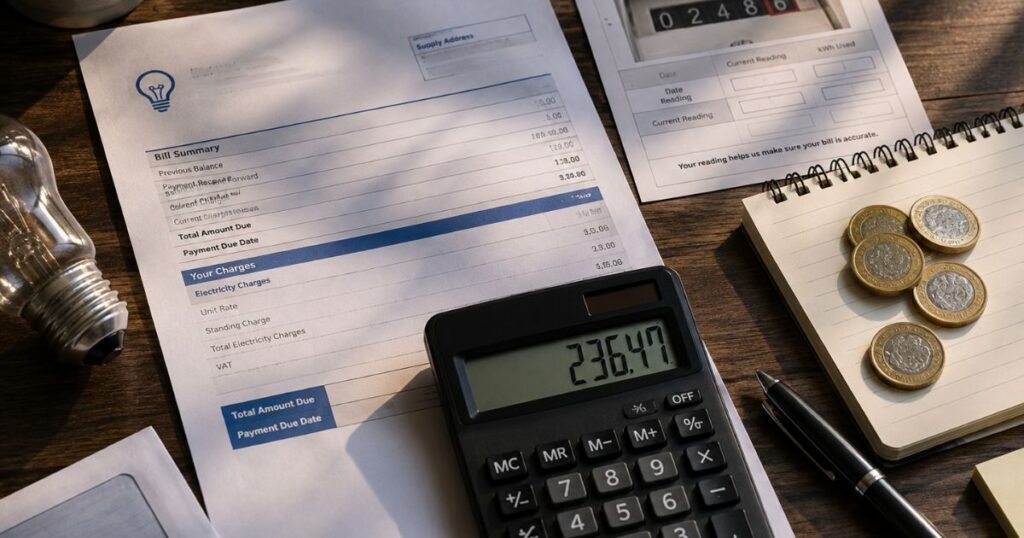
Before signing a contract, it’s important to understand exactly what you’re paying for.
1. Electricity Unit Rate
The unit rate is the price charged for each kilowatt-hour (kWh) of electricity consumed.
For example, a supplier might quote a particular price per kWh.
The actual rate offered to a business can depend on factors such as:
- Expected consumption
- Contract length
- Market conditions
- Meter type
- Supplier pricing
- Procurement strategy
- Business circumstances
A lower unit rate doesn’t automatically mean a lower overall bill.
2. Standing Charge
A standing charge is a fixed charge associated with the electricity supply.
It may be charged on a daily basis regardless of how much electricity the business consumes.
This means that two businesses with identical unit rates could still have different overall costs if their standing charges differ.
When comparing contracts, always look at both:
Unit rate + standing charge
rather than focusing on the unit rate alone.
3. Contract Length
The contract length specifies how long the agreed arrangement lasts.
Business electricity contracts can have different durations.
The appropriate contract length depends on the business and the terms being offered.
Ofgem states that business energy contracts can last for up to five years, although the exact options available depend on suppliers and circumstances.
For a detailed discussion specifically about contract duration, see our guide to business energy contract length.
This is an important distinction from this article: contract length is only one component of a wider business electricity contract.
Types of Business Electricity Contracts
There are several types of arrangements a business may encounter when looking for electricity.
Fixed-Rate Business Electricity Contract
With a fixed-rate contract, the agreed electricity unit price is generally fixed for the contract period.
This can make budgeting easier because the business has greater certainty about the agreed energy rate.
For example, if a company agrees a fixed unit rate, increases in wholesale energy prices don’t automatically change that agreed unit rate.
However, fixed doesn’t necessarily mean every component of the bill is frozen.
A contract can contain conditions allowing certain charges or components to change.
Ofgem specifically advises businesses to check whether their contract contains conditions that could allow the rate to change.
Potential advantages
- Greater price certainty
- Easier budgeting
- Reduced exposure to some market movements
- More predictable energy costs
Potential disadvantages
- The business may not benefit if market prices fall
- Early termination may have costs or restrictions
- Contract conditions may limit flexibility
- The quoted rate may not represent the entire electricity bill
Variable Business Electricity Contracts
A variable contract allows the amount charged for electricity to change according to energy costs.
Ofgem describes variable contracts as arrangements where the amount paid for energy can rise or fall during the contract based on the cost of energy.
This means businesses can have greater exposure to changes in energy prices.
Potential advantages
- Potential to benefit when energy costs fall
- Greater flexibility in some arrangements
- May suit businesses comfortable with market exposure
Potential disadvantages
- Costs can increase
- Budgeting can be more difficult
- Greater exposure to market conditions
Businesses considering variable arrangements should understand how and when the supplier can change the price.
Deemed Business Electricity Contracts
A deemed contract can apply when a business moves into premises and begins using electricity without first agreeing a contract with a supplier.
It can also arise in certain circumstances when an existing contract ends and the supplier continues supplying energy, depending on the terms of the original agreement.
Ofgem distinguishes a deemed contract from an out-of-contract rate.
Businesses should avoid treating a deemed arrangement as a deliberate long-term procurement strategy without first understanding the applicable rates and options.
If you’re moving into new premises, it’s sensible to establish who currently supplies the property and arrange the appropriate business electricity contract as early as possible.
Rollover and Evergreen Business Electricity Contracts
Some business energy contracts contain automatic renewal or rollover provisions.
If a business doesn’t change its arrangement before the existing contract expires, it may automatically move onto another period under specified terms.
Ofgem notes that rollover contracts can apply where a business does not change its contract before expiry. Microbusinesses cannot have a rollover contract lasting more than 12 months.
This makes it particularly important to know:
- When your contract ends
- Whether automatic renewal applies
- How much notice is required
- What rate applies after expiry
- Whether you can negotiate a new arrangement
- Whether there are termination conditions
Don’t assume that your current contract will simply stop on the end date.
What Costs Can Be Included in a Business Electricity Contract?
One of the most confusing parts of commercial energy is understanding what sits behind the final electricity price.
Your business electricity costs can involve several components.
Wholesale Energy Costs
This is the cost associated with purchasing electricity for customers.
Wholesale market conditions can change over time, which can influence the pricing offered to businesses.
Network Costs
Electricity has to travel through the transmission and distribution network before reaching the business premises.
Business electricity pricing can therefore include network-related charges.
These can include charges associated with transmission and distribution networks.
Government Schemes and Levies
Business energy bills can include various government schemes and industry levies.
The exact treatment can depend on the business and the energy contract.
Ofgem lists several components that can contribute to business energy costs, including government schemes, network costs, wholesale costs and supplier costs.
Taxes
Taxes such as VAT can also form part of a business energy bill.
The applicable treatment can depend on the business and its circumstances.
Businesses should therefore consider the total quoted cost rather than assuming the advertised unit rate represents the complete amount payable.
What Should You Check Before Signing a Business Electricity Contract?
Signing an energy contract can be a significant financial commitment.
Before agreeing to one, carefully review the terms.
1. Unit Rate
Check the price per kWh.
Don’t compare this figure in isolation.
2. Standing Charge
Check the daily standing charge and understand how it affects your expected annual cost.
3. Contract Start Date
Confirm exactly when the new contract begins.
This is particularly important when switching suppliers or moving premises.
4. Contract End Date
Know exactly when your current arrangement ends.
This helps you plan your next procurement decision.
5. Renewal Terms
Check whether the contract automatically renews and what you need to do if you want to switch.
6. Termination Conditions
Look for conditions relating to early termination.
These can be particularly important if your business might move premises, close, expand or change its energy requirements.
7. Early Exit Fees
Check whether leaving the contract early could result in charges.
Don’t assume that you can cancel whenever you want.
8. Payment Terms
Understand how and when you’re expected to pay.
Suppliers may have different payment requirements depending on the business and contract.
9. Metering Requirements
Check whether your contract is appropriate for the type of electricity meter installed at your premises.
This can be particularly relevant for businesses with half-hourly meters.
10. Additional Charges
Ask what other charges may apply.
A quotation should be understood in the context of the complete contract rather than just the headline electricity rate.
Ofgem’s 2026 guidance for intermediaries recommends that important contract terms such as pricing, contract length, start date, renewal terms, termination conditions and early-exit fees are clearly set out before customers agree to an energy contract.
Fixed vs Variable Business Electricity Contracts
The choice between fixed and variable pricing depends on the business’s circumstances and approach to energy-price risk.
| Feature | Fixed Contract | Variable Contract |
|---|---|---|
| Unit price | Generally fixed | Can change |
| Budget certainty | Higher | Lower |
| Exposure to market changes | Lower for the fixed component | Higher |
| Benefit from falling prices | Limited | Potentially greater |
| Risk of rising prices | Lower for the fixed component | Higher |
| Procurement complexity | Generally simpler | Can require more active monitoring |
Neither option is automatically better for every business.
The right choice depends on factors such as cash flow, consumption, risk tolerance, contract terms and market conditions.
How to Compare Business Electricity Contracts
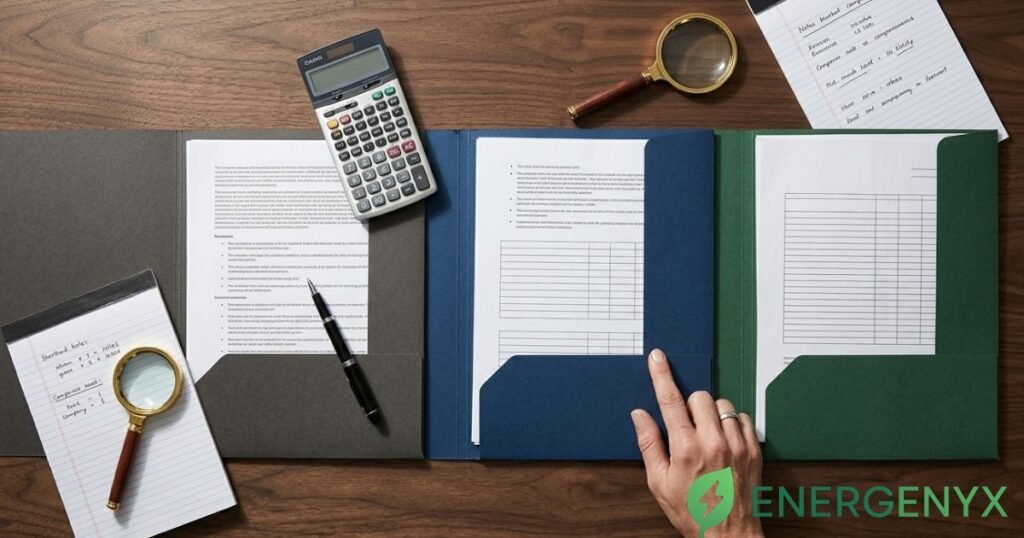
Comparing business electricity contracts should involve more than finding the lowest quoted unit rate.
Start by gathering your current energy information.
Step 1: Review Your Current Contract
Find:
- Current supplier
- Current unit rate
- Standing charge
- Contract start date
- Contract end date
- Contract type
- Annual consumption
Step 2: Understand Your Consumption
Review your electricity usage over recent billing periods.
If your business has grown, reduced its operating hours or installed new equipment, your future consumption may differ from previous years.
Step 3: Request Suitable Quotes
Obtain quotations that reflect your actual business requirements.
If using an energy broker, understand which suppliers they approach and how their fees or commissions work.
Ofgem recommends that businesses using brokers check their fees, which suppliers the broker works with, the terms of the broker’s service and what authority they give the broker.
Step 4: Compare the Complete Cost
Compare:
- Unit rate
- Standing charge
- Contract length
- Estimated annual cost
- Payment terms
- Additional charges
- Renewal terms
- Exit conditions
Step 5: Read the Contract
Don’t rely solely on a verbal quotation.
Make sure you receive and understand the contract terms before agreeing.
Business Electricity Contracts and Half-Hourly Meters
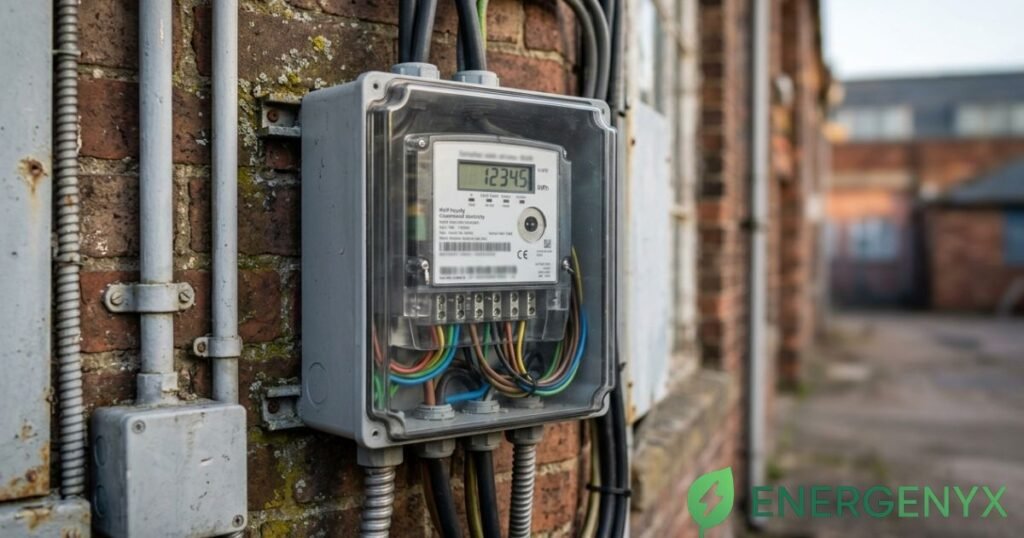
Metering can be an important consideration when choosing a business electricity contract.
Some businesses have half-hourly electricity meters that provide consumption information in 30-minute intervals.
Ofgem notes that suppliers can record certain business energy consumption every half hour as part of the electricity settlement process.
For businesses with substantial electricity consumption, understanding their demand profile can be useful when evaluating procurement options.
If your business uses a half-hourly meter, consider reviewing our detailed guide to half-hourly electricity meters.
Business Electricity Contracts When Moving Premises
Moving to a new business property creates additional energy considerations.
Before moving, check your existing contract and determine whether you have any obligations relating to the current premises.
You should also establish the electricity supplier at the new premises.
If you move into premises and begin using electricity before arranging a new contract, you may be placed on a deemed arrangement.
Therefore, businesses should ideally investigate their new electricity supply before moving in.
This gives you more time to understand the available options and avoid unnecessary uncertainty.
Can You Switch a Business Electricity Contract?
In many cases, businesses can switch suppliers, but the timing and contractual conditions matter.
Ofgem states that most energy suppliers will not allow businesses to switch before the end of their contract.
That means businesses should identify their contract end date and any notice requirements well in advance.
If you’re approaching the end of your agreement, start comparing suitable options rather than waiting until the final days of the contract.
For more information, see our guide to switching business electricity suppliers.
Business Electricity Contracts for Small Businesses
Smaller businesses often want straightforward contracts with predictable costs.
For these companies, a fixed-rate arrangement may be attractive because it can make budgeting easier.
However, the cheapest-looking contract isn’t necessarily the most suitable.
A small business should consider:
- Annual electricity consumption
- Unit rate
- Standing charge
- Contract length
- Payment method
- Renewal conditions
- Exit fees
- Supplier reputation
- Available customer support
The business should also understand whether it falls into a category such as a microbusiness or small business, as different rules and protections can apply. Ofgem’s current guidance defines these categories using factors including employee numbers, turnover or balance-sheet totals and energy consumption.
Business Electricity Contracts for Larger Businesses
Larger organisations can have more complex energy requirements.
For example, a company operating:
- Multiple premises
- Manufacturing facilities
- Large warehouses
- Retail chains
- Office buildings
- High-energy equipment
may have a very different procurement requirement from a small office.
These businesses may benefit from more detailed consumption analysis and a structured procurement strategy.
For larger energy users, factors such as consumption profiles, contract structure, purchasing strategy and market exposure can become particularly important.
This is where business energy procurement can become an important part of the overall energy strategy.
Should You Use a Business Energy Broker?

Businesses can arrange an energy contract directly with a supplier or use a third-party intermediary such as an energy broker.
A broker may help with tasks such as:
- Gathering quotations
- Comparing suppliers
- Explaining contract options
- Negotiating arrangements
- Managing the switching process
However, businesses should understand how the broker is paid.
Ask:
- What fee or commission do you receive?
- Which suppliers do you work with?
- Are all relevant suppliers included?
- What services are included?
- Do I have to pay you directly?
- Are there any additional charges?
Ofgem’s July 2026 guidance for intermediaries specifically highlights transparency around the intermediary’s role, supplier coverage, pricing, contract terms and commission or fee arrangements.
Common Business Electricity Contract Mistakes
Choosing Based Only on the Unit Rate
A low unit rate doesn’t necessarily mean the lowest overall cost.
Always consider the standing charge and other applicable costs.
Ignoring the Contract End Date
If you don’t know when your contract ends, you may miss the opportunity to properly compare alternatives.
Not Reading the Renewal Terms
Automatic renewal or rollover conditions can affect your options.
Assuming Fixed Means Everything Is Fixed
Check the contract carefully to understand which charges are actually fixed.
Failing to Check Exit Conditions
Businesses can face costs or restrictions when attempting to leave a contract early.
Signing Without Reviewing the Written Terms
Make sure you understand the agreement before accepting it.
Choosing a Broker Without Checking Their Fees
Understand how the intermediary is compensated and which suppliers they work with.
Leaving Procurement Until the Last Minute
Starting early gives you more time to understand your options and make an informed decision.
Business Electricity Contract Checklist
Before signing a new contract, ask yourself:
Pricing
- What is the unit rate?
- What is the standing charge?
- Are there other charges?
Contract
- What is the start date?
- What is the end date?
- Is it fixed or variable?
- Does it automatically renew?
Switching
- What notice is required?
- Are there early exit fees?
- What happens if the business moves premises?
Consumption
- What is my annual electricity consumption?
- What type of meter do I have?
- Has my consumption changed recently?
Supplier or Broker
- Who is supplying the electricity?
- If using a broker, how are they paid?
- Which suppliers were considered?
- What services does the broker provide?
Taking the time to answer these questions can help reduce surprises later.
Frequently Asked Questions
What is a business electricity contract?
A business electricity contract is an agreement between a commercial customer and an electricity supplier covering the supply and pricing of electricity to business premises.
What types of business electricity contracts are available?
Businesses may encounter fixed-rate, variable, deemed, out-of-contract and rollover arrangements. The options available depend on the supplier and circumstances.
Is a fixed business electricity contract better?
Not necessarily. A fixed contract can provide greater price certainty, while other arrangements may offer different levels of flexibility or exposure to market movements.
Can I switch my business electricity supplier before my contract ends?
Usually, contractual restrictions apply. Ofgem states that most suppliers will not allow businesses to switch before the end of their contract, so businesses should check their specific terms.
What happens when a business electricity contract ends?
The outcome depends on the terms of the contract. A business may renew, agree a new contract, move supplier or in some circumstances be placed on an out-of-contract or deemed arrangement.
Does a business electricity contract include standing charges?
It can. Standing charges are one component that may appear on a business electricity bill, depending on the contract.
Can a business use an energy broker?
Yes. Businesses can arrange contracts themselves or use a third-party intermediary such as an energy broker. Businesses should understand the broker’s fees, supplier coverage and terms before proceeding.
How should I compare business electricity contracts?
Compare the complete arrangement rather than just the unit rate. Look at the standing charge, estimated annual cost, contract type, length, payment terms, renewal conditions and exit provisions.
Final Thoughts
A business electricity contract is more than a price per kilowatt-hour.
The contract determines how your business pays for electricity and can affect your budgeting, flexibility and ability to switch suppliers.
Before signing, look carefully at the unit rate, standing charge, contract type, start and end dates, renewal conditions, payment terms and termination provisions.
It’s also important to understand your business’s electricity consumption and meter arrangements.
For some businesses, a straightforward fixed-rate contract may provide the certainty they want. Others may have more complex requirements that justify a different procurement approach.
The key is to choose a contract based on your actual business requirements rather than simply choosing the lowest advertised rate.
And don’t wait until your current contract is about to expire.
Reviewing your existing arrangement early gives you more time to understand the market, compare suitable options and make a considered decision.
Compare Business Electricity Options with Energenyx

Choosing a suitable business electricity contract can be time-consuming.
Energenyx helps UK businesses explore their commercial energy options and understand different electricity and gas arrangements.
Whether you’re reviewing an existing contract, approaching renewal or moving into new business premises, comparing your options can help you make a more informed energy decision.
Ready to review your business electricity options?
Contact Energenyx to explore suitable business energy options for your organisation.