

Introduction
Has your business energy contract expired without you signing a new agreement? If so, you could be paying out-of-contract business energy rates, which are often higher than the prices available through a fixed-term contract.
Many business owners don’t realise their energy contract has ended until they notice an increase in their electricity or gas bills. Others assume they’ll continue paying the same rates after their contract expires, only to discover that their supplier has moved them onto a more expensive tariff.
The good news is that being on out-of-contract rates doesn’t usually have to be a long-term situation. By understanding how these rates work and comparing your options, you may be able to move to a more suitable business energy contract.
In this guide, we’ll explain what out-of-contract business energy rates are, why suppliers charge them, how they differ from deemed rates, and the practical steps you can take to avoid paying more than necessary.
Key Takeaways
Before exploring the details, here are the key points to remember:
- Out-of-contract business energy rates can apply when your fixed-term contract ends and you haven’t agreed to a new one.
- These rates are often higher than those available through negotiated business energy contracts.
- Out-of-contract rates are different from deemed rates, although both can result in higher energy costs.
- Reviewing your contract before it expires can help you avoid moving onto more expensive tariffs.
- Comparing business energy quotes early gives you more opportunities to find a competitive deal.
What Are Out-of-Contract Business Energy Rates?
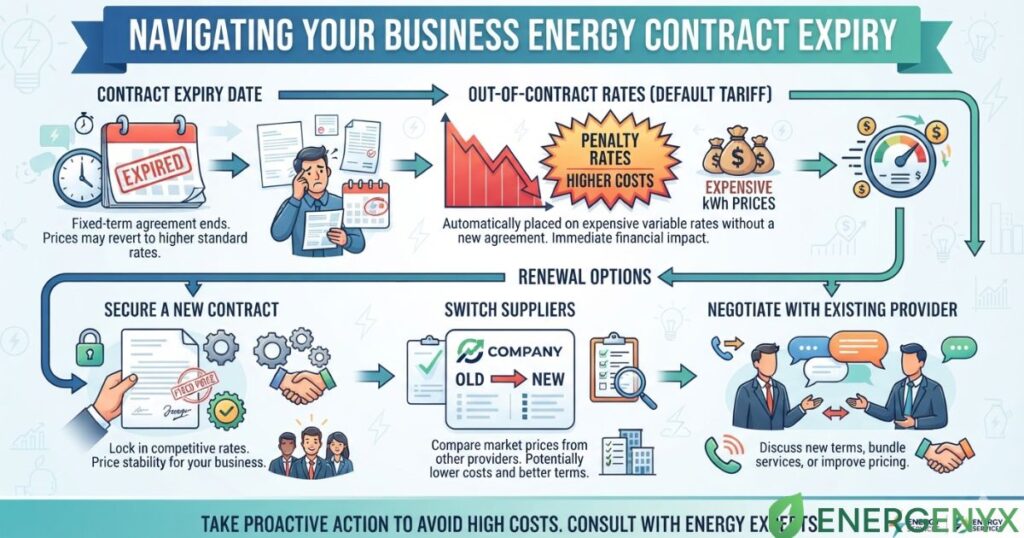
Out-of-contract business energy rates are temporary prices that may apply after your fixed-term business energy contract expires if you haven’t signed a new agreement or switched to another supplier.
Instead of immediately disconnecting your electricity or gas supply, your supplier continues providing energy while charging the rates set out in their out-of-contract terms.
This ensures your business continues to receive energy without interruption, but the prices are often less competitive than those available through a new fixed-term contract.
Although your supply continues as normal, remaining on out-of-contract rates for an extended period could increase your overall energy costs.
Want to know more about out of contract rates : Ofgem guidance for non-domestic energy customers
When Does a Business Move Onto Out-of-Contract Rates?
A business may be placed on out-of-contract rates in several situations.
Common examples include:
- Your fixed-term contract has expired.
- You haven’t accepted your supplier’s renewal offer.
- You haven’t switched to a new supplier.
- Your contract ended before a replacement agreement was arranged.
In many cases, businesses don’t intentionally choose out-of-contract rates. Instead, they simply miss their renewal deadline or delay comparing alternative suppliers.
Planning ahead can reduce the likelihood of this happening.
Why Are Out-of-Contract Rates Higher?
Out-of-contract rates are generally intended as temporary pricing rather than long-term contracts.
Because suppliers don’t have the same certainty about how long you’ll remain with them, these rates are often higher than those available under fixed-term agreements.
Higher pricing may also reflect:
- Greater pricing uncertainty.
- Administrative costs.
- Wholesale market fluctuations.
- Increased supplier risk.
For this reason, businesses are usually encouraged to review their options as soon as possible rather than remaining on out-of-contract rates indefinitely.
Why Are Out-of-Contract Rates Higher? you can know more about it here: Department for Energy Security and Net Zero
How Do Out-of-Contract Business Energy Rates Work?
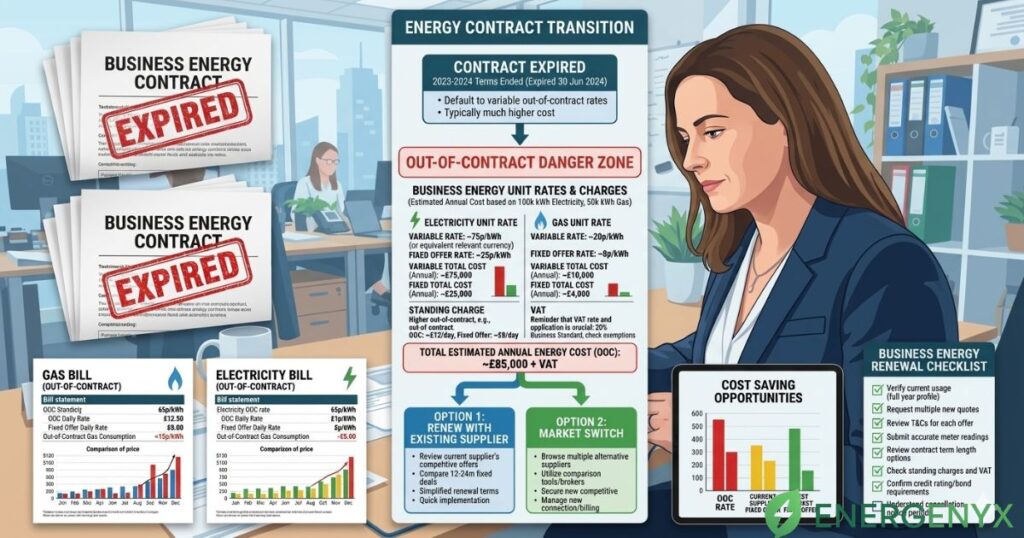
Although the pricing structure varies between suppliers, out-of-contract tariffs generally include the same core charges found in standard business energy contracts.
These usually include:
- Unit rates.
- Standing charges.
- VAT (where applicable).
- Other contractual charges that may apply.
The difference is that the unit rates and standing charges are often less competitive than those offered through a negotiated contract.
Electricity Out-of-Contract Rates
If your electricity contract expires, your supplier may continue supplying electricity while charging an out-of-contract electricity tariff.
Your bill will generally include:
- Electricity unit rate (per kWh)
- Daily standing charge
- VAT
- Any applicable adjustments
The exact rates depend on your supplier, business location, and the terms of your previous agreement.
Gas Out-of-Contract Rates
The same principle applies to business gas.
If no new agreement has been arranged, your supplier may continue supplying gas under out-of-contract pricing until a new contract is agreed or you switch suppliers.
Your gas bill may include:
- Gas unit rate
- Standing charge
- VAT
- Other applicable charges
As with electricity, remaining on these rates for longer than necessary could increase your annual energy costs.
Are Standing Charges Included?
Yes.
Most out-of-contract tariffs include both:
- A daily standing charge.
- A unit rate for every kilowatt-hour (kWh) of energy consumed.
This means your total bill depends on both how much energy your business uses and the daily fixed charges applied by your supplier.
When comparing alternative contracts, it’s important to review the overall annual cost rather than focusing on the unit rate alone.
Out-of-Contract Rates vs Deemed Rates
Many business owners use the terms out-of-contract rates and deemed rates interchangeably, but they are not the same.
Understanding the difference can help you choose the right course of action and avoid unnecessary energy costs.
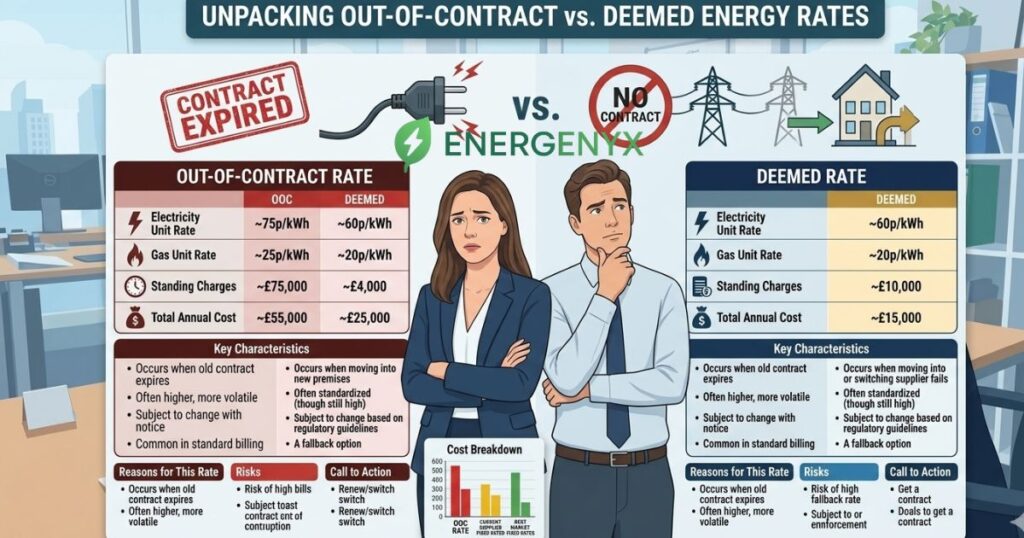
What Are Deemed Rates?
Deemed rates usually apply when a business is receiving electricity or gas without agreeing to a formal energy contract with the supplier.
This often happens when:
- A business moves into new premises.
- The previous occupier’s contract has ended.
- Energy is being supplied before a new agreement is arranged.
Although your energy supply continues, the supplier charges a deemed tariff, which is generally intended as a temporary arrangement until you sign a contract or switch suppliers.
Key Differences
| Out-of-Contract Rates | Deemed Rates |
|---|---|
| Usually apply after your fixed-term contract expires. | Often apply when no contract exists for the premises. |
| You normally had a previous contract with the supplier. | You may have recently moved into the property or inherited the supply. |
| Energy supply continues without interruption. | Energy supply also continues without interruption. |
| Temporary pricing until a new agreement is reached. | Temporary pricing until a formal contract is agreed. |
Although the reasons are different, both tariffs can result in higher energy costs than negotiated business contracts.
Which Is More Expensive?
There’s no universal answer.
Pricing varies between suppliers and market conditions.
However, both out-of-contract and deemed rates are generally less competitive than fixed-term business energy contracts.
Rather than comparing which temporary tariff is cheaper, businesses should focus on moving to a suitable contract as soon as practical.
Can You Leave Out-of-Contract Rates?
Yes.
In most cases, businesses don’t need to remain on out-of-contract rates permanently.
If your business has been placed on one of these tariffs, you generally have two options.
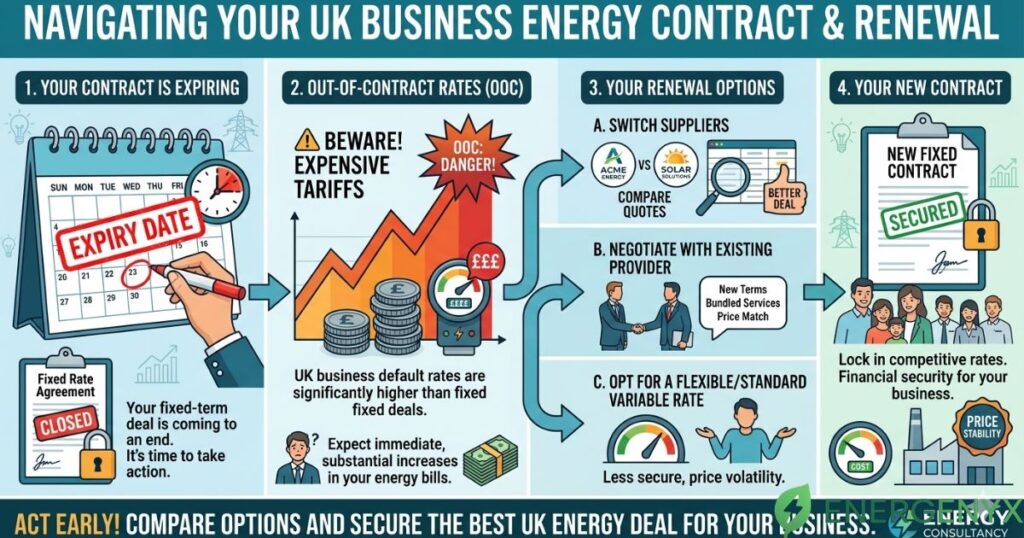
Option 1: Sign a New Contract With Your Current Supplier
If you’re satisfied with your current supplier, you may choose to agree to a new business energy contract.
Before accepting a renewal offer, it’s worth reviewing:
- Unit rates
- Standing charges
- Contract length
- Tariff type
- Renewable energy options
- Exit terms
Comparing these details helps ensure the contract still meets your business’s needs.
Option 2: Switch to Another Supplier
Many businesses compare quotes from multiple suppliers before making a decision.
Switching could offer benefits such as:
- More competitive pricing.
- Different contract lengths.
- Improved customer service.
- Renewable electricity options.
- Better online account management.
Provided the switching process is completed correctly, your electricity or gas supply should continue without interruption.
How to Avoid Out-of-Contract Business Energy Rates
The easiest way to avoid out-of-contract pricing is to plan ahead.
Here are several practical steps that can help.
Know Your Contract End Date
Record your contract expiry date in your calendar and set reminders several months in advance.
Starting early gives you more time to compare suppliers and review available tariffs.
Understand Your Notice Period
Some business energy contracts require notice before you can switch suppliers or decline a renewal offer.
Missing the notice period could delay your plans or reduce your available options.
Always review your current contract carefully.
Compare Quotes Before Renewal
Instead of accepting the first renewal quote you receive, compare offers from several suppliers.
When reviewing quotations, consider:
- Unit rates
- Standing charges
- Contract length
- Customer service
- Renewable energy availability
- Total estimated annual cost
Looking at the complete picture often provides a better indication of value than comparing unit rates alone.
Review Your Energy Usage
Businesses change over time.
You may now use:
- More electricity.
- Less gas.
- Different equipment.
- Longer operating hours.
- Additional premises.
Reviewing your latest business energy bills helps ensure your next contract reflects your current consumption rather than outdated estimates.
Want to reduce your carbon footprint you can visit: Carbon Trust
Signs You May Be Paying Out-of-Contract Rates
Not every business owner realises they’ve been moved onto an out-of-contract tariff.
Some common warning signs include:
- Your fixed-term contract has recently ended.
- Your latest energy bill is noticeably higher than previous bills.
- You haven’t agreed to a new contract.
- Your supplier has sent renewal reminders that haven’t been acted upon.
- You’re unsure when your current agreement expires.
If any of these situations apply, reviewing your current tariff and requesting updated quotes may help you identify more suitable options.
Business Energy Renewal Checklist

Before requesting quotes, gather the following information:
✔ Latest electricity bill
✔ Latest gas bill (if applicable)
✔ Annual energy consumption
✔ MPAN number
✔ Current supplier details
✔ Contract end date
✔ Notice period
✔ Preferred contract length
Having these details ready makes it easier to compare suppliers accurately and avoid delays during the renewal or switching process.
Common Mistakes Businesses Make
Many businesses end up paying more for their energy than necessary because they overlook important steps when their contract expires. Avoiding these common mistakes can help you secure a more suitable tariff and manage your energy costs more effectively.

Assuming Your Prices Will Stay the Same
One of the biggest misconceptions is that your electricity and gas prices will remain unchanged after your fixed-term contract ends.
In reality, your supplier may move you onto out-of-contract rates, which can be more expensive than the prices available under a new negotiated agreement.
Always check your renewal documents and understand what will happen when your contract expires.
Waiting Too Long to Compare Quotes
Some businesses only begin comparing suppliers after they notice a higher energy bill.
Starting the comparison process several months before your renewal date gives you more time to evaluate different suppliers and tariffs.
Planning ahead can also reduce the risk of moving onto temporary out-of-contract pricing.
Looking Only at Unit Rates
A low unit rate doesn’t always mean you’ll pay less overall.
When comparing business energy contracts, also consider:
- Daily standing charges
- Contract length
- Tariff type
- Customer service
- Billing options
- Renewable energy availability
- Total estimated annual cost
Comparing the complete package gives you a more accurate picture of long-term value.
Forgetting to Review Energy Usage
Business energy needs often change over time.
If your company has expanded, reduced operating hours, or introduced new equipment, your current energy usage may differ significantly from when you signed your last contract.
Reviewing your annual consumption before requesting quotes helps suppliers provide more accurate pricing.
Frequently Asked Questions
What happens when my business energy contract expires?
If you haven’t agreed to a new contract or switched suppliers, your supplier may continue providing energy on out-of-contract rates until a new agreement is in place.
The exact arrangements depend on your supplier and the terms of your previous contract.
Are out-of-contract business energy rates more expensive?
In many cases, yes.
Out-of-contract rates are often higher than negotiated fixed-term contracts, which is why businesses are generally encouraged to review their options before their current agreement expires.
Can I switch suppliers while on out-of-contract rates?
In many situations, yes.
If you’re paying out-of-contract rates, you can usually compare suppliers and arrange a new contract, subject to your supplier’s terms and any applicable notice requirements.
How long can my business stay on out-of-contract rates?
This varies between suppliers.
Because these rates are intended as a temporary arrangement, it’s usually in your best interest to explore alternative contracts as soon as possible.
Are out-of-contract rates the same as deemed rates?
No.
Although both can be more expensive than standard business energy contracts, they apply in different situations.
Out-of-contract rates usually apply when an existing contract has expired, while deemed rates commonly apply when energy is supplied without a formal contract for the premises.
How can I avoid paying out-of-contract rates?
The best approach is to:
- Monitor your contract expiry date.
- Understand your notice period.
- Compare suppliers before renewal.
- Review your energy usage.
- Arrange a new contract before your current agreement ends.
Planning ahead can help reduce the likelihood of moving onto temporary higher-cost tariffs.
Final Thoughts
Out-of-contract business energy rates are designed to ensure your electricity and gas supply continues after your fixed-term agreement ends. However, because these rates are often less competitive than negotiated contracts, remaining on them for an extended period may increase your business’s energy costs.
The good news is that you don’t have to stay on an out-of-contract tariff indefinitely.
By understanding your contract end date, comparing suppliers in advance, and reviewing your energy requirements, you can make informed decisions that better suit your business.
Whether you choose to renew with your current supplier or switch to a new one, taking action early can help you secure a more suitable tariff and avoid unnecessary costs.
Compare Business Energy Quotes with Energenyx
If your business is currently paying out-of-contract energy rates or your contract is due to expire soon, now is an ideal time to review your options.
At Energenyx, we help UK businesses compare commercial electricity and gas quotes from trusted suppliers, making it easier to find competitive tariffs that match your energy usage and business requirements. If you want to get business support you can visit: British Business Bank.

Whether you’re a small business, a growing company, or a large organisation, comparing multiple quotes can help you make a more informed decision.
Request your free, no-obligation business energy comparison today and discover whether you could reduce your business energy costs with a new contract.