

Introduction
Managing business energy can be complicated. From comparing suppliers and negotiating commercial energy contracts to monitoring consumption and planning energy renewals, businesses have to make several important decisions when purchasing electricity and gas.
This is where a business energy consultant can help.
Business energy consultants provide guidance to organisations looking to understand, manage, and improve their commercial energy arrangements. Depending on the service they provide, a consultant may help with energy procurement, supplier comparisons, contract negotiations, energy efficiency, sustainability planning, or ongoing energy management.
For a small business, getting the right advice can make the energy purchasing process easier to understand. For larger organisations with multiple premises, complex contracts, or significant energy consumption, specialist energy advice can become an important part of their procurement strategy.
However, not every business needs the same level of support. Understanding what energy consultants actually do, how they differ from business energy brokers, and what to look for when choosing one can help you decide whether professional assistance is appropriate for your organisation.
In this guide, we’ll explain what business energy consultants do, how they can support procurement and contract management, the potential benefits of using one, and how to choose the right consultant for your business.
Key Takeaways
Before choosing a business energy consultant, keep these points in mind:
- Business energy consultants help organisations make informed decisions about commercial energy.
- Services can include procurement, supplier comparison, contract management, and energy strategy.
- Some consultants specialise in procurement while others provide broader energy management services.
- Energy consultants and energy brokers can perform overlapping roles, but their services may differ.
- Businesses should understand how a consultant is paid before agreeing to a service.
- Compare experience, services, transparency, and customer support before choosing a consultant.
- The right level of energy support depends on your business size, energy usage, and requirements.
What Is a Business Energy Consultant?
A business energy consultant is a professional or company that provides advice and support to organisations regarding their commercial energy requirements.
Unlike a domestic energy customer who may simply compare household tariffs online, businesses often have more complex energy needs.
A commercial energy consultant may help a business:
- Understand its current business energy costs
- Analyse electricity and gas consumption
- Compare suppliers
- Review commercial energy contracts
- Develop an energy procurement business strategy
- Manage contract renewals
- Assess renewable energy options
- Identify opportunities for energy efficiency
- Manage energy purchasing across multiple premises
The exact services vary between consultants, so businesses should always establish what is included before entering an agreement.
Why Do Businesses Use Energy Consultants?
Energy is an essential operating cost for almost every organisation.
However, many business owners don’t have the time or specialist knowledge required to monitor energy markets, analyse complex contracts, compare suppliers, and manage procurement themselves.
An energy consultant can provide specialist knowledge and help simplify the process.
For example, a business owner may have to decide between several commercial energy contracts with different:
- Unit rates
- Standing charges
- Contract lengths
- Payment arrangements
- Renewable energy options
- Terms and conditions
A consultant can help the business understand these differences and evaluate which options are most appropriate for its circumstances.
What Does a Business Energy Consultant Do?
The services provided by energy consultants can vary considerably. Some focus primarily on procurement, while others provide a broader range of energy management services.
Here are some of the most common areas of support.
Energy Procurement
Energy procurement is one of the most common services provided by commercial energy consultants.
The consultant may help a business:
- Review its current energy requirements.
- Analyse historical consumption.
- Establish procurement objectives.
- Approach suitable suppliers.
- Obtain commercial energy quotations.
- Compare contract options.
- Evaluate pricing and terms.
- Select an appropriate supplier.
- Support the contract implementation process.
A structured procurement process can make it easier for businesses to make purchasing decisions based on their actual requirements rather than simply accepting the first available quotation.
Supplier Comparison

Businesses can have difficulty comparing commercial energy suppliers because quotations may use different pricing structures and contract terms.
A consultant may compare factors such as:
- Electricity unit rates
- Gas unit rates
- Standing charges
- Contract duration
- Payment terms
- Supplier services
- Renewable energy options
- Account management
This can give businesses a clearer view of their available options.
Contract Review

Commercial energy contracts can contain important terms that aren’t immediately obvious from a headline price.
An energy consultant may help businesses review:
- Contract duration
- Renewal conditions
- Notice periods
- Termination provisions
- Payment terms
- Pricing structures
- Additional charges
Understanding these terms before signing a contract can help businesses avoid unexpected problems later.
Energy Consultants and Contract Renewals
Contract renewal is another area where businesses can benefit from professional energy support.
Waiting until the final days of an existing contract can create unnecessary pressure.
Instead, businesses can begin reviewing their energy arrangements well before the contract expiry date.
A consultant may help by:
- Reviewing the existing agreement
- Analysing current energy consumption
- Comparing available suppliers
- Obtaining renewal quotations
- Evaluating alternative contracts
- Supporting the switching process
This allows the business to make its renewal decision with more information.
Energy Consultants for Small Businesses
Small businesses often have limited administrative resources.
A restaurant owner, retailer, office manager, or independent business may not have a dedicated energy procurement department.
An energy consultant can potentially reduce the amount of time the business needs to spend researching suppliers and reviewing commercial energy contracts.
For smaller organisations, useful services may include:
- Supplier comparison
- Contract renewal support
- Business electricity comparison
- Business gas comparison
- Bill review
- Energy-saving advice
- Contract management
However, smaller businesses should ensure that the cost of using a consultant is transparent and appropriate for the level of service being provided.
Energy Consultants for Larger Businesses
Larger organisations may have considerably more complex energy requirements.
For example, a business operating 20, 50, or 100 commercial premises may need to manage:
- Multiple electricity meters
- Multiple gas supplies
- Different contract expiry dates
- Large energy consumption
- Half-hourly meters
- Multiple suppliers
- Complex billing arrangements
In these circumstances, energy consultancy can involve much more than finding a cheaper tariff.
A consultant may help coordinate procurement across multiple locations, analyse consumption patterns, develop purchasing strategies, and centralise energy management.
Business Energy Consultant vs Energy Broker
The terms energy consultant and energy broker are sometimes used interchangeably, but they can describe different services.
An energy broker generally focuses on helping businesses compare and purchase energy contracts from suppliers.
An energy consultant may provide a broader range of strategic services, potentially including procurement, energy management, efficiency, sustainability, and long-term planning.
However, there is considerable overlap between the two industries.
The most important thing is therefore not the title of the company but the specific services it provides, how it is compensated, and what is included in its agreement.
Energy Broker
A broker may primarily help with:
- Supplier comparisons
- Energy quotations
- Contract negotiations
- Switching suppliers
- Contract renewals
Energy Consultant
A consultant may offer broader support, such as:
- Procurement strategy
- Energy market analysis
- Contract management
- Consumption analysis
- Energy efficiency
- Sustainability planning
- Multi-site energy management
Some companies offer both brokerage and consultancy services.
For this reason, businesses should ask potential providers to clearly explain the scope of their service before making a decision.
Benefits of Using a Business Energy Consultant
Working with a business energy consultant can provide several potential benefits, particularly for organisations that don’t have dedicated energy procurement expertise.
The value of a consultant depends on the services provided and the complexity of your energy requirements.
Save Time on Energy Research
Comparing commercial energy suppliers can be time-consuming.
A business may need to research suppliers, gather quotations, understand pricing structures, review contract terms, and manage communications with different providers.
A consultant can handle some or all of this process on behalf of the business, allowing management teams to focus on their core operations.
Access Specialist Knowledge
Commercial energy contracts and markets can be difficult to understand.
An experienced consultant may have knowledge of:
- Supplier offerings
- Commercial tariffs
- Procurement strategies
- Contract structures
- Market conditions
- Energy management
- Sustainability options
This knowledge can help businesses make more informed procurement decisions.
Compare Multiple Options
One of the biggest advantages of professional energy support is having access to multiple procurement options.
Instead of evaluating a single supplier’s offer, businesses can compare different quotations and contract structures.
However, businesses should ask exactly which suppliers a consultant works with and whether the consultant has access to a sufficiently broad range of options.
Improve Contract Management
Managing energy contracts involves more than signing an agreement.
Businesses also need to monitor:
- Contract start dates
- Expiry dates
- Renewal windows
- Meter information
- Billing
- Consumption
- Supplier performance
A consultant may help organise these processes and reduce the risk of important deadlines being missed.
How Business Energy Consultants Help With Procurement

Energy procurement is often one of the most valuable areas where a consultant can support a business.
A structured procurement process typically begins with understanding the organisation’s requirements.
1. Establish Energy Requirements
The consultant may collect information such as:
- Current suppliers
- Annual electricity usage
- Annual gas usage
- Meter numbers
- Number of business premises
- Contract expiry dates
- Historical energy bills
This information helps establish the organisation’s procurement requirements.
2. Develop a Procurement Strategy
The appropriate strategy depends on the business.
For example, an organisation prioritising predictable costs may prefer a fixed-price approach.
A larger organisation with significant energy consumption may consider a more flexible procurement strategy.
The consultant can help evaluate the available approaches based on the business’s objectives.
3. Obtain Supplier Quotations
Once the procurement requirements have been established, the consultant may request quotations from relevant suppliers.
The business can then compare available options based on its requirements.
4. Evaluate Contracts
A good procurement process shouldn’t stop at the cheapest headline price.
Businesses should consider:
- Unit rates
- Standing charges
- Contract duration
- Payment terms
- Supplier reputation
- Customer service
- Renewable options
- Contract conditions
5. Support Supplier Selection
After evaluating the available options, the consultant can help the business understand the differences and make an informed decision.
The final decision should remain with the business unless the consultancy agreement specifies otherwise.
How Consultants Can Help With Energy Contract Renewals

Energy contract renewals are an important part of commercial energy management.
A business that waits until its contract is about to expire may have less time to research alternatives.
Consultants can help businesses prepare earlier by monitoring contract dates and starting the comparison process in advance.
A typical renewal process may include:
Existing Contract → Consumption Review → Market Review → Supplier Quotes → Contract Comparison → Supplier Selection → Renewal/Switch
Starting early provides more time to evaluate alternatives and avoid rushed decisions.
Energy Consultants and Multi-Site Businesses
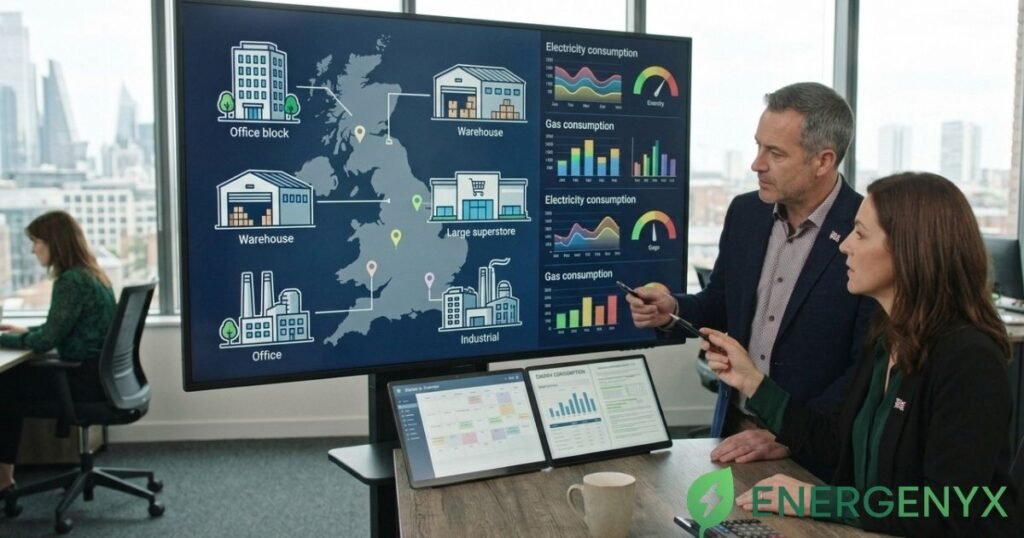
Managing energy across multiple premises can be particularly challenging.
A business with several locations may have different:
- Electricity meters
- Gas meters
- Suppliers
- Contract dates
- Consumption levels
- Tariffs
A consultant can help centralise this information and develop a more coordinated procurement strategy.
For larger organisations, this may involve analysing consumption across sites and identifying opportunities to improve procurement and energy management.
Energy Efficiency and Cost Reduction
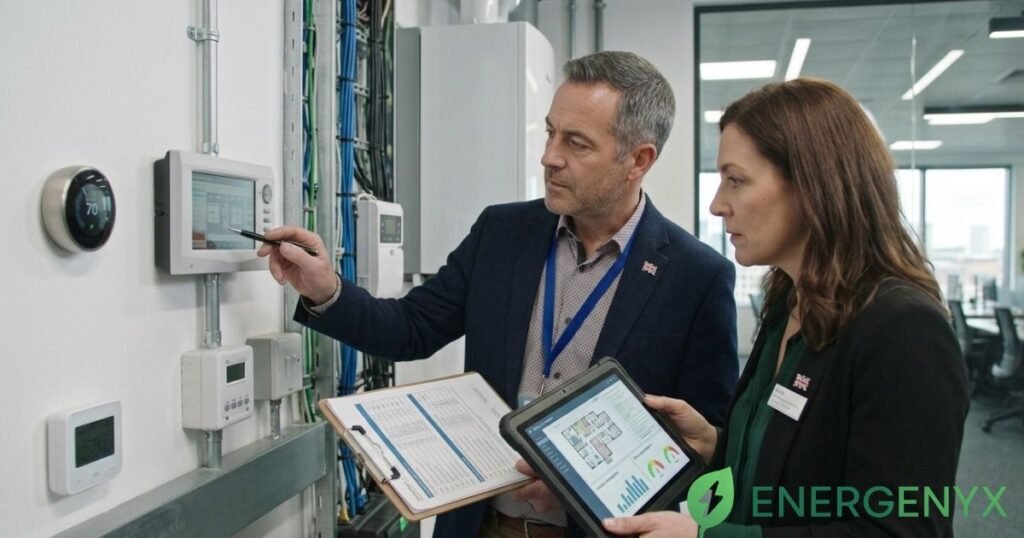
Some energy consultants provide services beyond procurement.
They may analyse how a business consumes energy and identify potential efficiency opportunities.
Examples can include:
- Improving lighting efficiency
- Optimising heating systems
- Reducing unnecessary consumption
- Improving building controls
- Monitoring energy usage
- Identifying unusual consumption patterns
Energy procurement and energy efficiency should ideally be considered together.
Reducing the amount of energy a business needs can be just as important as finding a competitive supply contract.
Sustainability and Renewable Energy Advice

Businesses are increasingly considering sustainability when making energy decisions.
Depending on their expertise, consultants may help organisations evaluate:
- Renewable electricity tariffs
- Solar energy
- Energy efficiency projects
- Carbon reduction strategies
- Electric vehicle charging
- Sustainability targets
For businesses with environmental objectives, energy procurement can form part of a wider sustainability strategy.
How Much Does a Business Energy Consultant Cost?
There is no single standard fee for business energy consultancy.
The cost can depend on:
- Size of the business
- Number of premises
- Energy consumption
- Complexity of procurement
- Services required
- Contract duration
- Level of ongoing support
Some providers may charge a direct consultancy fee, while others may receive commission or another form of remuneration associated with energy contracts.
Before signing an agreement, businesses should ask:
“How are you paid for your services?”
Understanding the answer helps businesses evaluate the true cost of the service.
How to Choose a Business Energy Consultant

Choosing the right consultant requires more than searching for the cheapest service.
Consider the following factors.
Industry Experience
Look for a consultant with relevant experience working with businesses similar to yours.
A consultant familiar with a restaurant, for example, may understand very different energy requirements from one specialising in large industrial sites.
Range of Services
Determine whether you need:
- Supplier comparison
- Procurement
- Contract management
- Energy efficiency
- Sustainability advice
- Multi-site management
Choose a provider whose services match your requirements.
Supplier Access
Ask which suppliers the consultant can access.
A broader range of options may provide greater choice, although the number of suppliers alone does not guarantee a better deal.
Fee Transparency
Make sure you understand:
- Whether there is a consultancy fee
- Whether commission is involved
- When fees become payable
- Whether there are cancellation charges
- What ongoing services are included
Clear pricing reduces the risk of misunderstandings.
Communication and Support
Consider how the consultant will communicate with you after the contract has been arranged.
Ask whether you’ll have:
- A dedicated account manager
- Email support
- Telephone support
- Regular reviews
- Contract renewal reminders
Ongoing support can be particularly valuable for businesses with complex energy requirements.
Questions to Ask Before Hiring a Business Energy Consultant
Before entering an agreement, ask potential consultants clear questions about their services, supplier relationships, fees, and responsibilities.
1. Which services do you provide?
Find out whether the consultant only compares energy contracts or also provides procurement, contract management, energy efficiency, and sustainability support.
2. Which energy suppliers can you access?
Ask for information about the range of suppliers available through their service.
3. How do you charge for your services?
Understand whether you will pay a direct fee, whether the consultant receives commission, or whether another charging structure applies.
4. Do you provide ongoing support?
Determine whether support ends once a contract is signed or continues throughout the contract period.
5. Can you manage multiple business premises?
If your organisation has multiple locations, make sure the consultant has experience handling multi-site energy requirements.
6. How will you compare my options?
Ask what factors they consider beyond the headline unit rate.
A useful comparison should consider pricing, standing charges, contract terms, supplier service, and your business requirements.
7. What information do you need from my business?
A professional procurement process may require recent energy bills, consumption information, meter details, contract information, and business requirements.
Common Mistakes When Choosing an Energy Consultant
Professional advice can be valuable, but businesses should still perform their own due diligence.
Choosing Based Only on Price
The cheapest consultancy service isn’t necessarily the best.
Consider the quality and scope of the service alongside the cost.
Not Understanding the Fee Structure
Always establish how the consultant is compensated before agreeing to a contract.
Assuming All Suppliers Are Available
Some consultants may work with a particular panel of suppliers rather than the entire market.
Ask about supplier coverage before requesting quotations.
Signing Without Reading the Agreement
Read the consultancy agreement carefully.
Pay particular attention to:
- Fees
- Contract duration
- Cancellation provisions
- Commission arrangements
- Responsibilities
- Renewal terms
Giving Complete Control to the Consultant
A consultant can provide recommendations, but businesses should understand the options before making significant purchasing decisions.
Ask questions whenever something isn’t clear.
When Should You Hire a Business Energy Consultant?
There is no single point at which every business needs an energy consultant.
However, professional support may be particularly useful when:
- Your energy contract is approaching renewal.
- Your business operates multiple premises.
- Energy costs represent a significant operating expense.
- Your organisation has complex energy requirements.
- You don’t have internal procurement expertise.
- You’re considering flexible energy procurement.
- You’re developing a sustainability strategy.
- You want to review existing supplier arrangements.
For a small business with straightforward energy requirements, a simple comparison service may be sufficient.
For a larger organisation, specialist consultancy may provide additional value.
Business Energy Consultants for SMEs
Small and medium-sized businesses often face a different set of challenges from large corporations.
They may not have dedicated procurement teams, yet still need to make important decisions about electricity, gas, contracts, and energy costs.
A consultant can potentially help SMEs by simplifying:
- Supplier research
- Contract comparison
- Renewal planning
- Energy procurement
- Bill analysis
- Energy management
However, the cost and complexity of the service should be proportionate to the size of the business.
Business Energy Consultants for Large Organisations
Large businesses can have much more complicated energy requirements.
For example, a company operating multiple warehouses, offices, factories, or retail locations may need to coordinate numerous energy contracts.
In these situations, consultancy can involve:
- Multi-site procurement
- Consumption forecasting
- Contract portfolio management
- Flexible purchasing
- Energy market analysis
- Sustainability planning
- Energy efficiency programmes
Larger organisations may therefore benefit from a more comprehensive energy management strategy rather than simply comparing tariffs.
Frequently Asked Questions
What does a business energy consultant do?
A business energy consultant provides professional advice and support relating to commercial energy. Services can include supplier comparison, procurement, contract management, energy efficiency, sustainability planning, and multi-site energy management.
Is an energy consultant the same as an energy broker?
Not necessarily. Energy brokers often focus on helping businesses compare and purchase commercial energy contracts, while consultants may offer broader strategic and energy management services. However, there can be significant overlap between the two.
Are business energy consultants worth it?
It depends on the business. Professional support can be particularly useful for organisations with complex energy requirements, multiple premises, significant consumption, or limited internal procurement expertise.
How do energy consultants make money?
Different consultants use different fee structures. Some may charge businesses directly, while others may receive commission or other compensation connected with energy contracts. Always ask for a clear explanation of fees before signing an agreement.
Can a consultant help me switch business energy suppliers?
Many energy consultants and brokers can assist with supplier comparisons and switching. The exact service varies, so confirm what is included before proceeding.
Can small businesses use energy consultants?
Yes. SMEs can use consultants to help with supplier comparisons, contract renewals, procurement, and energy management. However, businesses should ensure that the cost of the service is appropriate for their needs.
Can consultants help with renewable energy?
Some consultants provide advice on renewable electricity, energy efficiency, solar energy, carbon reduction, and other sustainability initiatives. The available services depend on the consultant’s expertise.
Should I use an energy consultant when renewing my contract?
Professional support can be useful when reviewing a renewal, particularly if you want to compare alternative suppliers or have a complex energy requirement. Businesses should ideally begin reviewing their options well before their existing contract expires.
Final Thoughts
Choosing the right energy arrangement is an important financial decision for any UK business.
A business energy consultant can help simplify the process by providing expertise in supplier comparison, procurement, contract management, energy efficiency, and sustainability.
However, businesses should not choose a consultant based solely on promises of cheaper energy.
Before entering an agreement, understand exactly what services are provided, which suppliers are available, how the consultant is paid, and what ongoing support you will receive.
For straightforward requirements, comparing business energy options may be all you need. For larger or more complex organisations, professional procurement and energy management support may provide additional value.
The key is to choose an approach that matches your organisation’s size, energy consumption, budget, and long-term objectives.
Compare Business Energy Options with Energenyx Today, take action now

Finding the right commercial energy arrangement doesn’t have to be complicated.
Energenyx helps UK businesses explore business electricity and gas options, compare suppliers, and make more informed energy decisions.
Whether you’re:
- Reviewing your current energy contract
- Preparing for renewal
- Comparing business electricity suppliers
- Comparing business gas suppliers
- Exploring procurement options
- Looking for a more suitable commercial energy arrangement
you can start by comparing your available options.
Ready to review your business energy?
Get in touch with Energenyx today to explore your business energy options and request a comparison.