
Business electricity costs can be one of the largest ongoing expenses for a company, particularly for businesses that operate machinery, refrigeration, heating, lighting, computers or other electrical equipment throughout the day.
But how much does electricity actually cost for a business in the UK?
There is no single business electricity price that applies to every company. The amount you pay depends on factors such as your annual electricity consumption, unit rate, standing charge, business size, location, meter type, contract type and the wider energy market.
Understanding these costs can help you budget more accurately, compare business electricity deals and identify opportunities to reduce your energy bills.
In this guide, we explain how business electricity costs are calculated, what affects the price you pay and how businesses can potentially reduce their electricity expenditure.
How Much Does Electricity Cost for a Business in the UK?
Business electricity prices vary considerably depending on the supplier, contract, consumption profile and market conditions.
Unlike domestic customers, businesses generally do not use the household energy price cap as a benchmark for their electricity contracts. Ofgem explains that business energy costs can include wholesale energy costs, network costs, environmental costs, supplier costs, taxes and other charges.
This means it is not accurate to say that every UK business pays a particular price per kWh.
For example, two businesses operating in different industries could have very different electricity costs:
- A small office may use relatively little electricity.
- A restaurant may have significant refrigeration and kitchen equipment.
- A retail shop may have substantial lighting and heating requirements.
- A manufacturing business may consume thousands of kWh every month.
- A warehouse may have high lighting, machinery and charging requirements.
The best way to understand your business electricity cost is therefore to look at your unit rate, standing charge and annual consumption.
What Is Business Electricity Cost Made Up Of?
Your business electricity bill is made up of several different costs rather than simply the price of the electricity itself.
Ofgem identifies several components that can contribute to business energy costs, including wholesale energy, network charges, environmental schemes, taxes, supplier costs and third-party charges.
The main components businesses should understand are:
1. Electricity Unit Rate
The unit rate is the amount you pay for each kilowatt-hour (kWh) of electricity you consume.
For example, if your contracted electricity rate were 25p per kWh and your business used 1,000 kWh, the energy usage element would be:
1,000 kWh × £0.25 = £250
Your actual bill may be higher because other charges can also apply.
2. Standing Charge
The standing charge is a fixed daily amount charged regardless of how much electricity your business consumes.
For example, if your standing charge were 50p per day:
£0.50 × 365 = £182.50 per year
Some business contracts may structure charges differently, so you should always check your individual agreement.
3. Wholesale Electricity Costs
Wholesale electricity is the cost associated with purchasing electricity in the energy market.
Wholesale prices can change significantly over time, which can ultimately influence the prices suppliers offer businesses.
Elexon’s market data provides information on wholesale electricity prices in Great Britain, including market index prices expressed in £/MWh.
Ofgem noted in 2026 that wholesale costs can typically represent around 40% of a business electricity bill, although the exact proportion varies depending on the business and circumstances.
4. Network Costs
Electricity has to be transported from generators through the electricity network to your business premises.
Business energy prices can therefore include network-related charges such as:
- Transmission Network Use of System (TNUoS)
- Distribution Use of System (DUoS)
- Balancing Services Use of System (BSUoS)
- Transmission and distribution losses
- Other network-related charges
These costs can vary according to factors including location, consumption and how electricity is used.
5. Government Taxes and Levies
Business electricity costs can also include taxes and government schemes.
Depending on the circumstances, these can include:
- VAT
- Climate Change Levy (CCL)
- Renewable energy-related schemes
- Other government environmental programmes
The exact treatment depends on the business and its eligibility.
6. Supplier and Other Charges
Suppliers also have operating and service costs.
Ofgem lists costs such as customer service, bad debt, brokerage or sales commissions, meter operator charges and excess capacity charges among the costs that can contribute to business energy prices.
How to Calculate Your Business Electricity Cost
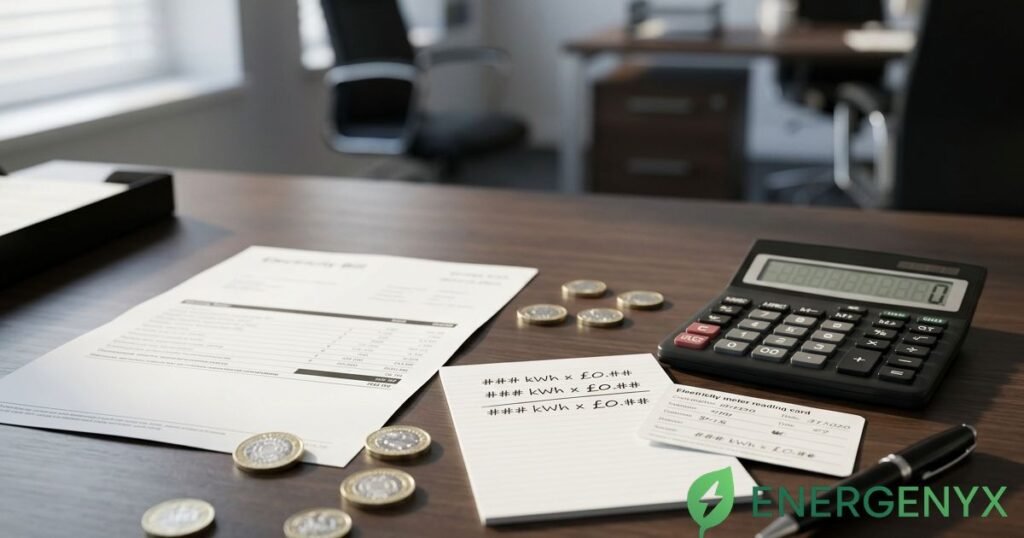
A simple way to estimate your electricity usage cost is:
Electricity cost = Annual electricity consumption × Unit rate
Then add applicable standing charges and other charges.
For example, suppose a business uses 20,000 kWh per year and has an electricity unit rate of 25p per kWh.
The electricity usage cost would be:
20,000 × £0.25 = £5,000
If the business also paid a standing charge of 50p per day:
365 × £0.50 = £182.50
The combined figure would therefore be approximately:
£5,182.50
This is a simplified example rather than a quotation. Your actual bill can include additional charges, taxes and levies.
Example Business Electricity Costs
The following examples demonstrate how consumption can affect electricity expenditure.
| Annual electricity usage | Example unit rate | Estimated usage cost |
|---|---|---|
| 5,000 kWh | 25p/kWh | £1,250 |
| 10,000 kWh | 25p/kWh | £2,500 |
| 20,000 kWh | 25p/kWh | £5,000 |
| 50,000 kWh | 25p/kWh | £12,500 |
| 100,000 kWh | 25p/kWh | £25,000 |
These figures are illustrative only and exclude standing charges, taxes, levies and other applicable charges.
They demonstrate an important point: even a small difference in the unit rate can have a substantial impact when a business consumes large amounts of electricity.
What Factors Affect Business Electricity Costs?
Several factors can influence how much your business pays.
Business Electricity Consumption
The amount of electricity your business uses is one of the most obvious factors.
A business consuming 100,000 kWh per year has significantly greater exposure to electricity prices than one consuming 10,000 kWh.
Reducing unnecessary consumption can therefore have a direct impact on energy expenditure.
Business Location
Your geographical location can influence network-related electricity costs.
Electricity distribution charges vary across different areas of Great Britain, meaning two otherwise similar businesses can have different overall energy costs.
Meter Type
The type of electricity meter your business uses can also affect how its energy is measured and billed.
Businesses may have:
- Smart meters
- Non-half-hourly meters
- Half-hourly meters
The details appearing on a business energy bill can depend partly on the meter type and the contract.
Contract Type
Your contract can have a major effect on your electricity costs.
Common business electricity arrangements include:
- Fixed-rate contracts
- Variable-rate contracts
- Deemed contracts
- Out-of-contract arrangements
Ofgem explains that businesses can be placed on a deemed contract when they move into premises and use energy before agreeing a contract with a supplier.
Contract Length
The length of your agreement can also influence the price available to your business.
Longer contracts may provide greater price certainty, while shorter arrangements may provide more flexibility but expose the business to future market changes.
When You Buy Your Energy
Wholesale energy prices fluctuate.
The price available when a supplier builds a quotation can therefore influence the eventual business electricity rate.
This is one reason businesses should avoid assuming that an old electricity quote will remain available indefinitely.
Does Business Size Affect Electricity Costs?
Business size can influence both consumption and the type of energy contract available.
Ofgem defines a microbusiness using criteria including employee numbers, turnover or balance sheet total, and energy consumption thresholds. For electricity, a business can fall within the microbusiness definition if it uses no more than 100,000 kWh per year, subject to the other applicable criteria.
Ofgem also introduced a Small Business classification from December 2024. Among the energy-use criteria, a business can qualify based on electricity consumption of no more than 200,000 kWh per year, subject to the other criteria.
This is useful when comparing energy options because the market and contractual requirements can differ depending on the size and characteristics of your business.
Business Electricity Cost vs Domestic Electricity Cost
Business and domestic electricity should not be treated as the same product.
Domestic customers on default tariffs are subject to Ofgem’s energy price cap, whereas business customers generally negotiate commercial energy contracts with suppliers.
For context, Ofgem’s household electricity price-cap rate for 1 July to 30 September 2026 is an average 26.11p per kWh, with a daily standing charge of 57.19p, including 5% VAT. However, this is a domestic price-cap figure and should not be used as a business electricity rate.
Business electricity pricing works differently and depends on the commercial contract and the circumstances of the business.
Why Business Electricity Prices Can Be Difficult to Compare
Looking only at the headline unit rate does not always tell you which electricity deal is cheapest.
For example:
Supplier A
- Unit rate: 24p/kWh
- Standing charge: 70p/day
Supplier B
- Unit rate: 25p/kWh
- Standing charge: 40p/day
If a business uses a large amount of electricity, Supplier A’s lower unit rate might be more important.
If the business has relatively low consumption, the standing charge could have a greater influence on the overall cost.
This is why businesses should compare the total expected cost, not just the advertised pence-per-kWh figure.
How Much Does Electricity Cost for a Small Business?
There is no universal electricity bill for a small business.
A small office might use only a few thousand kWh per year, while a restaurant, workshop or retail business could use substantially more.
For example, using an illustrative rate of 25p/kWh:
- 5,000 kWh = £1,250 usage cost
- 10,000 kWh = £2,500 usage cost
- 20,000 kWh = £5,000 usage cost
- 30,000 kWh = £7,500 usage cost
These figures do not represent current market quotations. They simply demonstrate how consumption affects electricity expenditure.
The best starting point is your previous year’s electricity consumption.
If you have an annual consumption figure from your bill, you can use it to estimate the impact of different electricity rates.
How to Find Your Business Electricity Consumption
Your previous electricity bills are usually the best starting point.
Look for information such as:
- Annual consumption
- Meter readings
- kWh used
- Current unit rate
- Standing charge
- Contract end date
- Meter number
- Current supplier
- Contract type
If your business has been operating for at least a year, your historical consumption can provide a useful baseline when comparing new deals.
If you have recently moved premises or your business is new, estimating consumption may be more difficult.
In that situation, the size and type of premises, opening hours, equipment and previous consumption at the property may help produce an estimate.
How to Reduce Business Electricity Costs
Reducing electricity costs is not always about finding a cheaper supplier.
Businesses can also reduce their bills by lowering unnecessary consumption.
1. Reduce Unnecessary Electricity Usage
Switch off equipment, lighting and appliances when they are not required.
For businesses operating outside normal hours, automated controls and timers can help prevent equipment from being left on unnecessarily.
2. Improve Lighting Efficiency
Replacing inefficient lighting with modern LED lighting can reduce electricity consumption.
Motion sensors and timers can also help in areas that are not continuously occupied.
3. Monitor Electricity Consumption
Regularly monitoring electricity use can reveal unusual increases.
Smart meters and energy monitoring systems can make it easier to understand when your business consumes the most electricity.
4. Review Equipment
Older electrical equipment may consume more electricity than newer, more efficient alternatives.
Businesses should consider energy efficiency when replacing equipment, particularly where machinery operates for many hours each day.
5. Compare Business Electricity Deals
Once you understand your consumption, comparing business electricity contracts can help you identify potentially better rates.
Don’t compare unit rates alone. Look at the complete cost, including standing charges and other applicable charges.
6. Review Your Contract Before Renewal
Avoid waiting until the last minute to review your contract before the business electricity renewal.
Starting the process early gives you more time to understand your options and compare available deals.
Can an Energy Broker Help Reduce Business Electricity Costs?
Businesses can arrange energy contracts themselves or use an energy broker.
Ofgem confirms that businesses can set up an energy contract directly or use a third party such as an energy broker. Brokers may charge a fee for their service.
An energy broker may help by:
- Obtaining quotations
- Comparing suppliers
- Explaining contract options
- Helping with contract negotiations
- Supporting the switching process
However, businesses should understand how the broker is paid and whether any commission or fee is included in the deal.
A lower unit rate does not automatically mean a lower overall cost, so businesses should consider the complete quotation.
What Is a Good Business Electricity Price?
There is no single “good” business electricity price.
A rate that is competitive for one business may not be competitive for another because electricity prices depend on factors such as:
- Annual consumption
- Location
- Contract length
- Meter type
- Payment terms
- Market conditions
- Supplier
- Business size
- Contract start date
Instead of asking only “What is the cheapest business electricity rate?”, businesses should ask:
“What is the lowest overall cost for my specific consumption and requirements?”
That is a much more useful way to compare business electricity deals.
How to Compare Business Electricity Costs
Before switching electricity supplier, gather the following information:
Step 1: Find Your Current Consumption
Check your latest bills and identify your annual kWh usage.
Step 2: Check Your Current Unit Rate
Find the price you currently pay per kWh.
Step 3: Check Your Standing Charge
Find out how much you pay per day.
Step 4: Check Your Contract End Date
Knowing when your current electricity contract ends can help you avoid being moved onto less favourable arrangements.
Step 5: Compare Multiple Quotes
Obtain quotes from several suppliers or use an energy comparison service.
Step 6: Calculate the Total Cost
Compare the estimated annual cost rather than focusing only on the unit rate.
Step 7: Check the Contract Terms
Look at:
- Contract length
- Payment terms
- Exit fees
- Renewal arrangements
- Standing charges
- Unit rates
- Additional fees
Step 8: Choose the Deal That Fits Your Business
The cheapest headline price isn’t necessarily the best contract.
Consider price, flexibility, contract terms and the level of service you need.
Frequently Asked Questions
How much does electricity cost for a business?
There is no standard business electricity cost. Your bill depends on electricity consumption, unit rate, standing charge, contract type, location, meter type and other charges.
Is business electricity cheaper than domestic electricity?
Not necessarily. Business and domestic electricity are priced through different arrangements, and businesses generally negotiate commercial contracts rather than relying on the domestic price cap.
How is business electricity calculated?
A simplified calculation is:
Electricity consumption × unit rate + standing charges + applicable additional charges
Your actual bill may contain network charges, taxes, levies and other costs.
What is the average business electricity price per kWh?
There is no single UK-wide average rate that applies to every business. Rates vary according to the business, contract, consumption, location, meter and market conditions.
Can I reduce my business electricity bill?
Yes. Businesses can potentially reduce costs by improving energy efficiency, reducing unnecessary consumption, monitoring usage and comparing electricity contracts.
Should I compare electricity unit rates or total costs?
You should compare the overall expected cost. A lower unit rate can be offset by a higher standing charge or other contractual costs.
Are businesses protected by the Ofgem price cap?
Generally, business energy contracts are not covered by the domestic energy price cap. Businesses typically negotiate commercial energy contracts with suppliers.
When should I compare business electricity prices?
Ideally, start reviewing your options before your current contract ends. This gives you time to understand your consumption, compare quotations and check contract terms.
Final Thoughts
Business electricity costs can have a significant impact on your company’s operating expenses, but there is no single price that applies to every business.
The most important factors to understand are your electricity consumption, unit rate, standing charge and contract terms.
From there, you can look at the wider costs that contribute to your electricity bill, including wholesale energy, network charges, environmental costs, taxes and supplier costs.
The best way to manage your electricity expenditure is to monitor how much energy your business actually uses, improve efficiency where possible and compare suitable commercial electricity contracts before renewal.
If you’re looking to reduce your business electricity costs, understanding your current consumption is the first step. Once you know how many kWh your business uses and what you’re currently paying, you can make a much more informed comparison of alternative electricity deals.
Ready to Reduce Your Business Electricity Costs?
If you’re paying more than necessary for electricity, comparing your current deal with alternative business electricity rates could help you find a more competitive option. Compare business electricity deals today and see what options may be available for your business.