
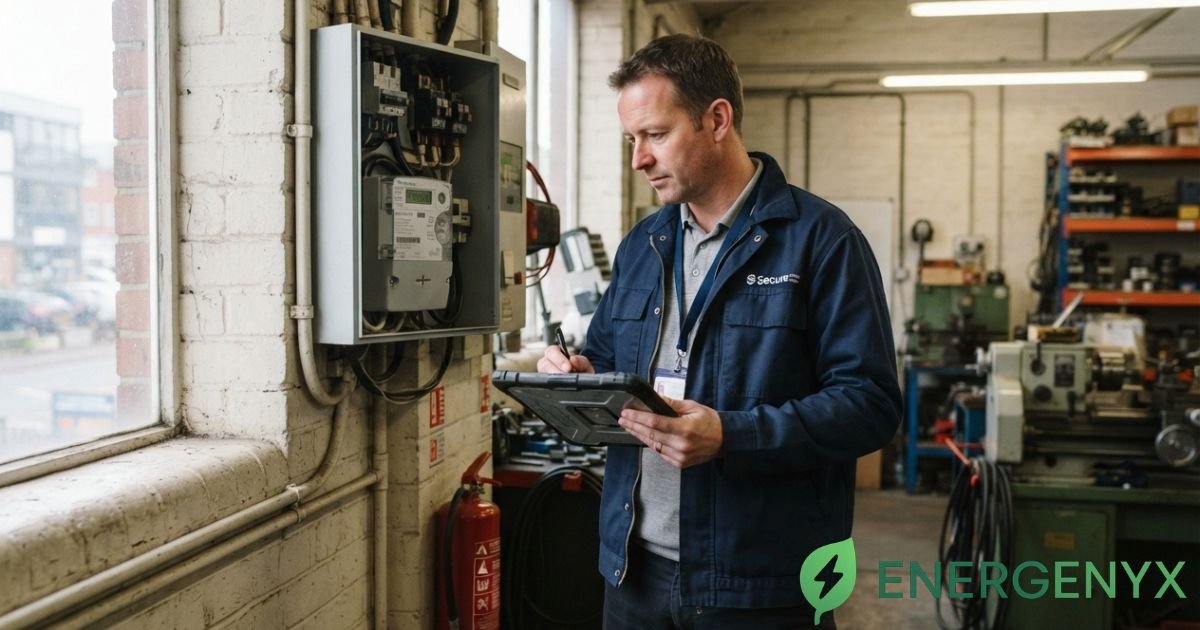
Knowing how to read a business electricity meter is an important part of managing your company’s energy costs. An accurate meter reading can help your electricity supplier produce bills based on your actual consumption rather than estimates.
For businesses, this can be particularly important when electricity usage changes significantly from one month to another. Providing regular readings can also help you spot unusual consumption, check your bills and identify potential billing problems.
However, not every electricity meter is read in the same way. A business may have a traditional analogue meter, a digital meter, a two-rate meter, a smart meter or a more advanced commercial metering system.
In this guide, we’ll explain how to read a business electricity meter, what numbers to record, which numbers to ignore, how to submit a reading and what to do if your reading doesn’t match your electricity bill.
If you want to reduce your bill or want to do a commercial energy comparison, you can contact energenyx now.
What Is a Business Electricity Meter Reading?
A business electricity meter reading shows how much electricity the premises has consumed.
Electricity consumption is normally measured in kilowatt-hours (kWh).
Your meter records cumulative electricity usage. Your supplier can then use the current reading and previous readings to calculate how much electricity you’ve consumed during a particular billing period.
For example, if your previous meter reading was:
25,400 kWh
and your current reading is:
26,150 kWh
your electricity consumption during that period would be:
26,150 − 25,400 = 750 kWh
The supplier can then apply the relevant electricity unit rate and other applicable charges according to your contract and bill.
Why Is Reading a Business Electricity Meter Important?
Regular meter readings can provide several benefits for a business.
More Accurate Electricity Bills
If your supplier receives actual meter readings, it has better information about your electricity consumption.
Without an actual reading, a supplier may sometimes need to estimate usage.
Regular readings can therefore help reduce discrepancies between estimated consumption and actual consumption.
Better Control of Energy Costs
Knowing how much electricity your business is using can help you monitor energy costs.
If consumption suddenly increases, you can investigate what caused the change.
For example, increased usage could be linked to:
- Longer operating hours
- New electrical equipment
- Heating or cooling
- Increased production
- Refrigeration
- Lighting
- Machinery
- Seasonal changes
Easier Bill Checking
A meter reading gives you a useful reference when checking your electricity bill.
If the bill shows a much higher consumption figure than expected, comparing the bill with your actual meter reading can help identify whether further investigation is needed.
Helps Identify Billing Problems
Incorrect meter readings can contribute to billing disputes.
Keeping a record of readings can provide useful evidence if you need to challenge an electricity bill or investigate a backdated charge.
This is particularly relevant to businesses dealing with business electricity back billing.
How to Read a Business Electricity Meter
The exact process depends on the type of meter installed at your premises.
Before taking a reading, first identify which type of electricity meter you have.
The most common situations include:
- Digital electricity meters
- Traditional analogue meters
- Two-rate or Economy 7-style meters
- Smart meters
- Advanced and half-hourly meters
Let’s look at each one.
You can also read OFGEM Guidance on metering.
How to Read a Digital Business Electricity Meter
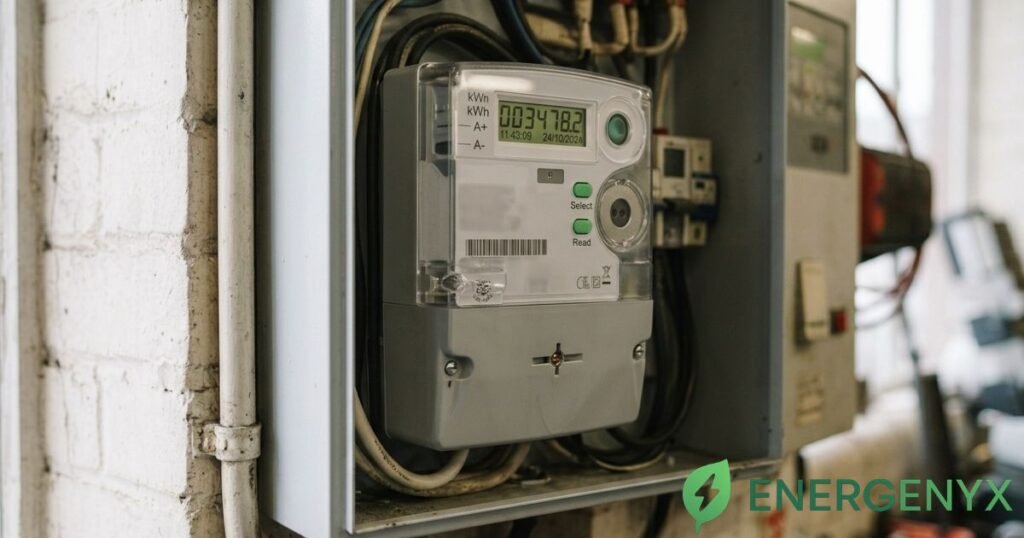
Digital electricity meters normally display your electricity consumption using numbers on a screen.
The display may show a reading in kWh.
Step 1: Locate the Meter
Find the electricity meter serving your business premises.
It may be located in:
- A utility room
- Electrical cupboard
- Plant room
- Reception area
- External meter cabinet
- Building services area
If you’re unsure which meter belongs to your business, ask your landlord, facilities manager or electricity supplier.
Step 2: Check the Display
Look at the digital display.
You may need to press a button to cycle through different screens.
The meter can display several pieces of information, so don’t automatically record the first number you see.
Step 3: Find the Electricity Consumption Reading
Look for the reading expressed in kWh.
This is normally the figure your supplier needs for a standard electricity meter reading.
Step 4: Record the Number
Write down the reading exactly as displayed.
For example:
18,742 kWh
Take a photograph of the display if possible.
A dated photograph can provide useful evidence of the reading you submitted.
How to Read a Traditional Analogue Electricity Meter
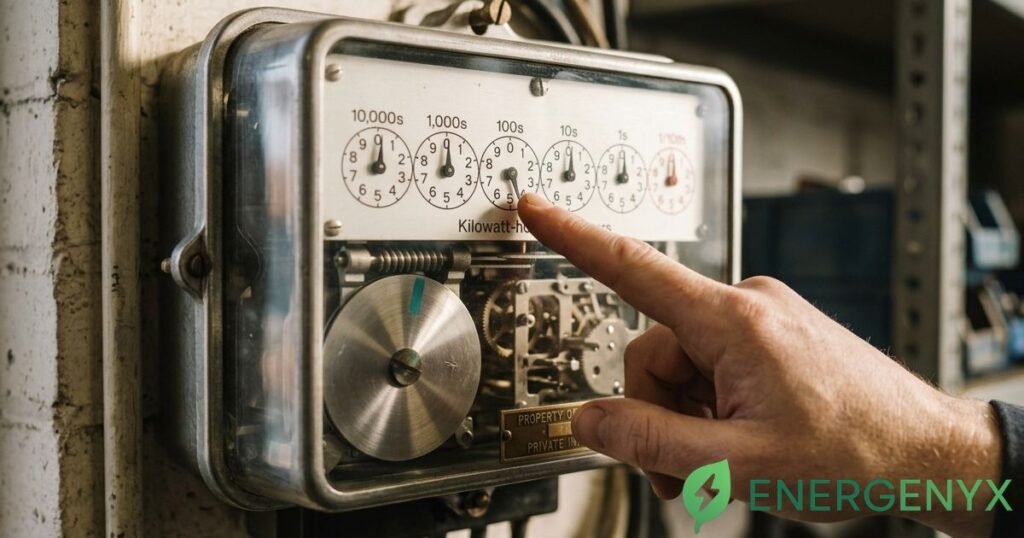
Older electricity meters may use a series of rotating numbers or dials.
Reading these meters requires slightly more care.
Some analogue meters have several dials, each representing a different position in the electricity reading.
How to Read Electricity Meter Dials
Read the dials from left to right.
For each dial:
- Identify the two numbers between which the pointer sits.
- Record the lower number.
- If the pointer is exactly between two numbers, follow the meter’s specific reading instructions.
- Repeat the process for each relevant dial.
Because different analogue meters can use different dial arrangements, check the meter instructions or supplier guidance if you’re uncertain.
Do not guess if the pointer position is unclear.
A photograph can also help your supplier confirm the reading.
How to Read a Two-Rate Business Electricity Meter
Some businesses have meters that record electricity consumption at different rates or during different periods.
A two-rate meter may show separate readings, such as:
- Rate 1
- Rate 2
The exact terminology depends on the meter.
One reading may represent electricity consumed during one period and another may represent consumption during a different period.
What Should You Record?
If your supplier requests readings for both rates, record both readings.
For example:
Rate 1: 14,850 kWh
Rate 2: 6,320 kWh
Do not assume that only one figure is required.
If your electricity bill contains separate consumption figures, compare each one with the appropriate meter reading.
Want to do a commercial electricity comparison, you can contact energenyx now.
How to Read a Smart Meter for Business
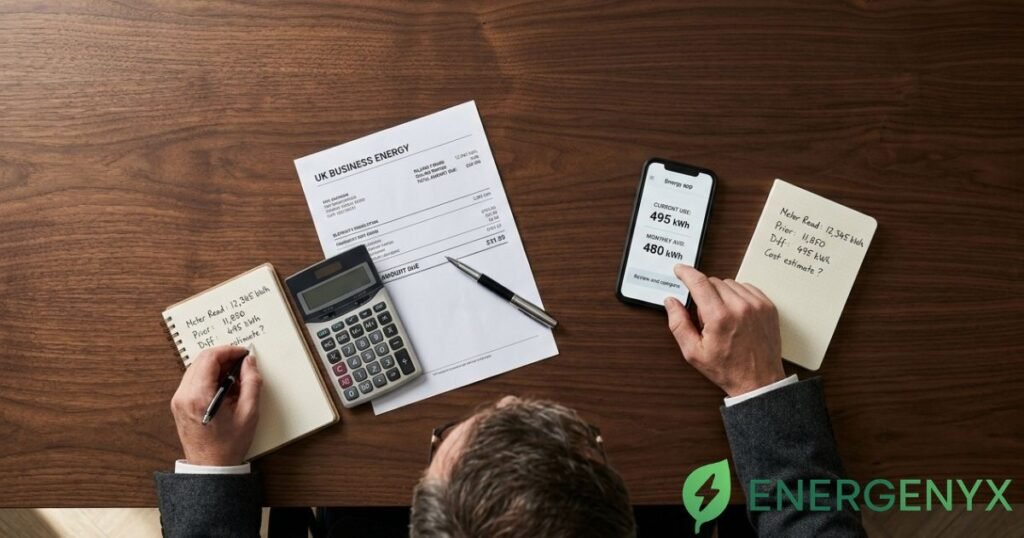
Smart meters are designed to communicate electricity consumption information to the supplier automatically when operating correctly in smart mode.
However, businesses may still need to check the meter display or provide a manual reading if requested.
To read a smart meter:
- Locate the meter.
- Wake the display if it is inactive.
- Identify the electricity consumption reading.
- Check that the unit is kWh.
- Record the displayed figure.
- Take a photograph if you want a record of the reading.
Don’t confuse the electricity consumption figure with other information displayed by the meter.
For more information, see our guide to smart meters for business.
What Does kWh Mean on an Electricity Meter?
kWh stands for kilowatt-hour.
It is the standard unit used to measure electricity consumption.
For example, if equipment with a power demand of 1 kilowatt operates continuously for one hour, it would use approximately 1 kWh of electricity.
Businesses don’t normally need to calculate their entire electricity usage manually because the meter records cumulative consumption.
The important figure when taking a standard meter reading is generally the cumulative electricity consumption displayed in kWh.
Which Numbers Should You Record?
This is one of the most common sources of confusion.
Electricity meters can display several numbers, codes or indicators.
For a standard meter reading, you generally need the electricity consumption figure in kWh.
Depending on the meter, you may see:
- kWh consumption
- Meter identification information
- Rate information
- Voltage
- Current
- Time
- Date
- Other technical information
Don’t automatically submit every number displayed on the meter.
If you’re unsure which figure your supplier needs, check your supplier’s instructions.
There is PDF Guide from OFGEM also available
Should You Include Numbers After the Decimal Point?
Whether you should include decimal places depends on the meter and your supplier’s instructions.
Some meters display whole kWh while others may show decimal places.
If your supplier specifically asks for a certain format, follow its instructions.
For a standard reading, don’t invent or round numbers unless the supplier tells you to do so.
How to Submit a Business Electricity Meter Reading
Once you’ve taken the reading, you normally submit it directly to your electricity supplier.
The available methods vary between suppliers but can include:
- Online account
- Supplier mobile app
- Telephone
- Customer portal
- Other supplier-provided methods
Have the following information available:
- Meter reading
- Meter number or identification information if requested
- Business account details
- Date of reading
- Photograph of the meter, if useful
Submitting readings through the correct channel can help ensure the supplier associates the reading with the correct account.
How Often Should a Business Take a Meter Reading?
There isn’t one universal schedule that is ideal for every business.
A business can benefit from taking readings regularly, particularly when:
- Electricity usage changes significantly
- A new contract is starting
- An existing contract is ending
- A business is switching supplier
- The premises is changing
- You receive an unexpectedly high bill
- Your supplier requests a reading
- You suspect an estimated reading has been used
For businesses with significant energy consumption, monitoring usage more frequently may provide greater visibility.
Smart or advanced metering can also provide more detailed information without relying entirely on manual readings.
Take a Meter Reading Before Switching Business Electricity Supplier
If you’re changing electricity supplier, recording the meter reading around the changeover date is a sensible step.
Keep a dated photograph of the meter where possible.
This creates a record of the electricity consumption at the time of the transition.
It can be particularly useful if there is later a disagreement about:
- Final bills
- Opening readings
- Closing readings
- Consumption
- Contract changeover dates
When switching electricity, also make sure you understand which supplier is responsible for the relevant period.
Take a Meter Reading When Your Business Electricity Contract Ends
Your contract renewal is another useful time to record the meter reading.
Take the reading close to the relevant date and keep evidence of it.
This can help you compare:
Previous supplier → Changeover reading → New supplier
If something later appears incorrect on your bills, you have a stronger record to refer back to.
How to Check a Business Electricity Bill Against Your Meter
You can compare the meter reading with the readings shown on your bill.

Look for:
- Previous reading
- Current reading
- Consumption
- Meter number
- Billing dates
- Unit rate
- actual Standing charge
- Estimated or actual reading indicator
For example:
Previous reading: 30,000 kWh
Current reading: 31,250 kWh
Consumption: 1,250 kWh
If the numbers don’t appear consistent, investigate before assuming the bill is correct or incorrect.
Remember that the bill may relate to a specific billing period, so the dates must also match.
What Is an Estimated Electricity Meter Reading?
An estimated reading is a supplier’s calculation of how much electricity the business has used when an actual meter reading isn’t available.
Estimated readings are not necessarily evidence of a billing error.
However, estimates can differ from actual consumption.
If your business receives an estimated bill, submitting an accurate meter reading can help your supplier update the account, subject to the supplier’s billing process and the circumstances.
What If Your Business Electricity Bill Uses an Estimated Reading?
First, check your actual meter.
Record the current reading and take a photograph.
Then compare it with the reading shown on the bill.
If the supplier accepts customer readings for your meter, submit the reading using its approved process.
Keep a copy or screenshot of the submission where possible.
If there is a significant discrepancy, contact the supplier and ask it to review the account.
What If Your Meter Reading Is Much Higher Than Expected?
A sudden increase doesn’t automatically mean the meter is faulty.
Investigate possible causes first.
Your business may have:
- Increased production
- Added equipment
- Longer operating hours
- Increased heating or cooling
- Seasonal demand
- New refrigeration
- Additional staff or premises
- Equipment operating outside normal hours
If you cannot explain the increase, contact your supplier or a qualified professional to investigate further.
What If the Meter Reading Is Lower Than Expected?
The same principle applies.
Check whether:
- Your business operated fewer hours
- Production decreased
- Equipment was replaced
- The premises was temporarily closed
- Seasonal conditions changed
- Energy-efficiency measures were introduced
If the reading appears impossible or inconsistent with your historical usage, ask your supplier to investigate.
Can a Business Electricity Meter Be Wrong?
Meters can experience faults or other technical problems, although an unusual bill doesn’t necessarily mean the meter is faulty.
If you suspect a problem:
- Record the current reading.
- Photograph the meter.
- Check your recent bills.
- Compare historical consumption.
- Contact your electricity supplier.
- Follow the supplier’s instructions for testing or inspection.
Don’t attempt to open, modify or repair an electricity meter yourself.
Metering equipment can involve dangerous electrical systems and should be handled by appropriately qualified professionals.
What If Your Electricity Meter Is Not Working?
If the display is blank, damaged or appears to be malfunctioning, contact your supplier or the appropriate responsible party.
Don’t attempt to repair the meter yourself.
If the business has lost electricity supply as well as experiencing a meter problem, treat the situation as an electricity fault and contact the relevant emergency or network service according to your supplier’s guidance.
How Meter Readings Relate to Business Electricity Costs
Your meter reading tells you how much electricity has been consumed.
Your electricity contract determines how that consumption is charged.
A simplified example might look like:
Electricity consumption × unit rate = energy charge
But a business electricity bill can contain other costs, including standing charges and applicable taxes or other charges.
This means reducing the meter reading through energy efficiency can help reduce consumption-related costs, but the total bill is not determined by consumption alone.
For more information, see our guide to business electricity prices.
How Meter Readings Can Help Prevent Back Billing Problems
Regular readings can help create a record of your actual electricity consumption.
This can be valuable if your supplier later identifies a billing discrepancy.
For example, keeping dated readings can help demonstrate:
- What the meter showed
- When the reading was taken
- What information was supplied to the energy company
- Whether bills were based on actual or estimated readings
This doesn’t guarantee that a business will never receive a backdated bill, but good records can make billing problems easier to investigate.
Read our guide to business electricity back billing to understand how backdated charges can arise and what protections may apply to qualifying businesses.
Keeping a Business Electricity Meter Reading Record
Businesses should consider keeping a simple record of their readings.
You could use a spreadsheet containing:
| Date | Meter Reading | Unit | Actual/Estimated | Notes |
|---|---|---|---|---|
| 1 January | 25,400 | kWh | Actual | Monthly reading |
| 1 February | 26,150 | kWh | Actual | Normal operation |
| 1 March | 27,020 | kWh | Actual | Production increased |
You can also save photographs alongside the records.
This creates a useful historical record of electricity consumption.
What Information Should You Keep?
Keep copies of:
- Meter readings
- Meter photographs
- Electricity bills
- Supplier correspondence
- Contract documents
- Change-of-supplier information
- Meter installation information
- Reading submission confirmations
- Relevant complaint correspondence
The exact records you need will depend on your business and circumstances.
For larger businesses, energy records may form part of a broader energy-management process.
Business Electricity Meter Reading Checklist
Before submitting a meter reading, check:
- I am reading the correct electricity meter.
- The meter belongs to the correct business premises.
- I have identified the correct electricity consumption figure.
- The reading is in kWh where applicable.
- I have recorded all required rates if the meter has multiple rates.
- I have checked whether the supplier wants decimal places.
- I have photographed the meter.
- I have recorded the date.
- I have submitted the reading through the supplier’s approved method.
- I have saved confirmation of submission.
- I have compared the reading with my latest bill where appropriate.
Common Business Electricity Meter Reading Mistakes
Mistake 1: Reading the Wrong Meter
Large commercial buildings can have multiple meters.
Always confirm which meter relates to your business account.
Mistake 2: Recording the Wrong Display
Digital meters can display multiple pieces of information.
Make sure you’re recording the electricity consumption reading rather than another value.
Mistake 3: Forgetting Multiple Rates
If your meter records multiple rates, check whether the supplier requires all relevant readings.
Mistake 4: Not Taking a Photograph
A photograph provides a useful record of what the meter displayed on a particular date.
Mistake 5: Ignoring Estimated Readings
If your bill is based on an estimate, check your actual meter and provide a reading when appropriate.
Mistake 6: Not Keeping Records
Don’t rely entirely on your supplier’s records.
Keeping your own meter-reading history can make future billing investigations easier.
Business Electricity Meter Reading FAQs
How do I read a business electricity meter?
Identify the type of meter first. For a standard digital meter, locate the electricity consumption reading, usually shown in kWh, and record the required number. For multi-rate meters, you may need to record more than one reading.
What number do I give my electricity supplier?
For a standard electricity reading, your supplier will generally require the electricity consumption figure shown in kWh. The exact information required can vary by meter and supplier.
Should I take a photo of my business electricity meter?
Yes. A dated photograph can provide useful evidence of the reading you recorded, particularly when starting or ending a contract, switching suppliers or investigating a billing problem.
How often should I read my business electricity meter?
There is no single schedule suitable for every business. Regular readings can help monitor consumption and identify discrepancies, while businesses with smart or advanced metering may have automated data available.
What is kWh on an electricity meter?
kWh means kilowatt-hour and is the standard unit used to measure electricity consumption.
What is an estimated electricity reading?
An estimated reading is a supplier’s calculation of electricity consumption when an actual meter reading is not available.
Why is my business electricity bill higher than my meter reading?
Check the billing dates, previous reading, current reading, unit rate and other charges on the bill. The total bill can include costs beyond electricity consumption, so the meter reading alone does not determine the final amount.
Can I read a smart meter manually?
Yes, you can generally view the meter’s displayed information, although a smart meter is designed to communicate readings automatically when operating correctly in smart mode. Follow your supplier’s instructions if it requests a manual reading.
What should I do if my business electricity meter appears faulty?
Do not attempt to repair or interfere with the meter. Record the reading if possible, photograph the display and contact your electricity supplier or relevant metering provider.
Should I take a meter reading when switching suppliers?
Yes. Recording a dated reading around the changeover can provide a useful record for checking final and opening bills.
Final Thoughts
Learning how to read a business electricity meter is a simple but valuable part of managing your company’s energy costs.
Whether your business has a traditional, digital, smart or multi-rate meter, understanding what the meter is showing can help you monitor consumption, check bills and maintain better energy records.
The most important habits are straightforward: identify the correct meter, record the correct electricity reading, take photographs, submit readings through the appropriate supplier channel and keep your own records.
If your business is receiving estimated bills, experiencing unusual electricity costs or approaching the end of an energy contract, accurate meter information can also help you make better decisions about your next business electricity deal.
Once you understand your actual electricity consumption, the next step is to review whether your current tariff and supplier still offer the right deal for your business.
Don’t Wait Until Your Contract Ends
The best time to review your business electricity options is before your current contract expires. Starting early gives you more time to understand your options and avoid making a rushed decision.
👉 Ready to see whether your business could get a better electricity deal?