
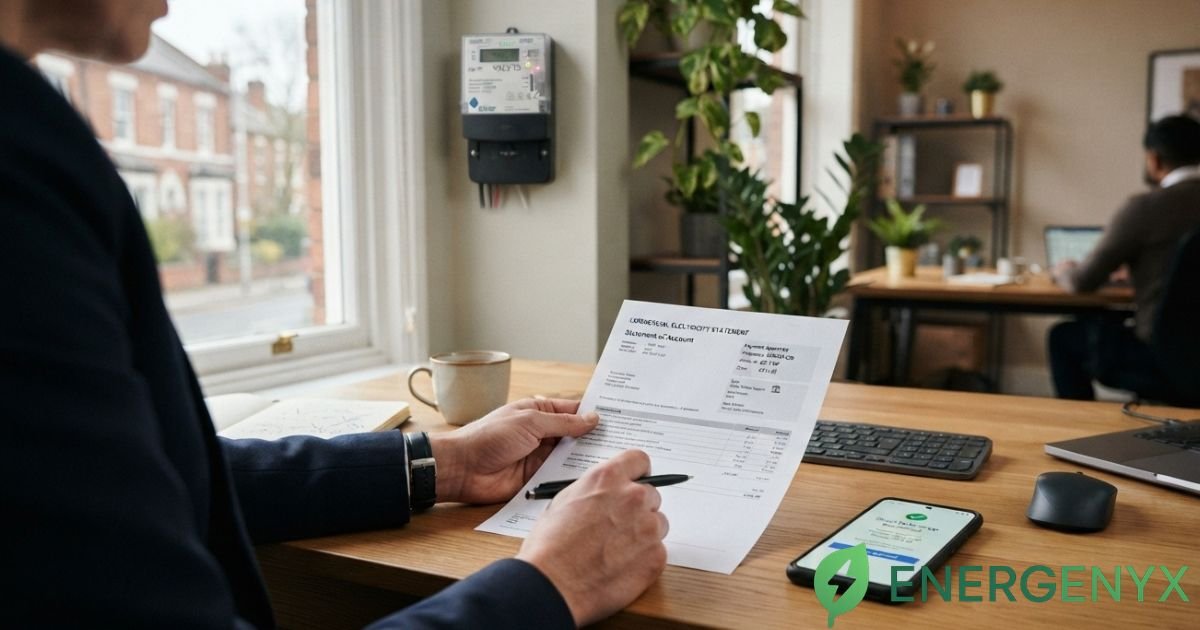
Paying your business electricity bill by Direct Debit can make managing energy costs much easier. Instead of manually paying every electricity bill, you authorise your energy supplier to collect payments directly from your business bank account according to the agreed payment arrangement.
For many businesses, Direct Debit provides a convenient way to keep electricity payments on schedule and reduce the risk of missed payment deadlines. However, it is important to understand how Direct Debit works, how suppliers calculate payments, and what to do if the amount being collected does not look right.
In this guide, we explain how business electricity Direct Debit works, how payments are calculated, its advantages and disadvantages, and what businesses should check before agreeing to a Direct Debit arrangement.
What Is a Business Electricity Direct Debit?
A business electricity Direct Debit is an arrangement that allows your electricity supplier to collect money directly from your business bank account to pay your electricity bills.
Rather than logging into your bank or making a manual payment each time a bill arrives, you give your supplier permission to collect the amount owed.
The exact payment arrangement depends on your supplier and contract. Some businesses may have payments collected based on actual bills, while others may have an agreed payment amount that is reviewed periodically.
Direct Debit is one of the established ways of paying energy bills. Ofgem describes it as a quick and easy way to pay energy bills and advises customers to make sure their Direct Debit amount remains appropriate for their energy use.
How Does Business Electricity Direct Debit Work?
The process is relatively straightforward.
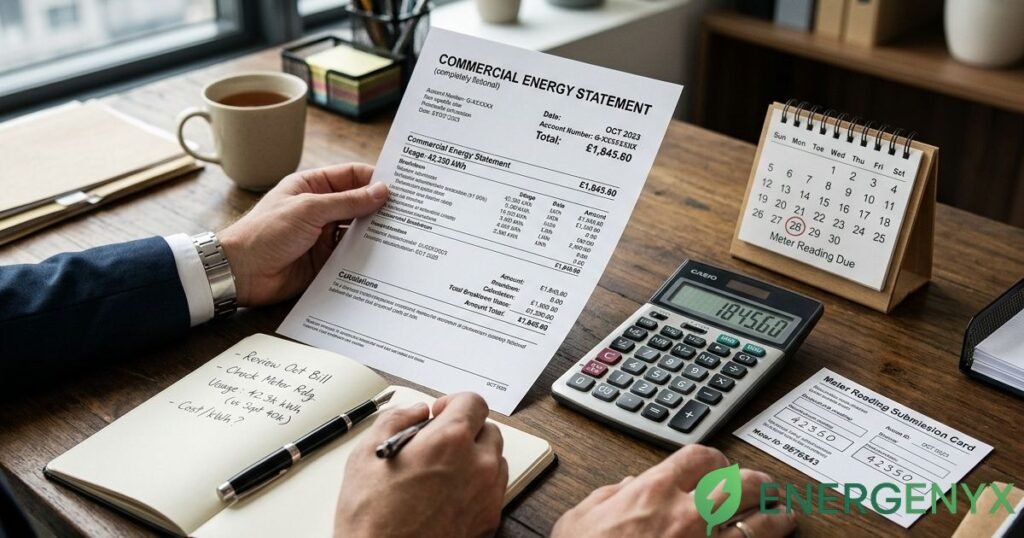
1. You choose Direct Debit as your payment method
When you arrange your business electricity contract, your supplier may offer Direct Debit as one of the available payment methods.
You provide the necessary bank account details and authorise the supplier to collect payments.
2. Your supplier sets up the Direct Debit
The supplier establishes the Direct Debit instruction with your bank.
You should receive information explaining the payment arrangement, including when payments will be collected and, depending on the arrangement, how much will be taken.
3. Your electricity bill is calculated
Your supplier calculates your electricity charges based on your contract and electricity consumption.
A business electricity bill can include several components, including the electricity unit rate, standing charges, taxes and other applicable costs. Ofgem notes that business energy contracts can include wholesale, network, government scheme, supplier and other costs.
4. The payment is collected automatically
On the agreed collection date, your supplier requests the payment from your business bank account.
If sufficient funds are available, the payment is processed without you needing to make a manual bank transfer or card payment.
5. Your account is reviewed
Your supplier may periodically review your payments against your actual electricity consumption.
If your usage changes significantly, your Direct Debit amount may need to be adjusted.
How Much Is a Business Electricity Direct Debit?
There is no standard Direct Debit amount for every business.
Your payment depends on factors such as:
- Electricity consumption
- Unit rate
- Standing charge
- Contract type
- Contract length
- Meter type
- Business size
- Seasonal consumption
- Outstanding account balance or credit
- Taxes and other applicable charges
For example, a small office using relatively little electricity could have significantly lower monthly payments than a manufacturing business operating machinery throughout the day.
This is why businesses should not judge an electricity contract simply by looking at the monthly Direct Debit.
The unit rate, standing charge, contract terms and expected annual consumption are also important.
Are Business Electricity Direct Debits Fixed Every Month?
Not necessarily.
The way Direct Debit payments work depends on your supplier and payment arrangement.
Some suppliers may collect an amount based on your actual bill, while others may calculate regular payments based on expected annual consumption and periodically review the account.
For example, imagine a business expects to spend £6,000 on electricity over a year. The supplier could potentially arrange regular payments around the expected annual cost, subject to the supplier’s billing method and subsequent reviews.
However, actual consumption may be higher or lower than expected.
If the business uses significantly more electricity than forecast, its account could build up a balance that needs to be addressed.
This is why businesses should regularly check their bills and account balance rather than assuming that a fixed-looking monthly Direct Debit means their electricity costs are fixed.
What Happens If Your Electricity Usage Changes?
Your electricity consumption can change for many reasons.
For example:
- Your business expands
- You add new equipment
- Your opening hours increase
- You move to larger premises
- Production increases
- You install energy-efficient equipment
- Your business operates less frequently
If your usage increases substantially, your existing Direct Debit may no longer accurately reflect your expected annual electricity costs.
This can result in an account balance building up.
If you notice that your Direct Debit appears too low compared with your actual electricity bills, contact your supplier rather than waiting until the end of your contract.
Ofgem advises businesses experiencing difficulty managing their energy bills to contact their supplier as soon as possible. Suppliers may be able to review payment arrangements and discuss options such as payment plans.
Can a Business Electricity Direct Debit Be Increased?
Yes, a supplier may review your payment arrangement and determine that a higher payment is necessary based on your consumption, account balance or expected future costs.
For example:
Original Direct Debit: £400 per month
Actual average electricity cost: £500 per month
If the difference continues over time, your account could fall into debit.
The supplier may therefore review the payment amount.
If your supplier proposes a significant change, check your recent bills and consumption before accepting the new amount. You should understand whether the increase is caused by:
- Higher electricity usage
- Higher rates
- An accumulated balance
- An estimated meter reading
- A billing correction
- A combination of these factors
What If Your Direct Debit Is Too High?
The opposite situation can also occur.
If your Direct Debit is substantially higher than your actual electricity costs, you could build up a credit balance.
For example, if you pay £700 per month but your actual average cost is only £500, your account could accumulate credit.
A credit balance is not necessarily a problem, but businesses should understand why it exists and whether their payment amount should be reviewed.
Check:
- Your latest electricity bill
- Your actual meter readings
- Your account balance
- Your recent consumption
- Your current tariff
- Your Direct Debit amount
If something doesn’t appear correct, contact your supplier.
Business Electricity Direct Debit vs Paying by Bank Transfer
Direct Debit isn’t the only way to pay for business electricity.
Businesses may also have options such as manual bank payments or other payment methods depending on their supplier and contract.
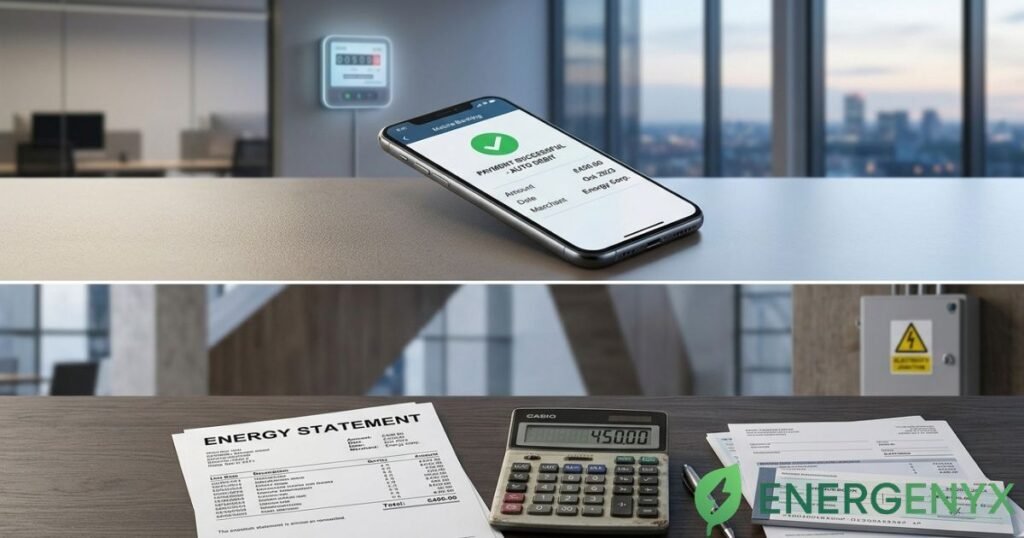
Direct Debit
Advantages:
- Automatic payments
- Less administration
- Lower risk of forgetting a payment
- Easier cash-flow planning
- No need to manually pay every bill
Potential disadvantages:
- Payments are taken automatically
- Incorrect payment amounts can affect cash flow
- Businesses need to monitor their account
- Payment dates need to be understood
Bank Transfer
Advantages:
- Greater control over each individual payment
- You manually authorise the payment
- Useful for businesses that prefer manual invoice approval
Potential disadvantages:
- More administration
- Greater risk of missed deadlines
- Someone needs to monitor and process invoices
- Payments may take additional time to arrange
For many businesses, Direct Debit can be convenient, but the best payment method depends on the company’s accounting processes and cash-flow preferences.
Is Direct Debit Cheaper for Business Electricity?
Not necessarily.
A Direct Debit payment method does not automatically mean your electricity tariff is cheaper.
Your total electricity cost is influenced by the terms of your business energy contract, including the unit rate, standing charge and other applicable charges.
Some suppliers or tariffs may offer different pricing depending on payment method, but businesses should compare the overall cost of the contract, rather than choosing a tariff solely because it offers Direct Debit.
Ofgem notes that business energy contracts can contain a range of costs beyond the basic electricity unit price, including network costs, government schemes and supplier costs.
Does Direct Debit Protect Your Business From Rising Electricity Prices?
No.
Direct Debit is simply a payment method. It does not determine whether your electricity tariff is fixed or variable.
For example, you could pay by Direct Debit under:
- A fixed-rate electricity contract
- A variable-rate contract
- Other types of business energy arrangements
The contract determines how your electricity price is calculated.
A fixed-rate contract generally provides a fixed unit price for the agreed contract period, subject to the contract’s terms and conditions. A variable contract can have electricity prices that change according to its terms.
Therefore:
Direct Debit ≠ fixed electricity price
This distinction is important when comparing business electricity deals.
What Happens If a Business Direct Debit Payment Fails?
A Direct Debit payment can fail if, for example, there is insufficient money in the bank account or there is a problem with the payment instruction.
If this happens, contact your supplier promptly.
A missed payment could potentially lead to:
- An unpaid balance
- Additional administration
- A request for payment through another method
- Problems managing your account if missed payments continue
The exact consequences depend on your supplier and contract.
If your business is struggling to pay its energy bills, don’t simply ignore the failed payment. Ofgem recommends contacting the supplier as soon as possible because suppliers may be able to discuss payment arrangements with eligible businesses.
Can You Cancel a Business Electricity Direct Debit?
You can generally cancel a Direct Debit instruction through your bank, but cancelling the Direct Debit does not cancel your electricity contract or remove money that you legitimately owe.
This distinction is extremely important.
If you cancel the Direct Debit because you believe your bill is incorrect, contact your supplier and explain the issue.
If you simply cancel the payment without arranging another way to pay, you could end up with an overdue balance.
If your electricity supplier goes out of business, Ofgem’s safety-net arrangements also cover Direct Debit arrangements. Ofgem says a new supplier will contact affected customers about how their account and Direct Debits will be handled.
What Should Businesses Check Before Setting Up Direct Debit?
Before agreeing to a business electricity Direct Debit, check the following.
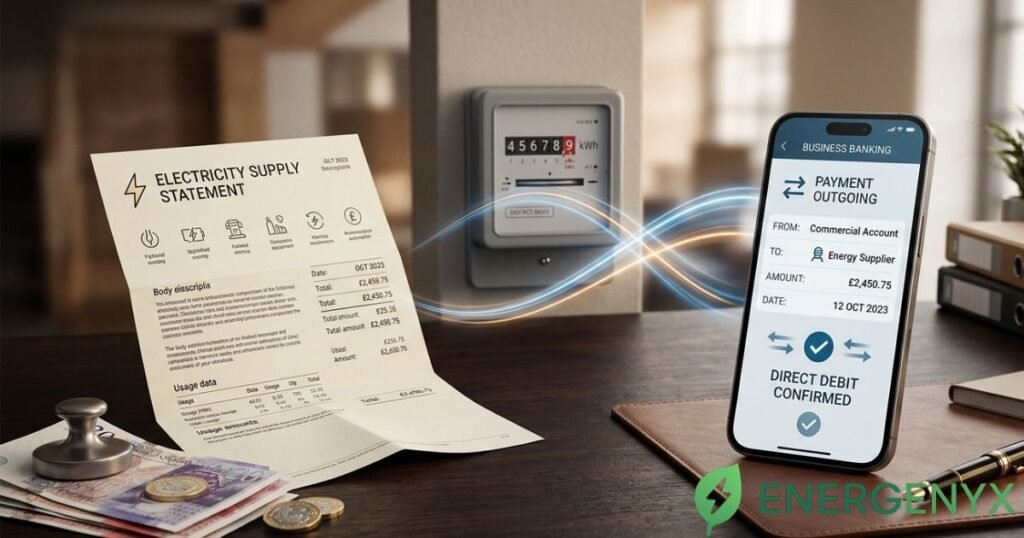
1. Your electricity tariff
Understand exactly what you are paying per kWh.
2. Standing charge
Check the daily or periodic standing charge included in your contract.
3. Payment frequency
Find out whether payments are monthly, quarterly or based on another schedule.
4. Direct Debit amount
Understand how the supplier calculates the amount being collected.
5. Review process
Ask how frequently the supplier reviews Direct Debit payments.
6. Contract terms
Check the full electricity contract, including its duration and termination conditions.
7. Meter readings
Keep your meter readings accurate and up to date.
8. Account balance
Regularly check whether your business account is in credit or debit.
Why Accurate Meter Readings Matter
Accurate meter readings can help your supplier calculate your electricity consumption correctly.
If your supplier relies on estimates and those estimates differ significantly from your actual usage, your bills and Direct Debit payments may not accurately reflect what your business is consuming.
Ofgem explains that the details shown on business energy bills can vary according to factors including the business, contract and type of meter.
Where possible, businesses should therefore:
- Take regular meter readings
- Submit readings when requested
- Keep records of readings
- Check bills against actual consumption
- Investigate unusual changes
Smart and half-hourly metering arrangements can provide more detailed consumption information for some businesses.
What If Your Business Electricity Bill Is Wrong?
Don’t assume that an incorrect-looking Direct Debit automatically means the payment itself is the problem.
First, check the underlying bill.
Look for:
- Meter readings
- Billing period
- Unit rate
- Electricity consumption
- Standing charges
- VAT
- Other charges
- Previous balance
- Credit or debit balance
If something appears incorrect, contact your supplier.
Ofgem also has rules concerning back billing. For households and microbusinesses, certain circumstances can limit how far back a supplier can charge for previously unbilled energy. This can include situations where a Direct Debit was previously set too low to cover the amount owed.
Business Electricity Direct Debit and Cash Flow
Cash flow is particularly important for small businesses.
Direct Debit can make regular electricity payments easier to budget for because the business knows when money will leave its account.
However, businesses should avoid treating their Direct Debit as a guaranteed monthly electricity cost.
Your actual energy expenditure can differ because of:
- Changing consumption
- Tariff changes
- Contract renewal
- Billing adjustments
- Account balances
- Additional charges
A good approach is to monitor your electricity account alongside your wider business finances.
Should Your Business Pay Electricity by Direct Debit?
For many businesses, Direct Debit can be a convenient option.
It can reduce administrative work and help prevent missed payments.
However, convenience shouldn’t replace regular account monitoring.
The ideal approach is:
Set up Direct Debit → monitor consumption → check bills → review payments → compare tariffs before renewal.
This ensures that your business gets the convenience of automatic payments without losing visibility over its energy costs.
How to Reduce Your Business Electricity Costs

Changing your payment method alone is unlikely to dramatically reduce electricity costs.
A bigger opportunity can come from reviewing your business electricity tariff.
Before your current contract ends, compare:
- Unit rates
- Standing charges
- Contract length
- Supplier terms
- Renewable electricity options
- Payment arrangements
- Additional charges
Ofgem explains that business energy contracts can last for several years and that most suppliers will not allow businesses to switch before the end of their contract.
This makes it important to review your options before your existing agreement expires.
If you’re looking for a new business electricity deal, comparing available tariffs can help you understand whether your current arrangement remains competitive.
Business Electricity Direct Debit Checklist
Before setting up or reviewing your Direct Debit, check:
- Electricity unit rate
- Standing charge
- Contract end date
- Direct Debit amount
- Payment frequency
- Account balance
- Latest meter reading
- Recent electricity consumption
- Electricity VAT and other charges
- Contract terms
- Renewal options
- Alternative supplier prices
Keeping track of these details can help prevent unpleasant surprises and make it easier to manage your business electricity budget.
Frequently Asked Questions
What is a business electricity Direct Debit?
It is an arrangement that allows an electricity supplier to automatically collect payments from a business bank account according to the agreed payment and billing arrangement.
Is business electricity Direct Debit mandatory?
No. Direct Debit is a payment method, and the options available depend on the supplier and contract.
Can my business electricity Direct Debit amount change?
Yes. Your supplier may review your payment amount based on electricity consumption, account balance and expected costs.
Is Direct Debit cheaper than paying by bank transfer?
Not automatically. Direct Debit is primarily a payment method. The overall cost of your electricity depends on the tariff and contract terms.
What happens if I don’t have enough money in my account?
The payment may fail. You should contact your supplier promptly and arrange payment to avoid an overdue balance or other consequences.
Can I cancel my business electricity Direct Debit?
You can generally cancel a Direct Debit instruction, but cancelling the payment method does not cancel your electricity contract or any outstanding amount you owe.
Why has my electricity Direct Debit increased?
It could be because your electricity consumption has increased, your account has accumulated a debit balance, your supplier has reviewed its payment calculation, or there has been a billing adjustment.
Should I review my Direct Debit regularly?
Yes. Businesses should check their bills, consumption and account balance regularly to make sure their Direct Debit remains appropriate.
Conclusion
A business electricity Direct Debit is a convenient way to automate electricity payments and reduce the risk of forgetting to pay a bill. However, businesses should not simply set up a Direct Debit and forget about their energy account.
Regularly checking your electricity bills, meter readings, consumption and account balance can help you identify problems early and keep your energy costs under control.
Most importantly, remember that Direct Debit is a payment method, not an electricity tariff. The real opportunity to reduce your energy costs comes from understanding your contract, comparing suppliers and securing a competitive business electricity deal.
If your business electricity contract is approaching renewal, now is a good time to compare your options rather than automatically continuing with your existing arrangement.
Ready to compare business electricity options? Explore Energenyx’s business energy comparison service to see what type of deal could work for your business.