

VAT is an important part of the cost of running a business, and electricity is no exception. If your company uses commercial electricity, understanding business electricity VAT can help you read your bills correctly, calculate your true energy costs and identify whether you’re paying the correct rate.
For many businesses, electricity is normally subject to the standard 20% VAT rate. However, some businesses and organizations can qualify for the reduced 5% VAT rate when their electricity use meets specific conditions.
There is also an important change taking effect from 1 October 2026. Eligible non-domestic customers who currently qualify for the reduced 5% rate will temporarily benefit from a 0% VAT rate on qualifying electricity supplies until 31 March 2027.
So, how much VAT do businesses actually pay on electricity?
Let’s look at the rules, exceptions, examples and what businesses should check on their electricity bills.
What VAT Rate Applies to Business Electricity?
The VAT rate applied to business electricity depends on how the electricity is used and whether the supply qualifies for reduced-rate treatment.
For a typical business using electricity for commercial purposes, the supply is generally standard-rated at 20% VAT.
However, certain businesses can qualify for the reduced 5% VAT rate where their electricity use meets HMRC’s conditions for domestic or qualifying use. Small quantities of fuel and power can also be treated as domestic use under the de minimis rules, even when supplied to a business.
In simple terms:
| Situation | VAT treatment |
|---|---|
| Standard business electricity | 20% |
| Qualifying reduced-rate electricity | 5% |
| Eligible reduced-rate electricity from 1 Oct 2026 to 31 Mar 2027 | 0% |
The exact VAT treatment depends on the circumstances of the supply, so businesses should not assume that every commercial electricity bill automatically receives the same VAT rate.
Do Businesses Pay 20% VAT on Electricity?
Usually, yes.
Most electricity supplied for ordinary commercial business use is subject to the standard VAT rate of 20%.
For example, suppose a business has electricity charges of:
£1,000 before VAT
At 20% VAT:
£1,000 × 20% = £200 VAT
The total electricity bill would therefore be:
£1,200 including VAT
This VAT may be recoverable for a VAT-registered business, subject to the normal input-tax rules.
HMRC explains that VAT-registered businesses can generally reclaim VAT on purchases used for their business and taxable supplies, provided the relevant conditions are met and appropriate records are kept.
When Can a Business Pay 5% VAT on Electricity?

Some business electricity supplies can qualify for the reduced 5% VAT rate.
This generally relates to supplies that qualify for the domestic or qualifying-use rules rather than ordinary commercial electricity consumption.
For example, the reduced rate can potentially apply where electricity is supplied in qualifying circumstances such as:
- Certain residential accommodation
- Certain charitable or non-business activities
- Supplies falling within the de minimis limits
- Other qualifying situations specified by HMRC
HMRC’s VAT Notice 701/19 explains the rules governing fuel and power, including electricity, and identifies circumstances where the reduced rate applies.
A business should therefore look at how the electricity is being used, rather than assuming that its business status alone determines the VAT rate.
What Is the Business Electricity De Minimis Rule?
The de minimis rule is particularly important for some businesses.
HMRC allows certain small quantities of fuel and power to be treated as being supplied for domestic use even when the customer is a business.
For electricity, the relevant threshold is based on the amount of electricity supplied. HMRC’s VAT guidance sets out the applicable limits and explains that supplies within the limits should be taxed at the reduced rate.
This means a small business with very low electricity consumption may potentially qualify for the reduced rate.
However, you should check the current HMRC guidance rather than relying on a general assumption that every small business qualifies.
How Much Electricity Qualifies for the Reduced VAT Rate?
The reduced-rate rules aren’t simply based on whether you have a small business.
The amount of electricity consumed and the circumstances of its use can determine whether the supply qualifies.
This is why two businesses operating from similar premises could potentially receive different VAT treatment.
For example:
Business A
A small commercial premises uses a relatively small amount of electricity and falls within the applicable qualifying rules.
It may be able to receive the reduced rate.
Business B
A larger commercial premises uses electricity well above the relevant limits for ordinary business operations.
It is likely to receive the standard rate.
If you’re unsure, check your electricity bill and ask your supplier how the VAT treatment has been determined.
What Changes From 1 October 2026?
This is particularly important for businesses reading this guide in late 2026.
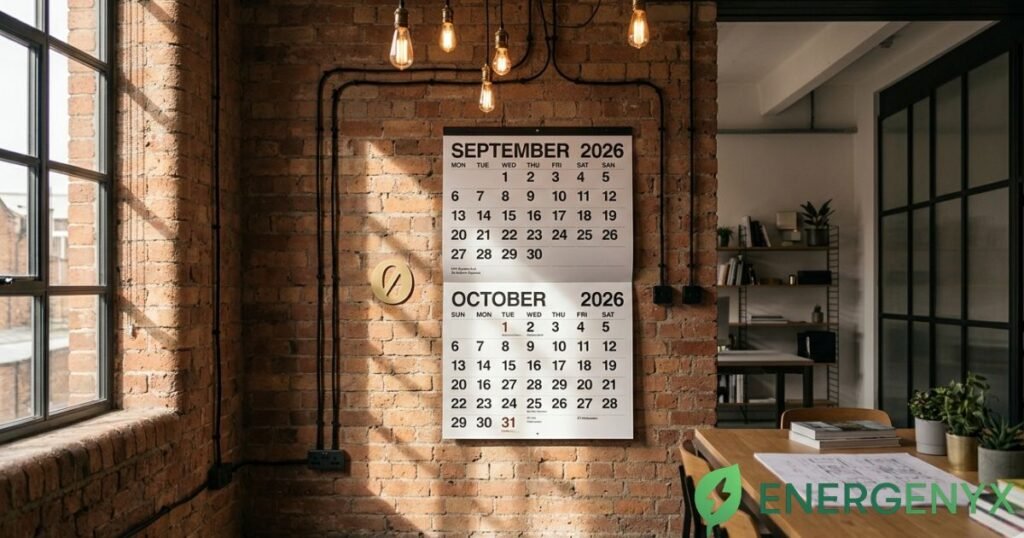
From 1 October 2026, the UK government is temporarily reducing VAT on qualifying electricity supplies from 5% to 0%.
The measure applies to eligible non-domestic customers who already qualify for the reduced VAT rate, including certain small businesses, charities and residential care homes. It is scheduled to run until 31 March 2027.
For more information you can read it here on OFGEM official website: Changes to energy price cap between 1 October and 31 December 2026
Important distinction
This does not mean that all business electricity automatically becomes VAT-free.
The government specifically states that small businesses and other eligible non-domestic customers that already qualify for the reduced 5% rate will benefit from the temporary 0% rate.
Therefore:
Standard-rated business electricity → generally remains 20%
Qualifying reduced-rate electricity → 5% before 1 October 2026
Qualifying reduced-rate electricity → 0% from 1 October 2026 to 31 March 2027
This distinction is extremely important when calculating business electricity costs.
Can VAT-Registered Businesses Reclaim VAT on Electricity?
Generally, a VAT-registered business can reclaim VAT paid on business purchases when the relevant input-tax conditions are satisfied.
HMRC states that VAT-registered businesses can reclaim VAT on goods and services purchased for use in their business, subject to the applicable rules. You must keep appropriate records and valid VAT invoices to support the claim.
For example, if your business receives an electricity bill showing:
Electricity before VAT: £1,000
VAT at 20%: £200
Total: £1,200
A VAT-registered business making taxable supplies may generally be able to claim the £200 input VAT through its VAT return, assuming the normal conditions are met.
This means the VAT may not represent a permanent cost to the business.
However, VAT registration alone isn’t enough to assume that every penny can always be reclaimed. Businesses making exempt supplies or using electricity partly for non-business purposes may have additional considerations.
What If My Business Isn’t VAT Registered?
If your business isn’t VAT registered, you generally cannot reclaim VAT charged on your business purchases in the same way as a VAT-registered business.
That means VAT becomes part of the cost you pay.
For example:
Electricity: £1,000
VAT: £200
Total: £1,200
If the business cannot reclaim the £200 VAT, its effective cost is £1,200.
This is one reason VAT treatment can have a greater impact on smaller businesses that aren’t VAT registered.
How VAT Appears on a Business Electricity Bill
Your electricity bill should normally make it possible to understand how the total has been calculated.
You may see items such as:
- Electricity usage
- Unit rate
- Standing charge
- Other applicable charges
- VAT
- Total amount payable
For example:
| Charge | Amount |
|---|---|
| Electricity usage | £800 |
| Standing charge | £200 |
| Subtotal | £1,000 |
| VAT at 20% | £200 |
| Total | £1,200 |
Your actual bill can contain additional charges depending on your contract and supplier.
VAT-registered businesses should keep valid VAT invoices because HMRC requires appropriate evidence when reclaiming input tax.
Is VAT Charged on Business Electricity Standing Charges?
Yes.
Where the electricity supply is subject to VAT, the VAT treatment generally applies to the relevant supply, including the standing charge.
This means businesses should not look only at their electricity unit rate when calculating VAT.
For example:
Electricity usage: £900
Standing charge: £100
Total before VAT: £1,000
At 20% VAT:
VAT = £200
Total:
£1,200
This is why understanding both business electricity unit rates and standing charges is important when comparing business energy suppliers.
VAT on Business Electricity and Gas
Businesses that use both electricity and gas should also check the VAT treatment of each energy supply.
Fuel and power supplies can be subject to different VAT treatment depending on the circumstances.
For standard commercial use, both electricity and gas can be subject to the standard VAT rate.
Qualifying supplies can potentially receive reduced-rate treatment.
The HMRC fuel and power guidance covers electricity, gas and other forms of fuel and power and explains when reduced-rate treatment can apply.
Don’t assume that the VAT treatment of electricity automatically determines the treatment of every other energy product on your account.
VAT on Business Electricity for Small Businesses
Small businesses often ask:
“Do small businesses pay 20% VAT on electricity?”
The answer is:
It depends.
Being a small business does not automatically mean that your electricity qualifies for 5% VAT.
The reduced rate depends on the relevant VAT rules and how the electricity is supplied and used.
However, some small businesses can qualify for reduced-rate treatment, including through the de minimis rules where the applicable conditions are met.
From 1 October 2026, eligible customers who already qualify for the reduced rate can temporarily benefit from 0% VAT on qualifying electricity.
VAT on Business Electricity for Charities
Charities can have different VAT considerations.
HMRC explains that supplies of fuel and power used for certain non-business charitable activities can qualify for reduced-rate treatment.
Charities should establish whether their electricity is being used for:
- Business activities
- Non-business activities
- Mixed activities
The VAT treatment can depend on these circumstances.
From 1 October 2026, eligible charities already receiving the reduced rate can benefit from the temporary 0% rate on qualifying electricity supplies.
Can You Reclaim 5% or 20% VAT on Business Electricity?
If your business is VAT registered and the electricity is an eligible business expense, you may generally reclaim the VAT as input tax, subject to the normal VAT rules.
The rate itself doesn’t determine whether you can reclaim it.
For example:
20% VAT
£1,000 electricity
- £200 VAT
= £1,200 total
Potential VAT recovery:
£200
5% VAT
£1,000 electricity
- £50 VAT
= £1,050 total
Potential VAT recovery:
£50
0% VAT
£1,000 electricity
- £0 VAT
= £1,000 total
There is no VAT charged to reclaim.
The actual treatment depends on your business’s VAT status and use of the electricity. HMRC’s general input-tax rules should be followed.
What If Your Business Uses Electricity for Both Business and Private Purposes?
Mixed use can complicate VAT treatment.
For example, suppose electricity is supplied to premises that contain both:
- A business area
- Private residential accommodation
The VAT treatment may need to reflect the circumstances and applicable rules.
HMRC’s general VAT guidance states that where purchases are partly for business and partly for private use, only the business proportion may normally be recoverable.
Keep records showing how you determined the business proportion.
If you’re uncertain, speak with your accountant or tax adviser rather than simply reclaiming the entire amount.
How to Check Whether You’re Paying the Correct VAT
If you’re unsure about the VAT on your electricity bill, follow these steps.
1. Check the VAT rate
Look at your electricity invoice and identify the VAT percentage.
2. Check your electricity usage
Look at your annual or monthly electricity consumption.
3. Check how the premises are used
Determine whether the electricity is being used entirely for business purposes or whether there is qualifying domestic or non-business use.
4. Check whether you qualify for reduced-rate treatment
Review HMRC’s current fuel and power guidance.
5. Contact your supplier
If you believe the wrong VAT rate is being applied, ask your electricity supplier to review your account.
6. Keep supporting documents
Keep bills, VAT certificates, declarations and other evidence supporting the VAT treatment.
HMRC requires businesses to maintain records supporting VAT claims, and valid VAT invoices are important evidence when reclaiming input VAT.
What Is a VAT Declaration for Business Energy?
Where a business believes it qualifies for reduced-rate fuel and power, the supplier may require information or a declaration confirming the circumstances.
For example, a supplier may ask for details about:
- How the premises are used
- Electricity consumption
- Qualifying activities
- Proportion of business and non-business use
The exact process can vary between suppliers.
If your circumstances change, such as moving premises or changing the nature of your energy use, you should check whether your VAT treatment needs to be updated.
Business Electricity VAT Example
Let’s consider a hypothetical small business.
The business uses electricity costing:
£500 per month before VAT
At 20% VAT
VAT:
£500 × 20% = £100
Total:
£600
Annual total:
£7,200
At 5% VAT
VAT:
£500 × 5% = £25
Total:
£525
Annual total:
£6,300
At 0% VAT
VAT:
£0
Total:
£500
Annual total:
£6,000
The difference between 20% and 5% is significant.
However, whether a business qualifies for the reduced rate depends on the applicable HMRC rules.
Does the 2026 VAT Change Make Business Electricity Cheaper?
For businesses that qualify for the temporary 0% rate, yes, the VAT element of their qualifying electricity costs will fall from 5% to 0% from 1 October 2026.
But businesses paying the standard 20% rate should not assume that their electricity VAT will fall to zero.
The government announcement specifically covers eligible non-domestic customers that already qualify for the reduced rate.
Therefore, the impact on your business depends on your existing VAT treatment.
What Happens After 31 March 2027?
The temporary 0% VAT measure is currently scheduled to run until 31 March 2027.
Businesses should therefore avoid building long-term budgets on the assumption that 0% VAT will continue indefinitely.
If you’re signing a longer-term electricity contract, check how VAT changes are treated under the contract.
Your supplier should apply the legally applicable VAT rate to the relevant supplies.
Business Electricity VAT FAQs
What VAT rate is charged on business electricity?
Most ordinary commercial business electricity is generally subject to the standard 20% VAT rate. Certain qualifying supplies can receive the reduced 5% rate.
Do small businesses pay 20% VAT on electricity?
Not necessarily. Some small businesses can qualify for the reduced 5% rate if their electricity supply meets the relevant conditions. Business size alone does not automatically qualify a company for reduced VAT.
Can I reclaim VAT on business electricity?
A VAT-registered business can generally reclaim eligible input VAT on business electricity used for taxable business purposes, subject to HMRC’s rules and appropriate records.
Is VAT charged on the electricity standing charge?
Yes. Where the electricity supply is taxable, VAT can apply to the standing charge as part of the supply.
What is the business electricity de minimis rule?
The de minimis rule allows certain small quantities of fuel and power supplied to a business to be treated as domestic use for VAT purposes and therefore potentially receive the reduced rate.
Does the 0% VAT rate apply to all business electricity from October 2026?
No. The temporary 0% rate applies to eligible non-domestic customers that qualify for the reduced 5% rate, rather than automatically applying to all commercial electricity.
How long will the 0% VAT rate last?
The government has announced the temporary reduction for the period from 1 October 2026 to 31 March 2027.
Do charities pay VAT on electricity?
Charities can qualify for reduced-rate treatment in certain circumstances, particularly where fuel and power are used for qualifying non-business activities. The exact treatment depends on the charity’s circumstances.
What happens if my electricity supplier charges the wrong VAT rate?
Contact your supplier and ask them to review the VAT treatment of your account. Keep copies of your bills and any supporting declarations or certificates.
Business Electricity VAT Checklist
Before paying or reclaiming VAT on your electricity bill, check:
- VAT rate shown on the bill
- Electricity consumption
- Unit rate
- Standing charge
- How the premises are used
- Whether the de minimis rules apply
- Whether you qualify for reduced-rate treatment
- Whether your business is VAT registered
- Whether the electricity is used for taxable business activities
- Valid VAT invoice available
- Supplier’s VAT treatment
- Any required VAT declaration or certificate
Final Thoughts
Understanding business electricity VAT can help you avoid paying more than necessary and make your energy bills easier to manage.
For most ordinary commercial electricity supplies, the standard VAT rate is 20%. However, certain qualifying supplies can receive the reduced 5% rate, including supplies that meet specific domestic-use, non-business or de minimis conditions.
From 1 October 2026, eligible non-domestic customers already receiving the reduced 5% rate will temporarily move to 0% VAT on qualifying electricity supplies until 31 March 2027. This includes qualifying small businesses, charities and residential care homes.
If you’re VAT registered, you may generally be able to reclaim eligible VAT on business electricity through your VAT return, subject to the normal input-tax rules.
The key is to understand which VAT rate applies to your particular electricity supply, rather than assuming every business receives the same treatment.
When reviewing your energy costs, don’t look at VAT in isolation. Compare your unit rate, standing charge, contract length and overall electricity cost as well.
And if your current business electricity contract is approaching renewal, comparing alternative deals could potentially have a much greater impact on your overall energy costs than focusing on VAT alone.